


Mazmarts oil pressure bypass install with some surprising findings!


I was talking about a specific system...the engine in this car with a bypass regulator....Higher bypass pressure will result in more flow below the cracking pressure of the regulator
Still think I'm wrong?
Or do you want to go to a fluid dynamics argument? This is getting stupid
Still think I'm wrong?
Or do you want to go to a fluid dynamics argument? This is getting stupid

Ayrton Senna Forever
Joined: Sep 2005
Posts: 406
Likes: 1
From: Europe
Peace

Super Moderator
Joined: Apr 2005
Posts: 10,880
Likes: 340
From: Australia
Todd, If this is the case then why are there different Oil Pressure numbers at 3000RPM for the Series 1 RX-8 (5W20) and the FC RX-7 (20W50), when Both use the exact same Oil Pump, the exact same Rear By Pass Valve.
The FC has One small oil cooler (under radiator), the Rx-8 has two separate oil coolers further from oil pump.
Oil Pressure Numbers taken by factory oil pressure tool 49-0187-230 at same location (oil filter neck)..
Can someone please explain?
The FC has One small oil cooler (under radiator), the Rx-8 has two separate oil coolers further from oil pump.
Oil Pressure Numbers taken by factory oil pressure tool 49-0187-230 at same location (oil filter neck)..
Can someone please explain?

Registered
Joined: Jun 2006
Posts: 427
Likes: 1
From: Europe - Greece
As a result, whether you pump honey or water the same volume of this fluid over fixed time interval is pumped? Are you sure that this correct?

3-wheeler
Joined: Dec 2005
Posts: 2,734
Likes: 1
From: Phoenix
So you are saying that the pump will always pump the same volume of two fluids no matter their viscosity.
As a result, whether you pump honey or water the same volume of this fluid over fixed time interval is pumped? Are you sure that this correct?
As a result, whether you pump honey or water the same volume of this fluid over fixed time interval is pumped? Are you sure that this correct?
Todd, If this is the case then why are there different Oil Pressure numbers at 3000RPM for the Series 1 RX-8 (5W20) and the FC RX-7 (20W50), when Both use the exact same Oil Pump, the exact same Rear By Pass Valve.
The FC has One small oil cooler (under radiator), the Rx-8 has two separate oil coolers further from oil pump.
Oil Pressure Numbers taken by factory oil pressure tool 49-0187-230 at same location (oil filter neck)..
Can someone please explain?
The FC has One small oil cooler (under radiator), the Rx-8 has two separate oil coolers further from oil pump.
Oil Pressure Numbers taken by factory oil pressure tool 49-0187-230 at same location (oil filter neck)..
Can someone please explain?
Last edited by Flashwing; Oct 6, 2010 at 05:13 AM.
Registered
Joined: Jun 2006
Posts: 427
Likes: 1
From: Europe - Greece
Originally Posted by rotaryPilot
So you are saying that the pump will always pump the same volume of two
fluids no matter their viscosity.
As a result, whether you pump honey or water the same volume of this fluid over fixed time interval is pumped? Are you sure that this correct?
fluids no matter their viscosity.
As a result, whether you pump honey or water the same volume of this fluid over fixed time interval is pumped? Are you sure that this correct?
Ok So in case that Positive Displacement Pump always pumps the same volume independent from oil viscosity how do you comment on the following statement/diagrams that clearly shows how a positive displacement pump is affected concerning flow and efficiency by altering the viscosity ? I am referring to PD pumps


Momentum Keeps Me Going
Joined: Sep 2002
Posts: 5,036
Likes: 5
From: Colorado
before I add oil I will ...
always jack my car driver side up first, drain, let it down, jack the other side up, let it down, jack the driver side up again, drain
Its pretty complicated, but its not that hard, when it drain, I usually gonna leave it there for at least 15 minutes. go have a quick snack or lunch.
I can get almost 6 quart of oil out everytime. so Im happy.
always jack my car driver side up first, drain, let it down, jack the other side up, let it down, jack the driver side up again, drain
Its pretty complicated, but its not that hard, when it drain, I usually gonna leave it there for at least 15 minutes. go have a quick snack or lunch.
I can get almost 6 quart of oil out everytime. so Im happy.

Extraordinary Engineering
Joined: Oct 2005
Posts: 4,733
Likes: 14
From: Burls On
Ok So in case that Positive Displacement Pump always pumps the same volume independent from oil viscosity how do you comment on the following statement/diagrams that clearly shows how a positive displacement pump is affected concerning flow and efficiency by altering the viscosity ? I am referring to PD pumps
The simple math says that this mod gives the engine internals more pressure and flow above the opening of the stock pressure relief valve. Below it makes no difference.
I wanted to ensure that my engine maintains good flow under all circumstances of weather and driving style. Given the low oil pressure of the series 1 engine this seems like an excellent reliability mod.

Ok So in case that Positive Displacement Pump always pumps the same volume independent from oil viscosity how do you comment on the following statement/diagrams that clearly shows how a positive displacement pump is affected concerning flow and efficiency by altering the viscosity ? I am referring to PD pumps
I was talking about a specific system...the engine in this car with a bypass regulator....Higher bypass pressure will result in more flow below the cracking pressure of the regulator
Still think I'm wrong?
Or do you want to go to a fluid dynamics argument? This is getting stupid
Still think I'm wrong?
Or do you want to go to a fluid dynamics argument? This is getting stupid
Say you look at pressure and flow at 3000 rpm. The value for 5W20 I had was about 50 psi. When I switched to 15W-40, that value under about the same conditions otherwise was 60 psi. Since the bypass valve is closed, the oil system from the oil pump to the point oil leaks through the bearings into the engine is hydralically locked. This means the flow is exactly the same for the light oil vs. the heavy, even though the pressure in the latter case is different.
For a displacement pump, the pressure of the fluid being pumped does not at all affect the volume being pumped (within reason).
(Using round numbers here), increase the rpm to 4000, and you get 60 psi for the light and 70 psi for the heavy oil; still both cases are flowing the same oil volume.
A slight increase in rpm from there, causes the bypass to open for the heavy oil, resulting in no increase in flow for the heavy case, but more flow in the light-oil case because since it's running 10 psi less, the valve hasn't yet opened. That flow difference will increase as the rpm increases until the bypass valve opens for the 5-20W oil too. From that point on, the light-oil case will be flowing a greater volume than the heavy-oil case.
For our systems, a higher bypass valve opening pressure allows an increase in flow above the pressure range allowed by the original valve. Below that range, there is no difference at all.
Academic exercise?
What I'm trying in multiple ways to get across is that the equation: more pressure = more flow is only true sometimes and is false more often than not. Even everyday experience with a garden hose nozzle will show that it's not true.
Extraordinary Engineering
Joined: Oct 2005
Posts: 4,733
Likes: 14
From: Burls On
Hey, HiFlite999, want to come join the other oil pressure thread?
https://www.rx8club.com/series-i-aftermarket-performance-modifications-23/increased-oil-pressure-really-needed-205900/
There seems to be a misconception that the Re Oil Pressure mod somehow achieves higher pressure through higher restriction through the engine passages...
Having done this mod I can assure everyone that this mod only affects the point at which the bypass back to the pan opens. There is no oil system restriction and the flow will be the same (at lower pressure) or higher (above the original valve opening pressure) than stock under all circumstances for any given viscosity.
https://www.rx8club.com/series-i-aftermarket-performance-modifications-23/increased-oil-pressure-really-needed-205900/
There seems to be a misconception that the Re Oil Pressure mod somehow achieves higher pressure through higher restriction through the engine passages...
Having done this mod I can assure everyone that this mod only affects the point at which the bypass back to the pan opens. There is no oil system restriction and the flow will be the same (at lower pressure) or higher (above the original valve opening pressure) than stock under all circumstances for any given viscosity.
Last edited by DarkBrew; Oct 6, 2010 at 12:49 PM.

Super Moderator
Joined: Apr 2005
Posts: 10,880
Likes: 340
From: Australia
You're talking about two different oil systems.
And yes, Sorry, my question was about OP, you were talking Flow.
I went through this on the other thread...it's from the seepage past the seals.
.
Say you look at pressure and flow at 3000 rpm. The value for 5W20 I had was about 50 psi. When I switched to 15W-40, that value under about the same conditions otherwise was 60 psi. Since the bypass valve is closed, the oil system from the oil pump to the point oil leaks through the bearings into the engine is hydralically locked. This means the flow is exactly the same for the light oil vs. the heavy, even though the pressure in the latter case is different.
Clearly, IMO Mazda should have used the FD Oil Pump and BPV set up in the Series 1 RX-8, rather than any 'alleged restrictions' in Oil Coolers or Lines or Cooler Thermostat to bump up Oil Pressure as it did not work, particularly NA market with 5W20...History .


Registered
Joined: Dec 2007
Posts: 863
Likes: 0
From: UK

Viscosity makes a big difference in bleed paths like that, 's why your dampers feel a lot stiffer when it's cold outside.
As I've said before, higher viscosity = earlier opening of the bypass valves = less flow = thinner oil film + more heat at high revs...that's without even considering the cavitiation on an oil pump with such a wide operating rpm range.
Obviously there's a balancing point, but I'll stay with my 0w-30...
Last edited by PhillipM; Oct 6, 2010 at 05:16 PM.
with so many parts (not just oil pump, I have an FC so I know which parts are the same) being the same and FC use 20w50 with much less hp. hmm. I will stick with 20w50 (or maybe 15w50 for winter)

Thread Starter
Registered
iTrader: (3)
Joined: Apr 2004
Posts: 10,828
Likes: 40
From: macon, georgia
guys all this flow/pressure is only related to lubrication IF the lubricate has the film strength to do the job. Pressure/flow is totally irrelevant if your oil lacks the required film strength.
Do not forget that point?
Point being you can flow all you want of a 5w/20 etc and your engine will still not get proper lubrication.In many minds including what is left of mine minimal viscosity generally speaking should be nothing lighter than a 10w/40.. And it should be an oil that will hold its viscosity.
OD
Do not forget that point?
Point being you can flow all you want of a 5w/20 etc and your engine will still not get proper lubrication.In many minds including what is left of mine minimal viscosity generally speaking should be nothing lighter than a 10w/40.. And it should be an oil that will hold its viscosity.
OD
im also amazed they shared so many parts, including parts that will see the love of oil. difference is that the same part is having much more work to do now (pushing more power)
FC is known to have oil pressure issue (too low), so a lot of owners increase the oil pressure to around 100 psi
- either by using a press to "squeeze" the stock oil pressure regulator, use FD regulator, or use MFR's adjustable regulator (expensive ****)
Mazda is just stupid enough to leave S1's Rx-8 the way it is (oil pressure). Its using most of the parts as FC but it's pushing like 50% more power.
At least I think they got the S2 right, somewhat.
FC is known to have oil pressure issue (too low), so a lot of owners increase the oil pressure to around 100 psi
- either by using a press to "squeeze" the stock oil pressure regulator, use FD regulator, or use MFR's adjustable regulator (expensive ****)
Mazda is just stupid enough to leave S1's Rx-8 the way it is (oil pressure). Its using most of the parts as FC but it's pushing like 50% more power.
At least I think they got the S2 right, somewhat.
Last edited by nycgps; Oct 6, 2010 at 10:04 PM.

Sydney, Australia
Joined: Feb 2009
Posts: 202
Likes: 1
From: Sydney, Australia
The only difference in the Oil System are the Coolers and Lines, everything else is Identical to the FC of 25 years ago.
And yes, Sorry, my question was about OP, you were talking Flow.
Phillip, you are talking Oil Pump?, there are no real "Seals" as such, it is metal to metal...you know that...but yeah, there is 'some' seepage from any Oil Pump...
It is interesting...talking viscosity/pressure....and as I have said many times before, the rear By Pass Valve in OEM S1 RX-8's was First used in 1976, 3648-14-250 (RX-5) 13B that is 34 years ago, back then 5W20 never existed....the S1's Oil Pump is from 1985, (FC RX-7), also back then 5W20 did not exist...
Clearly, IMO Mazda should have used the FD Oil Pump and BPV set up in the Series 1 RX-8, rather than any 'alleged restrictions' in Oil Coolers or Lines or Cooler Thermostat to bump up Oil Pressure as it did not work, particularly NA market with 5W20...History .
And yes, Sorry, my question was about OP, you were talking Flow.
Phillip, you are talking Oil Pump?, there are no real "Seals" as such, it is metal to metal...you know that...but yeah, there is 'some' seepage from any Oil Pump..
.It is interesting...talking viscosity/pressure....and as I have said many times before, the rear By Pass Valve in OEM S1 RX-8's was First used in 1976, 3648-14-250 (RX-5) 13B that is 34 years ago, back then 5W20 never existed....the S1's Oil Pump is from 1985, (FC RX-7), also back then 5W20 did not exist...
Clearly, IMO Mazda should have used the FD Oil Pump and BPV set up in the Series 1 RX-8, rather than any 'alleged restrictions' in Oil Coolers or Lines or Cooler Thermostat to bump up Oil Pressure as it did not work, particularly NA market with 5W20...History .
Super Moderator
Joined: Apr 2005
Posts: 10,880
Likes: 340
From: Australia
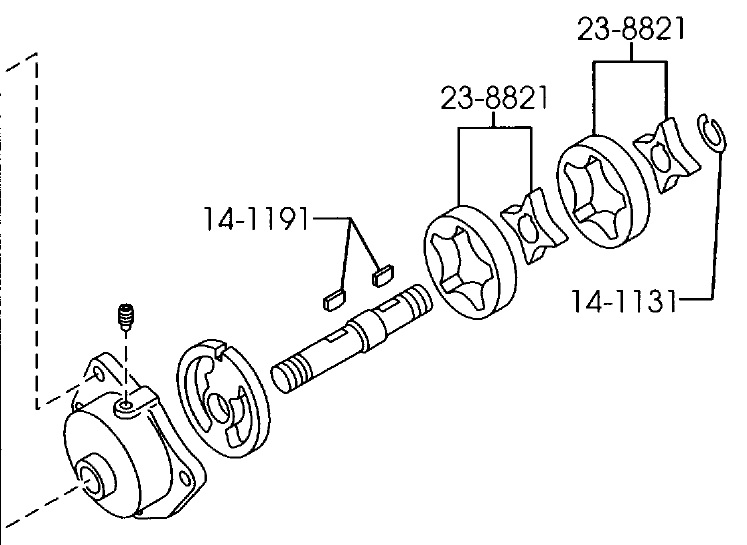
Just to set the record straight...Mazda's like most Oil Pumps have No Seals Internally, None.
Dampers or Struts or Shock-absorbers have a Seal at the top of casing that shock chromed piston moves inside through a rubber (usually) round Seal.
There are Far more Parts that are from the FC RX-7 than are exclusive only to an RX-8 short engine wise including Oil Pump, Oil Pump Rotors, Drive Chain, Sprockets, Rear By Pass Valve, Oil Pump Relief Piston, Rotor Oil Rings, Springs, Bearings, Oil Filter, Rotor Housing Seals, etc,etc, etc, ALL from 1985 FC RX-7....a Part Number is a Part Number...and these are ALL Identical.
The Series 1 RX-8 engine core is directly from the FC, of course the main differences are side exhaust ports through iron housings and intake system which is exclusively RENESIS...no one has ever said the RX-8 is and RX-7...only Many many engine parts.
No internal Seals in any Mazda Rotary Oil Pumps from 1970-2008
Dampers or Struts or Shock-absorbers have a Seal at the top of casing that shock chromed piston moves inside through a rubber (usually) round Seal.
There are Far more Parts that are from the FC RX-7 than are exclusive only to an RX-8 short engine wise including Oil Pump, Oil Pump Rotors, Drive Chain, Sprockets, Rear By Pass Valve, Oil Pump Relief Piston, Rotor Oil Rings, Springs, Bearings, Oil Filter, Rotor Housing Seals, etc,etc, etc, ALL from 1985 FC RX-7....a Part Number is a Part Number...and these are ALL Identical.
The Series 1 RX-8 engine core is directly from the FC, of course the main differences are side exhaust ports through iron housings and intake system which is exclusively RENESIS...no one has ever said the RX-8 is and RX-7...only Many many engine parts.
No internal Seals in any Mazda Rotary Oil Pumps from 1970-2008
Last edited by ASH8; Oct 7, 2010 at 03:28 AM.
Super Moderator
Joined: Apr 2005
Posts: 10,880
Likes: 340
From: Australia
FD Rotors are 5mm wider than FC or FE (RX-8) Rotors, middle plate is thinner.
Oil Pump Sprocket is identical and so is the Drive Chain.
So yes, an FD Oil Pump should fit without installation issues.
How to do it, you need to remove the front Alloy Timing Cover to expose the Oil Pump assembly, pretty easy if engine is out, a lot, lot more work if engine is still mounted in engine bay.
FD RX-7's were made in 4 Series while sold in the Australian market,
From Jan 1992, August 1993, July 1994, Jan 1996, I think there was one more minor update for JDM only in 1998-9 until it ceased in Japan market only in 2002...then the Series 1 RX-8 was made from April 2003, and Series 2 in April 2008...these are all production Start dates.