


For the 'Benefit' Of many - Jet Stream Electric Supercharger


does anyone know why an engine actually has better response and power (compared to n/a )even when the supercharger is not in boost?
This is not a trick question. It is not meant to be a smart *** question. It may be a dumb question.
This is not a trick question. It is not meant to be a smart *** question. It may be a dumb question.

Think about what the implication of the phrase "not in boost" is.
There may not be relative positive pressure in the manifold before you change throttle angle, but there is in the rest of the intake system, which includes everything between the filter and the TB.
There may not be relative positive pressure in the manifold before you change throttle angle, but there is in the rest of the intake system, which includes everything between the filter and the TB.



Just throwing this thought out .
If you somehow put an electric supercharger on the low rpm side of the vfad and had it turn on at wot up to the point the vfad swithced over . Maybe lower the rpm switch over point as well to the point where the SC ran out of puff.
You could have a setup that gave you a pound or two of boost at low rpm only .... could be done quite cheaply and make for a low rpm torque improvement ........
If you somehow put an electric supercharger on the low rpm side of the vfad and had it turn on at wot up to the point the vfad swithced over . Maybe lower the rpm switch over point as well to the point where the SC ran out of puff.
You could have a setup that gave you a pound or two of boost at low rpm only .... could be done quite cheaply and make for a low rpm torque improvement ........

Release the twins.
Joined: Jan 2010
Posts: 241
Likes: 0
From: Mobile, AL
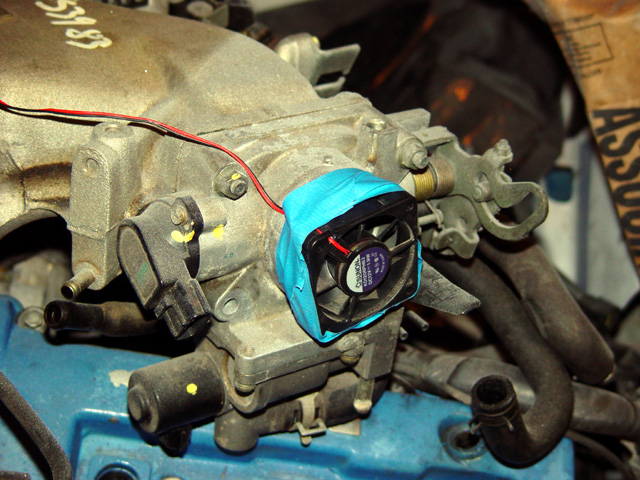
That's an old 3100, 3400 ,3800 chevy v6 from the 90s. i've done like 3 of those intake jobs in a day.... from 3 different customers.


For what it's worth, a gentleman I knew who was an inveterate tinkerer and race car fabricator, did develop an electric supercharger years ago that he fitted in the intact tract of a BMW 318i and activated it with a switch inside the car. I drove the car and activated the blower, and damn if there wasn't a meaningful, seat-of-the-pants performance increase.
No ideas on pressure generated, but the fan was housed in a shaped tube and it worked. Not sure if he ever finished the project or marketed it, but I tell no lies. It worked.
No ideas on pressure generated, but the fan was housed in a shaped tube and it worked. Not sure if he ever finished the project or marketed it, but I tell no lies. It worked.

Administrator
Joined: Jul 2002
Posts: 21,958
Likes: 115
From: portland oregon
and he probably had it connected to a dedicated battery(ies) so that it could actually make power. once those are empty its a drag on the intake. its actually the same benefit as having NOS hooked to a switch... except the NOS install surely weighs less.

Registered
Joined: Dec 2009
Posts: 426
Likes: 29
From: Norway
It's no doubt that it would be possible to control boost in an independent and far more intelligent way by electricity.
But...:
1. You need a quite large el.motor(and thereby VFD(Voltage- frequency Drive)) to run compressor. Means a lot of weight.
2. El.motor needs to have very fast and accurate response = permanent magnet motor = expensive.
3. Losses are gonna be higher as well, because on top of your normal mech losses, you're gonna have losses in VFD and motor.
Not mentioning that you're gonna have a lethal voltage somewhere in your car.
A "stupid"(no regulation) El. charger is a bit different, but then you're not able to do anything intelligent, just adding the losses in the el.motor.
But...:
1. You need a quite large el.motor(and thereby VFD(Voltage- frequency Drive)) to run compressor. Means a lot of weight.
2. El.motor needs to have very fast and accurate response = permanent magnet motor = expensive.
3. Losses are gonna be higher as well, because on top of your normal mech losses, you're gonna have losses in VFD and motor.
Not mentioning that you're gonna have a lethal voltage somewhere in your car.
A "stupid"(no regulation) El. charger is a bit different, but then you're not able to do anything intelligent, just adding the losses in the el.motor.


well- dont know about that. I think it may depend on what the goal is? It may not be actual boost that is being looked at, but rather what some others have mentioned--less vacuum dependence?
Electric supercharger expecting 7 lbs of positive pressure---totally agree--no way.
ESC with 1-2 lbs of actual boost in the lower rpms and less vacuum dependence in the higher rpms---maybe?
Electric supercharger expecting 7 lbs of positive pressure---totally agree--no way.
ESC with 1-2 lbs of actual boost in the lower rpms and less vacuum dependence in the higher rpms---maybe?


Registered
Joined: Jul 2008
Posts: 77
Likes: 2
If is there some interesting technology which should be examined, then it would be decoupling compressor and turbine of conventional turbocharger in such manner, that both devices could operate with optimal efficieny independently on each other.

A review of a previous discussion: With some limited exceptions, the only thing that matters for power output of a given engine is MAF, assuming the fuel system can maintain an appropriate a/f ratio. Related is manifold pressure, the higher the pressure in the lower manifold, the more air that will go into the cylinder when the port opens. With a calibration for a particular engine, one can relate MP to MAF to HP. At or near WOT, that calibration will be close to linear. WOT at sea level will be ~27" Hg, for a n/a engine. At ~10k feet, it will be ~18" Hg, corresponding to a 1/3 loss in HP. Manifold vacuum is a completely and utterly useless concept which only serves to generate endless confusion. "Boost" is a close second.
Suppose one has a turbo/super-charger capable of 5 psi (10" Hg) "boost". If the POV is located upstream of the throttle plate, that "boost" will give about 30% power gain at sea level and none (over the rated n/a HP) at 10,000 above sea level. If the POV is referenced instead to the manifold after the throttle plate and set to pop at ~36" Hg relative to ambient air pressure, then the power gain remains +30% over rated HP regardless of altitude. BUT, then at sea level, the TC is supplying a 5 psi gain at sea level over outside air pressure and 10 psi @ 10k feet.
So tell me again, what's "boost"?
When running near full out (POV closed), electric supercharging will work less efficiently than belt driven supercharging: crank --> belt --> SC vs crank --> belt --> alternator --> battery --> motor --> SC. At significantly less than WOT, it may well be more efficient. However, if the SC driven by the motor is mechanically efficient, it will represent a significant blockage or resistance to air flow when it is off. Either the electric SC runs at a nominal setting at low throttle setting to reduce that resistance, or there would have to be an airflow bypass around it under those conditions. Can it be made to work? Yes. Will it be more efficient than a turbo? Doubtful. Will it be cheaper?
Suppose one has a turbo/super-charger capable of 5 psi (10" Hg) "boost". If the POV is located upstream of the throttle plate, that "boost" will give about 30% power gain at sea level and none (over the rated n/a HP) at 10,000 above sea level. If the POV is referenced instead to the manifold after the throttle plate and set to pop at ~36" Hg relative to ambient air pressure, then the power gain remains +30% over rated HP regardless of altitude. BUT, then at sea level, the TC is supplying a 5 psi gain at sea level over outside air pressure and 10 psi @ 10k feet.
So tell me again, what's "boost"?
When running near full out (POV closed), electric supercharging will work less efficiently than belt driven supercharging: crank --> belt --> SC vs crank --> belt --> alternator --> battery --> motor --> SC. At significantly less than WOT, it may well be more efficient. However, if the SC driven by the motor is mechanically efficient, it will represent a significant blockage or resistance to air flow when it is off. Either the electric SC runs at a nominal setting at low throttle setting to reduce that resistance, or there would have to be an airflow bypass around it under those conditions. Can it be made to work? Yes. Will it be more efficient than a turbo? Doubtful. Will it be cheaper?


Hy 999 is absoulutely correct concerning many things.
Vacuum and boost are just generally accepted terms used to discuss the same things he mentioned?
The main concept as I understand it, is that there has to be a pressure differential between the manifold and the combustion chamber for the air to move. The greater the difference the more movement you get (basically speaking).
It does seem pausable to me that a very low boost ESC would be a possible thing in theory.
Whether or not it would be worth it--remains to be seen.
Vacuum and boost are just generally accepted terms used to discuss the same things he mentioned?
The main concept as I understand it, is that there has to be a pressure differential between the manifold and the combustion chamber for the air to move. The greater the difference the more movement you get (basically speaking).
It does seem pausable to me that a very low boost ESC would be a possible thing in theory.
Whether or not it would be worth it--remains to be seen.

Thread
Thread Starter
Forum
Replies
Last Post
JimmyBlack
Series I Major Horsepower Upgrades
273
Feb 10, 2020 10:23 PM
2011, electric, electrical, esc, intake, jet, jetstream, maf, rx8, rx8club, small, stream, supercharger, turbo, turbocharger
