


Tuning Calc. Load max on NA engine


Interesting . Should we be setting the entire IAT and Baro compensation tables to 1 to prevent this happening ?
Last edited by Brettus; Oct 20, 2011 at 09:39 PM.

Release the twins.
Joined: Jan 2010
Posts: 241
Likes: 0
From: Mobile, AL


 however, looking back at my notes I only changed the IAT load map at one particular point per my previous mention of it

My baro and IAT tables are flat at 1 and it's the way I like it.
I don't want anything removing fuel ...
What if the Baro sensor fails and starts providing a bad signal .... and thinks I'm on Mnt Everest or something.
My point .. I've had no issues tuning with these tables flattened
edit:
I've removed any area in these tables that have leaning effect on the end AFR ... if the BARO table has a .86 value ... it was flattened to 1
Values that increased the amount of fuel have been untouched ... for now
I don't want anything removing fuel ...
What if the Baro sensor fails and starts providing a bad signal .... and thinks I'm on Mnt Everest or something.
My point .. I've had no issues tuning with these tables flattened
edit:
I've removed any area in these tables that have leaning effect on the end AFR ... if the BARO table has a .86 value ... it was flattened to 1
Values that increased the amount of fuel have been untouched ... for now
Last edited by wcs; Oct 20, 2011 at 10:52 PM.
 j/k
j/k
^^^ Agreed Team .. and probably a bad example on my part.
Shouldn't the Maf have accounted for your cold front in term of air mass and air density?
Are you thinking you have a bad Maf and its not the tuning?
edit:
Still having those tables flat ... eliminates a lot of variables that really don't matter when you are FI
Shouldn't the Maf have accounted for your cold front in term of air mass and air density?
Are you thinking you have a bad Maf and its not the tuning?
edit:
Still having those tables flat ... eliminates a lot of variables that really don't matter when you are FI
Last edited by wcs; Oct 20, 2011 at 10:59 PM.
I think you should start with your coils
Replace the Cat
Then the TB
Report back
lolz
Because the low temp side increases the calc. load max. on the stock map . And you said it went lean in low temp condition right ?
Last edited by Brettus; Oct 20, 2011 at 11:29 PM.

My baro and IAT tables are flat at 1 and it's the way I like it.
I don't want anything removing fuel ...
What if the Baro sensor fails and starts providing a bad signal .... and thinks I'm on Mnt Everest or something.
My point .. I've had no issues tuning with these tables flattened
edit:
I've removed any area in these tables that have leaning effect on the end AFR ... if the BARO table has a .86 value ... it was flattened to 1
Values that increased the amount of fuel have been untouched ... for now
I don't want anything removing fuel ...
What if the Baro sensor fails and starts providing a bad signal .... and thinks I'm on Mnt Everest or something.
My point .. I've had no issues tuning with these tables flattened
edit:
I've removed any area in these tables that have leaning effect on the end AFR ... if the BARO table has a .86 value ... it was flattened to 1
Values that increased the amount of fuel have been untouched ... for now
Just want to clarify that they are load modifiers so they affect a number of engine control parameters, not just AFR


Release the twins.
Joined: Jan 2010
Posts: 241
Likes: 0
From: Mobile, AL
if someone doesn't change elevation often, then i don't see this being a problem, until someone does take it up in the mountains without reflashing the baro table, and blows the engine from running lean, so why would you flash something, thats going to have to come back and get reflashed and fixed later on.. do it right the first time, IMO.
So FWIW, here is a screen shot of my IAT and the Stock IAT
Now given that my setup is a draw thru and I don't have a Post Turbo IAT and:
- I live in a relatively cool climate
- I'm not tracking the car
I thought this was my best setup for the current environment
And given that I've never seen intake temperatures more that 20c degrees more than ambient (typically its about 10c more) that puts me around the 40c mark even in the dead of summer (104f is 40c)
I guess my understanding of how the Maf works is wrong.
The stock IAT table wants to take 10% off the load at 140f to compensate for the IAT.
Should not the Maf be able to measure the reduced air density as a reflection of a lower g/s?
edit:
I'm guessing it's compensating for the Maf?? Obviously it's reducing load based on IAT. Why else would you want to reduced the calculated load, to pull timing, AFR, or Fuel VE, all of the above.
I should take the time and go through the process of guesstimating my IAT Post turbo and Intercooler based on the Pre turbo IAT value.
Doing so would help keep you in the measurable universe as defined by our Calc Max Load table
My current setup
Attachment 178145
Stock values
Attachment 178146
Now given that my setup is a draw thru and I don't have a Post Turbo IAT and:
- I live in a relatively cool climate
- I'm not tracking the car
I thought this was my best setup for the current environment
And given that I've never seen intake temperatures more that 20c degrees more than ambient (typically its about 10c more) that puts me around the 40c mark even in the dead of summer (104f is 40c)
I guess my understanding of how the Maf works is wrong.
The stock IAT table wants to take 10% off the load at 140f to compensate for the IAT.
Should not the Maf be able to measure the reduced air density as a reflection of a lower g/s?
edit:
I'm guessing it's compensating for the Maf?? Obviously it's reducing load based on IAT. Why else would you want to reduced the calculated load, to pull timing, AFR, or Fuel VE, all of the above.
I should take the time and go through the process of guesstimating my IAT Post turbo and Intercooler based on the Pre turbo IAT value.
Doing so would help keep you in the measurable universe as defined by our Calc Max Load table
My current setup
Attachment 178145
Stock values
Attachment 178146
Last edited by wcs; Dec 12, 2011 at 08:06 AM.
if someone doesn't change elevation often, then i don't see this being a problem, until someone does take it up in the mountains without reflashing the baro table, and blows the engine from running lean, so why would you flash something, thats going to have to come back and get reflashed and fixed later on.. do it right the first time, IMO.
I'm not sure how this applies if you are FI
doesn't the forced induction part cancel out the reduced atmospheric pressure?
I do not.
Just a weather change can be up to 2 PSI difference in BARO.
I can have more than 1 PSI of BARO change within 40 miles of my house.
You begin your tune with them flat. Then you integrate the table to adjust for reality.
Just a weather change can be up to 2 PSI difference in BARO.
I can have more than 1 PSI of BARO change within 40 miles of my house.
You begin your tune with them flat. Then you integrate the table to adjust for reality.


The compensation tables are used to calculate the mass of a fixed volume, and that is affected by the General Gas Law, actually in this case Boyles / Charles's Law since volume is fixed. So if the volume can't change, then the effect of temperature and pressure would be on the mass side of the house.
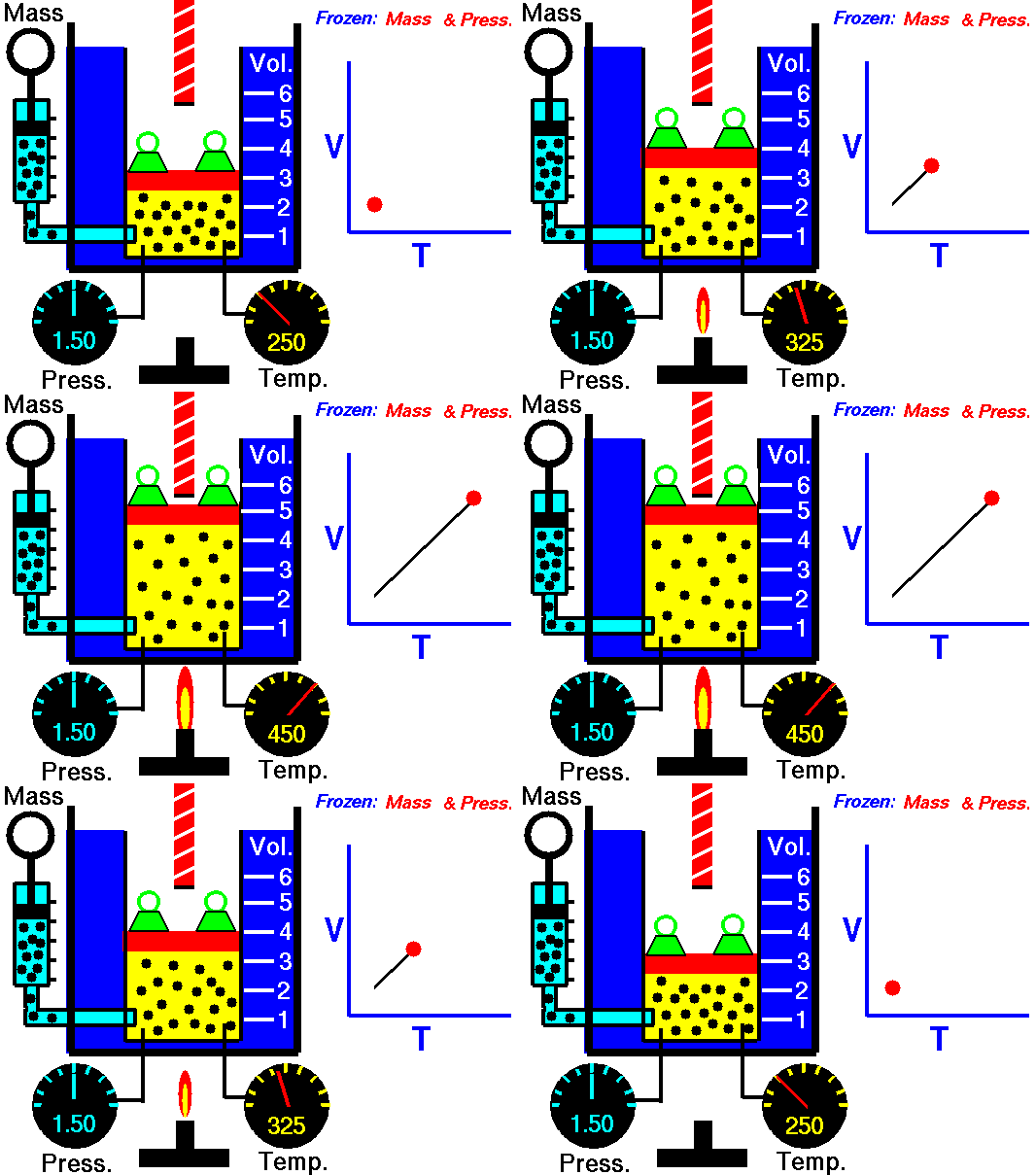
To elaborate: There are 4 variables in this picture - when you determine three of them, then you can solve for the fourth.... engine physics 101.
Last edited by Kane; Oct 22, 2011 at 12:05 PM.
Exactly .
But are they really error correction or are they Mazda's attempt to create a more stable combustion for an NA engine when these variables come into play ?
If so the question for FI people becomes... what do we want to happen in an FI engine and what do we have to do to achieve it ?
But are they really error correction or are they Mazda's attempt to create a more stable combustion for an NA engine when these variables come into play ?
If so the question for FI people becomes... what do we want to happen in an FI engine and what do we have to do to achieve it ?
Last edited by Brettus; Oct 22, 2011 at 03:43 PM.
Testing.
I spent many, many hours driving to locations that were below sea level and up to 12,000 feet above sea level and making comparisons and datalogs.
I also examined ranges of weather conditions from 27in/Hg to almost 33in/Hg with relative humidity from 2% to 100%.
It took almost a year of experimentation to come up with the correction values that work under all conditions for all of my FI calibrations.