


Brake FAQ



Thread Starter
justjim
Joined: Aug 2008
Posts: 345
Likes: 6
From: St. Petersburg, Florida
Brake FAQ
There are a lot of repetitive questions about brakes. I don’t see a Sticky for a Brake FAQ so I'll try and start one, maybe it will reduce some of the repetitive questions. I wrote the Brake FAQ for the Acura ClubRSX website, so I lifted it and tried to modify the vehicle specific information to reflect the RX8. Feel free to add to or correct factual errors, particularly vehicle specific ones I may have missed. Inevitably there are some areas that will be open to discussion but I've tried to cover the basics. When I get more info I'll add to it this was just a first try.
Brakes general description
The RX8 comes with either of 2 OEM brake systems. All models have ventilated front and rear disc brakes with ABS. The base AT model has 11.9 in. (303 mm) diameter front discs while the AT with sport suspension and all MT have larger 12.7 in. (323 mm) diameter front discs. Both models have the same 11.9 in. (302 mm) diameter ventilated rear discs and floating calipers. The larger front brakes have a different front caliper, master cylinder, and rear proportioning valve than the base AT model. Both models use single piston, cast iron, floating calipers front and rear.
The braking system is designed to stop the wheels of the car. Both the base AT model and the MT braking systems are fully capable of stopping the wheels of the car in excess of 60 mph multiple times in sequence. This is an important point. Because the brakes are fully capable of stopping the wheels at speeds likely to be encountered on the street, the limiting factor in how quickly you can stop your car is dependent primarily on your tires and road conditions (i.e. wet or dirt). If you truly want to stop your car in a shorter distance, buy stickier tires. This can be accomplished by buying tires with stickier rubber (generally lower treadwear rating), better construction, or wider footprints (most common). That said there are several areas where the OEM brakes can be modified to fit specific conditions and these are discussed below.
ABS
The Anti-lock Braking System is designed to prevent locking up of the wheels during hard or panic braking. A locked-up sliding wheel has a lower coefficient of friction with the road that a rolling wheel, so braking distances are shortened if the wheels can be slowed quickly without locking up. Furthermore, you can’t steer a locked-up sliding wheel, so ABS has the added benefit of allowing directional control during panic braking. The ABS system consists of wheel sensors that monitor wheel rotation, a computer that decides when the braking system should be modulated, and a hydraulic pump that actuates the brakes during ABS operation. All of this happens multiple times a second. If you set off the ABS on a wet or sandy road you will feel a vibrating "bbrrrrppp" in the brake pedal.
Brake fluid
The RX8 comes with a DOT3 recommended brake fluid like just about every car currently available. DOT3, DOT4, and DOT5.1 brake fluids are glycol ether based hydraulic fluids that by their chemical nature are hydroscopic, meaning they will absorb water. DOT5 is a silicon based brake fluid and is not compatible with the other fluids, once you use it you cannot return to the other fluids and should not be used. Water dissolved in the brake fluid does 2 things, both of them bad. It accelerates rust and corrosion of the internal parts in the master cylinder and caliper pistons. Worse, the boiling point of fresh brake fluid is significantly lowered by small concentrations of dissolved water in the fluid. For this reason, when comparing boiling points of brake fluid for a daily driver, the wet boiling point is probably the most important.
People who regularly stress their brakes due to carrying heavy loads (not usual with an RX8) or braking at high speeds (more common in an RX8) should, at the very least, replace their brake fluid annually with fresh fluid to keep their brake fluid boiling points near the dry point. If you are going to track your car either on an autocross track, or more importantly on a road course, the first modification you should make is to put fresh brake fluid in your RX8. Many people will at this point select a racing brake fluid with a higher wet and dry boiling point such as ATE Super Blue or Motul 600 racing brake fluid among others. The ATE Super Blue also comes in gold which is the same stuff without the dye, useful if you alternate colors so you know when the flushing is done.
For more info on brake fluid see http://www.stoptech.com/tech_info/wp...fluid_1a.shtml
This table of Brake fluid information is from Scott Barton's website
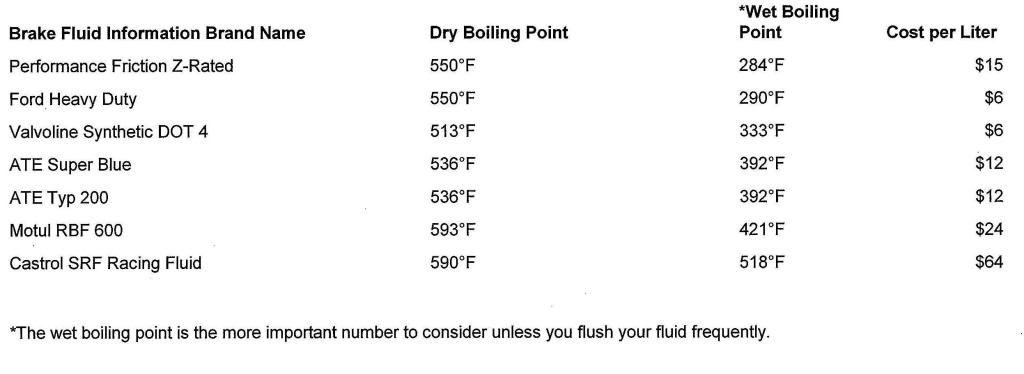
*The wet boiling point is the more important number to consider unless you flush frequently.
Brake Fade
There are 3 types of brake fade commonly encountered.
Green fade. This type of fade only happens with brand new unbedded pads. Pad compounds with organic binders will offgass as the binders volatilize when they are heated for the first time. These gasses produce a thin boundary layer on the pad surface which prevents or interferes with the proper friction of the pad on the rotor. Once the pads have been thoroughly heated the gasses are no longer produced and the problem goes away. As a result, your first braking application on brand new pads should not be a panic stop from 90 mph. All brake pads should be bedded in, more on that later.
Pad fade
Every pad compound, street or track has a range of operating temperature. Above that range the coefficient of friction will drop and the ability of the pad to stop the rotor will diminish. Multiple stops from high speed such as on a road course, or a fast descent down a twisty mountain road can over heat the brakes and exceed the operating range of the pads and the brakes will start to fade. The pedal will still feel hard and firm but the car doesn’t slow down like it used to. The cure is let the brakes cool off, and if the pads haven’t been incinerated they will resume working when temperatures cool down.
Fluid fade
This is the MacDaddy of fade and should be avoided (see wet and dry boiling points of brake fluid above). If the brakes get hot enough, the fluid in the caliper can exceed the boiling point of the fluid, especially if the fluid has absorbed water. Hydraulic systems depend on the physical principal of the incompressibility of fluids. When the fluid boils, bubbles of gas enter the hydraulic system, and unlike fluids, gasses are compressible. When you push on the brake pedal, all you are doing is squishing bubbles, not moving pistons. As a result, the brake pedal goes to the floor, the car goes where you don’t want it, and small wimpering sounds emanate from the driver as he/she looks for something soft to hit. The cure requires bleeding the brakes as the bubbles will not completely resorb on their own. Most people who track their car bleed their brakes before an event to have dry fluid and sometimes after an event to remove any bubbles.
Brake Pads
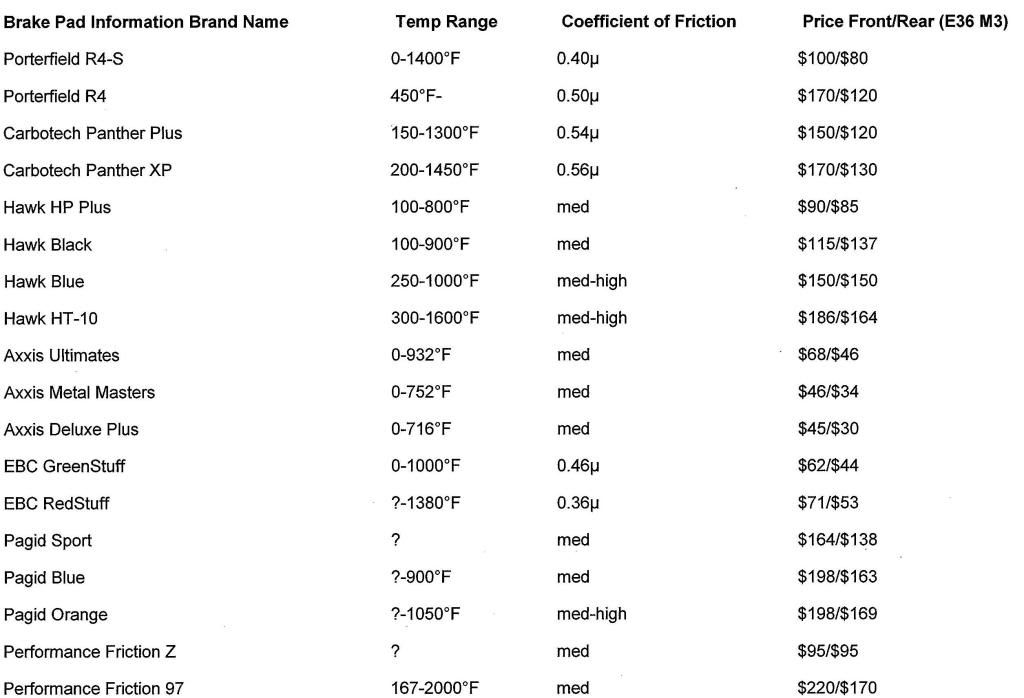
As mentioned above, the OEM brake pads are fully capable of setting off the ABS at high speeds, even with R-compound tires. They will do this multiple times. However, they won’t do it indefinitely. After 5 or 6 panic stops from 60mph they will begin to fade from overheating. Frequent hard braking with OEM pads may lead to pad deposits on the rotor which gives a pulsating pedal. For those who have encountered pad deposits (more on this later) or those who regularly autocross or track their car on road courses, an upgraded performance pad may increase the operating temperature range and prevent pad deposits and pad fade.
Brake pads generally fall in 3 categories – OEM, street performance, or track only. If all you ever do is drive to work, hit the interstate, and occasionally goose it at the traffic light, all you need are OEM pads. If you live in a mountainous area and like to drive fast, or you are continually exploring the limits of ABS on the off ramp, or you compete in autocrosses, you may benefit from a street performance brake pad. If you are tracking your car on road courses more than once (beyond the novice category), even a street performance pad may put pad deposits on your rotors and may fade. For experienced drivers on road courses, dedicated track pads will provide the best performance. Why not use track pads on the street, you may ask? Because, 1. They are expensive; 2. Some track pads need to be warmed up before they grab (although some modern formulas work relatively well when cold); 3. They are hard on the rotors; 4. They are very dusty; 5. The pad dust can be corrosive to wheels and body paint; 6. They tend to be noisy as well.
Some popular street performance pads for the RX8 include but are not limited to:
Axxis Ultimates
Hawk HP plus
Brembo Sport
Ferodo DS2500
Carbotech Bobcat
Cobalt GT Sport
Some popular dedicated track pads for the RX8 include but are not limited to:
Hawk HT10, DTC60
Carbotech XP10/XP8
Cobalt XR2/XR5
Track pad manufacturers often recommend using a slightly less aggressive compound in the rear such as Carbotech XP8 or Cobalt XR5.
Performance street pads and track pads generally have higher coefficients of friction (mu) as compared to OEM in addition to higher operating temperature ranges. This may give a better feel to the brake pedal but will not measurably shorten stopping distances. The benefits of performance street and track pads are in resistance to brake fade, which is incurred due to multiple hard stops such as encountered on road courses. The OEM brakes on the RX8 are superb and many people successfully track and race the RX8 with only a fluid and pad upgrade.
This table of brake pad information is from Scott Barton's website
Pad Bedding In
Most companies will include proper bedding technique in the instructions, and they more or less follow a similar procedure. As soon as the brake pads are installed, proceed to do some low speed braking, typically from 40mph to a slow roll to bring the brakes up to normal operating temperatures. Find yourself a place where you can do uninterupted sequential hard braking events. Do a set of 4 to 5, 70mph to 20mph, hard braking events followed by a 10-15 minute rolling cool down period. All of this is done Without coming to a complete stop. Braking should be hard but not hard enough to lock the wheels or set off the ABS. The brakes should be brought up to the upper thermal range of the pads. Bedding in the pads correctly does a few things: 1. Gets rid of green fade caused by outgassing of organic binders in the pad; 2. The primary purpose of bedding pads is to lay down an even layer of pad material on the rotor face to facilitate adherent friction. Everybody should find a place where there is a stretch of road with little or no traffic that they can safely get up to at least 60mph and do the above procedures including a 10 minute cooldown period afterwards WITHOUT COMING TO A COMPLETE STOP.
The Myth of Warped Rotors
Many people comment that they need to replace their entire brake setup because their rotors are "warped". While it may be possible (usually in an alternate universe) to warp a rotor it is exceedingly rare. Rotors may wear thin, they may crack, they may rust, but they rarely if ever warp. People think their rotors are warped for several reasons.
1. The pedal pulses and it “feels” like the rotor is “warped”.
2. Their mechanic told them its warped.
3. Their machinist told them its warped.
4. Their beer buddy, who knows all, told them its warped.
5. Their dad told them its warped.
The myth is perpetuated for several reasons. It sounds plausible, you can measure it, and the cure for a warped rotor fixes the problem that led to the belief that the rotor was warped, therefore it must have been warped. Not so, what is really happening was alluded to above in the brake pad discussion.
Brake pads rely on 2 types of friction, abrasive friction and adherent friction. Abrasive friction is just what it sounds like. Modern brake pads, particularly performance and track pads, rely heavily on a thing called adherent friction to fully develop their coefficient of friction. Adherent friction is more like the friction of sticky glue to something, a molecular bond that forms and breaks causing friction. Modern brake pads lay down a even layer of pad material on the rotor face during bedding and normal use. This layer of pad material on the rotor sticks to the pad material on the pad and voila increased friction. If the brake temperature exceeds the pads operating range this nice even layer starts to melt and becomes an uneven splotchy layer of material. This now variable thickness of glue stuck to the rotor causes the pulsations in the pedal as the pad follows the uneven pad deposits around the rotor face.
There are basically 2 ways to get rid of pad deposits. One is to machine them off. This is why the machinist and the mechanic (and for that matter, probably your dad and beer buddy) think the rotor is warped. The machinist measures the rotor as being warped when really he is measuring glue stuck to the rotor face. Machining the face of the rotor removes the glue and incorrectly confirms what he thought was the cause. The other way is to rebed the brakes, preferably with new pads of a higher temp range and coefficient of friction. Bedding (or rebedding because it can be repeated) brake pads is the controlled process of laying down an even layer of new pad material. If the new pads have a higher temperature range, you can melt off the old while you are laying on the new. This generally involves 5 or 6 hard braking events from 70 to 20 mph without stopping in rapid succession. Sometimes it may need to be repeated for another 5 events after cooling without stopping. I once had pad deposits after a track event on performance street pads that were so bad I stopped the car twice on the highway to check for broken suspension and brake parts. I cured the pad deposits with a new set of pads and a double bedding procedure.
Rotors are made of cast iron for a reason. It is tough stuff and is the best alloy in terms of heat resistance, ductility, strength, and hardness. All rotors, even the inexpensive ones, are made of similar cast iron alloys as the expensive racing rotors with the exception of carbon rotors found only on the highest end racing cars such as Formula 1 and a few others.
For further information on this subject see Carroll Smith
http://www.stoptech.com/tech_info/wp...rakedisk.shtml
Slotted and drilled rotors
Many people while trying to replace what they think are warped rotors, or while trying to make their car stop better, inquire about which is better, drilled or slotted rotors. The answer is neither. Neither holes nor slots will stop your car any quicker. Once you've gotten past green fade in the first heat cycle of new pads described above, outgassing is no longer a significant issue and holes and slots won't stop you any better. Holes and slot don't cool the rotors any better either. Furthermore, drilled rotors are generally to be avoided as the holes act as stress risers increasing the likelyhood of cracking. Slots won't hurt anything but your wallet but they won't help anything either except looks. If all you want is bling get the slots.
One structural aspect that will improve a rotors heat dissipation is curved internal vanes. The OEM rotor and most aftermarket rotors are straight vaned rotors. Curved vanes pump more air like a water pump. Racing Brake makes OEM sized rotors for the RX8 that are curved vanes. Another structural aspect that improves rotor design is 2-piece floating hat rotors. These rotors have a separate center hat, usually of aluminum alloy, that bolts to a cast iron ventilated rotor ring. These rotors have superior ventilation and the aluminum hat wicks away some of the heat, and they have less unsprung and rotational weight. Many aftermarket Big Brake Kits come with 2-piece floating hat rotors. Most competitive racing cars have 2-piece floating hat ventilated rotors.
OEM sized 2-piece floating hat rotors for the RX8 include but are not limited to:
DBA5000 www.dba.com
Racing Brake www.racingbrake.com
Big Brake Kits
Many people, in an effort to improve their cars decide to purchase an aftermarket brake system commonly referred to as a Big Brake Kit or BBK. As the term suggests the brakes are “bigger” than OEM. The implication is that bigger is better. Like much in life it is more complex than that. As mentioned above, the OEM brakes of both the AT model and the MT are fully capable of setting off the ABS under multiple panic stops. So if a brake system is already capable of locking up the wheel (even under racing conditions) how will a bigger braking system stop the car any shorter. The short answer is it won’t. BBKs don’t stop the car shorter or quicker. The advantage of a BBK is in the B as in bigger. A bigger rotor dissipates heat faster and better. So a well designed BBK will dump heat better. This is only an advantage if your brakes are overheating. Many of us race and track successfully without fade with OEM brakes with just better pads. If you are tracking the car with dedicated track pads and you are operating at the upper limit of your pads operating range you may benefit from a BBK. Better BBKs also utilize a 2-piece rotor which also has less unsprung and rotational weight.
Some people want a BBK for looks which is OK but buyer beware. Braking systems are all about balance, balance between the front and the rear. If a BBK is not well designed, and is just something available off the shelf that happens to fit, the front to rear brake bias or balance will be upset and the stopping distance with your very cool looking BBK will be longer, not shorter than your girlfriend with the stock OEM AT model on cheap tires.
The RX8 has a nearly 50/50 front/rear weight bias. Despite the RX8s excellent balance, the front brakes do more of the work than the rears due to weight shift under deceleration. Mazda engineers spent a lot of time matching piston diameters of the front and rear calipers and the master cylinder to get a balanced front/rear brake bias. Additionally, most cars including the RX8, have a proportioning valve between the front and rear which limits or modifies the maximum hydraulic pressure to the rear under heavy braking. This is necessary because of the forward weight shift under heavy braking. The proportioning valve prevents the rear wheels from prematurely activating the ABS and disrupting maximum braking efficiency.
Premature activation of the front or rear ABS is an important point to consider when making brake system modifications, such as adding a BBK. If the front caliper in the BBK you select is too big the front will activate the ABS prematurely. Since the front does most of the work you just turned off most of your brakes. If the front caliper is too small, it will allow the rear to activate prematurely. In either case once one end of the ABS goes off, further pedal pressure won't help and your stopping distances will increase instead of decrease. Bigger is not better if it upsets the balance of the braking system.
Some BBKs for the RX8 include but are not limited to:
Racing Brake www.racingbrake.com
StopTech www.stoptech.com
For more info on this subject see http://www.stoptech.com/tech_info/wp...formance.shtml
Brakes general description
The RX8 comes with either of 2 OEM brake systems. All models have ventilated front and rear disc brakes with ABS. The base AT model has 11.9 in. (303 mm) diameter front discs while the AT with sport suspension and all MT have larger 12.7 in. (323 mm) diameter front discs. Both models have the same 11.9 in. (302 mm) diameter ventilated rear discs and floating calipers. The larger front brakes have a different front caliper, master cylinder, and rear proportioning valve than the base AT model. Both models use single piston, cast iron, floating calipers front and rear.
The braking system is designed to stop the wheels of the car. Both the base AT model and the MT braking systems are fully capable of stopping the wheels of the car in excess of 60 mph multiple times in sequence. This is an important point. Because the brakes are fully capable of stopping the wheels at speeds likely to be encountered on the street, the limiting factor in how quickly you can stop your car is dependent primarily on your tires and road conditions (i.e. wet or dirt). If you truly want to stop your car in a shorter distance, buy stickier tires. This can be accomplished by buying tires with stickier rubber (generally lower treadwear rating), better construction, or wider footprints (most common). That said there are several areas where the OEM brakes can be modified to fit specific conditions and these are discussed below.
ABS
The Anti-lock Braking System is designed to prevent locking up of the wheels during hard or panic braking. A locked-up sliding wheel has a lower coefficient of friction with the road that a rolling wheel, so braking distances are shortened if the wheels can be slowed quickly without locking up. Furthermore, you can’t steer a locked-up sliding wheel, so ABS has the added benefit of allowing directional control during panic braking. The ABS system consists of wheel sensors that monitor wheel rotation, a computer that decides when the braking system should be modulated, and a hydraulic pump that actuates the brakes during ABS operation. All of this happens multiple times a second. If you set off the ABS on a wet or sandy road you will feel a vibrating "bbrrrrppp" in the brake pedal.
Brake fluid
The RX8 comes with a DOT3 recommended brake fluid like just about every car currently available. DOT3, DOT4, and DOT5.1 brake fluids are glycol ether based hydraulic fluids that by their chemical nature are hydroscopic, meaning they will absorb water. DOT5 is a silicon based brake fluid and is not compatible with the other fluids, once you use it you cannot return to the other fluids and should not be used. Water dissolved in the brake fluid does 2 things, both of them bad. It accelerates rust and corrosion of the internal parts in the master cylinder and caliper pistons. Worse, the boiling point of fresh brake fluid is significantly lowered by small concentrations of dissolved water in the fluid. For this reason, when comparing boiling points of brake fluid for a daily driver, the wet boiling point is probably the most important.
People who regularly stress their brakes due to carrying heavy loads (not usual with an RX8) or braking at high speeds (more common in an RX8) should, at the very least, replace their brake fluid annually with fresh fluid to keep their brake fluid boiling points near the dry point. If you are going to track your car either on an autocross track, or more importantly on a road course, the first modification you should make is to put fresh brake fluid in your RX8. Many people will at this point select a racing brake fluid with a higher wet and dry boiling point such as ATE Super Blue or Motul 600 racing brake fluid among others. The ATE Super Blue also comes in gold which is the same stuff without the dye, useful if you alternate colors so you know when the flushing is done.
For more info on brake fluid see http://www.stoptech.com/tech_info/wp...fluid_1a.shtml
This table of Brake fluid information is from Scott Barton's website
*The wet boiling point is the more important number to consider unless you flush frequently.
Brake Fade
There are 3 types of brake fade commonly encountered.
Green fade. This type of fade only happens with brand new unbedded pads. Pad compounds with organic binders will offgass as the binders volatilize when they are heated for the first time. These gasses produce a thin boundary layer on the pad surface which prevents or interferes with the proper friction of the pad on the rotor. Once the pads have been thoroughly heated the gasses are no longer produced and the problem goes away. As a result, your first braking application on brand new pads should not be a panic stop from 90 mph. All brake pads should be bedded in, more on that later.
Pad fade
Every pad compound, street or track has a range of operating temperature. Above that range the coefficient of friction will drop and the ability of the pad to stop the rotor will diminish. Multiple stops from high speed such as on a road course, or a fast descent down a twisty mountain road can over heat the brakes and exceed the operating range of the pads and the brakes will start to fade. The pedal will still feel hard and firm but the car doesn’t slow down like it used to. The cure is let the brakes cool off, and if the pads haven’t been incinerated they will resume working when temperatures cool down.
Fluid fade
This is the MacDaddy of fade and should be avoided (see wet and dry boiling points of brake fluid above). If the brakes get hot enough, the fluid in the caliper can exceed the boiling point of the fluid, especially if the fluid has absorbed water. Hydraulic systems depend on the physical principal of the incompressibility of fluids. When the fluid boils, bubbles of gas enter the hydraulic system, and unlike fluids, gasses are compressible. When you push on the brake pedal, all you are doing is squishing bubbles, not moving pistons. As a result, the brake pedal goes to the floor, the car goes where you don’t want it, and small wimpering sounds emanate from the driver as he/she looks for something soft to hit. The cure requires bleeding the brakes as the bubbles will not completely resorb on their own. Most people who track their car bleed their brakes before an event to have dry fluid and sometimes after an event to remove any bubbles.
Brake Pads
As mentioned above, the OEM brake pads are fully capable of setting off the ABS at high speeds, even with R-compound tires. They will do this multiple times. However, they won’t do it indefinitely. After 5 or 6 panic stops from 60mph they will begin to fade from overheating. Frequent hard braking with OEM pads may lead to pad deposits on the rotor which gives a pulsating pedal. For those who have encountered pad deposits (more on this later) or those who regularly autocross or track their car on road courses, an upgraded performance pad may increase the operating temperature range and prevent pad deposits and pad fade.
Brake pads generally fall in 3 categories – OEM, street performance, or track only. If all you ever do is drive to work, hit the interstate, and occasionally goose it at the traffic light, all you need are OEM pads. If you live in a mountainous area and like to drive fast, or you are continually exploring the limits of ABS on the off ramp, or you compete in autocrosses, you may benefit from a street performance brake pad. If you are tracking your car on road courses more than once (beyond the novice category), even a street performance pad may put pad deposits on your rotors and may fade. For experienced drivers on road courses, dedicated track pads will provide the best performance. Why not use track pads on the street, you may ask? Because, 1. They are expensive; 2. Some track pads need to be warmed up before they grab (although some modern formulas work relatively well when cold); 3. They are hard on the rotors; 4. They are very dusty; 5. The pad dust can be corrosive to wheels and body paint; 6. They tend to be noisy as well.
Some popular street performance pads for the RX8 include but are not limited to:
Axxis Ultimates
Hawk HP plus
Brembo Sport
Ferodo DS2500
Carbotech Bobcat
Cobalt GT Sport
Some popular dedicated track pads for the RX8 include but are not limited to:
Hawk HT10, DTC60
Carbotech XP10/XP8
Cobalt XR2/XR5
Track pad manufacturers often recommend using a slightly less aggressive compound in the rear such as Carbotech XP8 or Cobalt XR5.
Performance street pads and track pads generally have higher coefficients of friction (mu) as compared to OEM in addition to higher operating temperature ranges. This may give a better feel to the brake pedal but will not measurably shorten stopping distances. The benefits of performance street and track pads are in resistance to brake fade, which is incurred due to multiple hard stops such as encountered on road courses. The OEM brakes on the RX8 are superb and many people successfully track and race the RX8 with only a fluid and pad upgrade.
This table of brake pad information is from Scott Barton's website
Pad Bedding In
Most companies will include proper bedding technique in the instructions, and they more or less follow a similar procedure. As soon as the brake pads are installed, proceed to do some low speed braking, typically from 40mph to a slow roll to bring the brakes up to normal operating temperatures. Find yourself a place where you can do uninterupted sequential hard braking events. Do a set of 4 to 5, 70mph to 20mph, hard braking events followed by a 10-15 minute rolling cool down period. All of this is done Without coming to a complete stop. Braking should be hard but not hard enough to lock the wheels or set off the ABS. The brakes should be brought up to the upper thermal range of the pads. Bedding in the pads correctly does a few things: 1. Gets rid of green fade caused by outgassing of organic binders in the pad; 2. The primary purpose of bedding pads is to lay down an even layer of pad material on the rotor face to facilitate adherent friction. Everybody should find a place where there is a stretch of road with little or no traffic that they can safely get up to at least 60mph and do the above procedures including a 10 minute cooldown period afterwards WITHOUT COMING TO A COMPLETE STOP.
The Myth of Warped Rotors
Many people comment that they need to replace their entire brake setup because their rotors are "warped". While it may be possible (usually in an alternate universe) to warp a rotor it is exceedingly rare. Rotors may wear thin, they may crack, they may rust, but they rarely if ever warp. People think their rotors are warped for several reasons.
1. The pedal pulses and it “feels” like the rotor is “warped”.
2. Their mechanic told them its warped.
3. Their machinist told them its warped.
4. Their beer buddy, who knows all, told them its warped.
5. Their dad told them its warped.
The myth is perpetuated for several reasons. It sounds plausible, you can measure it, and the cure for a warped rotor fixes the problem that led to the belief that the rotor was warped, therefore it must have been warped. Not so, what is really happening was alluded to above in the brake pad discussion.
Brake pads rely on 2 types of friction, abrasive friction and adherent friction. Abrasive friction is just what it sounds like. Modern brake pads, particularly performance and track pads, rely heavily on a thing called adherent friction to fully develop their coefficient of friction. Adherent friction is more like the friction of sticky glue to something, a molecular bond that forms and breaks causing friction. Modern brake pads lay down a even layer of pad material on the rotor face during bedding and normal use. This layer of pad material on the rotor sticks to the pad material on the pad and voila increased friction. If the brake temperature exceeds the pads operating range this nice even layer starts to melt and becomes an uneven splotchy layer of material. This now variable thickness of glue stuck to the rotor causes the pulsations in the pedal as the pad follows the uneven pad deposits around the rotor face.
There are basically 2 ways to get rid of pad deposits. One is to machine them off. This is why the machinist and the mechanic (and for that matter, probably your dad and beer buddy) think the rotor is warped. The machinist measures the rotor as being warped when really he is measuring glue stuck to the rotor face. Machining the face of the rotor removes the glue and incorrectly confirms what he thought was the cause. The other way is to rebed the brakes, preferably with new pads of a higher temp range and coefficient of friction. Bedding (or rebedding because it can be repeated) brake pads is the controlled process of laying down an even layer of new pad material. If the new pads have a higher temperature range, you can melt off the old while you are laying on the new. This generally involves 5 or 6 hard braking events from 70 to 20 mph without stopping in rapid succession. Sometimes it may need to be repeated for another 5 events after cooling without stopping. I once had pad deposits after a track event on performance street pads that were so bad I stopped the car twice on the highway to check for broken suspension and brake parts. I cured the pad deposits with a new set of pads and a double bedding procedure.
Rotors are made of cast iron for a reason. It is tough stuff and is the best alloy in terms of heat resistance, ductility, strength, and hardness. All rotors, even the inexpensive ones, are made of similar cast iron alloys as the expensive racing rotors with the exception of carbon rotors found only on the highest end racing cars such as Formula 1 and a few others.
For further information on this subject see Carroll Smith
http://www.stoptech.com/tech_info/wp...rakedisk.shtml
Slotted and drilled rotors
Many people while trying to replace what they think are warped rotors, or while trying to make their car stop better, inquire about which is better, drilled or slotted rotors. The answer is neither. Neither holes nor slots will stop your car any quicker. Once you've gotten past green fade in the first heat cycle of new pads described above, outgassing is no longer a significant issue and holes and slots won't stop you any better. Holes and slot don't cool the rotors any better either. Furthermore, drilled rotors are generally to be avoided as the holes act as stress risers increasing the likelyhood of cracking. Slots won't hurt anything but your wallet but they won't help anything either except looks. If all you want is bling get the slots.
One structural aspect that will improve a rotors heat dissipation is curved internal vanes. The OEM rotor and most aftermarket rotors are straight vaned rotors. Curved vanes pump more air like a water pump. Racing Brake makes OEM sized rotors for the RX8 that are curved vanes. Another structural aspect that improves rotor design is 2-piece floating hat rotors. These rotors have a separate center hat, usually of aluminum alloy, that bolts to a cast iron ventilated rotor ring. These rotors have superior ventilation and the aluminum hat wicks away some of the heat, and they have less unsprung and rotational weight. Many aftermarket Big Brake Kits come with 2-piece floating hat rotors. Most competitive racing cars have 2-piece floating hat ventilated rotors.
OEM sized 2-piece floating hat rotors for the RX8 include but are not limited to:
DBA5000 www.dba.com
Racing Brake www.racingbrake.com
Big Brake Kits
Many people, in an effort to improve their cars decide to purchase an aftermarket brake system commonly referred to as a Big Brake Kit or BBK. As the term suggests the brakes are “bigger” than OEM. The implication is that bigger is better. Like much in life it is more complex than that. As mentioned above, the OEM brakes of both the AT model and the MT are fully capable of setting off the ABS under multiple panic stops. So if a brake system is already capable of locking up the wheel (even under racing conditions) how will a bigger braking system stop the car any shorter. The short answer is it won’t. BBKs don’t stop the car shorter or quicker. The advantage of a BBK is in the B as in bigger. A bigger rotor dissipates heat faster and better. So a well designed BBK will dump heat better. This is only an advantage if your brakes are overheating. Many of us race and track successfully without fade with OEM brakes with just better pads. If you are tracking the car with dedicated track pads and you are operating at the upper limit of your pads operating range you may benefit from a BBK. Better BBKs also utilize a 2-piece rotor which also has less unsprung and rotational weight.
Some people want a BBK for looks which is OK but buyer beware. Braking systems are all about balance, balance between the front and the rear. If a BBK is not well designed, and is just something available off the shelf that happens to fit, the front to rear brake bias or balance will be upset and the stopping distance with your very cool looking BBK will be longer, not shorter than your girlfriend with the stock OEM AT model on cheap tires.
The RX8 has a nearly 50/50 front/rear weight bias. Despite the RX8s excellent balance, the front brakes do more of the work than the rears due to weight shift under deceleration. Mazda engineers spent a lot of time matching piston diameters of the front and rear calipers and the master cylinder to get a balanced front/rear brake bias. Additionally, most cars including the RX8, have a proportioning valve between the front and rear which limits or modifies the maximum hydraulic pressure to the rear under heavy braking. This is necessary because of the forward weight shift under heavy braking. The proportioning valve prevents the rear wheels from prematurely activating the ABS and disrupting maximum braking efficiency.
Premature activation of the front or rear ABS is an important point to consider when making brake system modifications, such as adding a BBK. If the front caliper in the BBK you select is too big the front will activate the ABS prematurely. Since the front does most of the work you just turned off most of your brakes. If the front caliper is too small, it will allow the rear to activate prematurely. In either case once one end of the ABS goes off, further pedal pressure won't help and your stopping distances will increase instead of decrease. Bigger is not better if it upsets the balance of the braking system.
Some BBKs for the RX8 include but are not limited to:
Racing Brake www.racingbrake.com
StopTech www.stoptech.com
For more info on this subject see http://www.stoptech.com/tech_info/wp...formance.shtml
Last edited by justjim; Mar 9, 2010 at 02:33 PM.





Great info jim, thanks.
I'm looking for pads (maybe rotors) replacement and didnt understand much about it. Lots of info well explained in the same post makes it so much clearer!
Now, I still need to take the car to the dealer to figure out what parts exactly need to be changed but I was already told that its recommanded to get new rotors as well because they will probably get too think when installing the pads.
How can I figure out for sure whether I really need to change the rotors or not?
at the same time, maybe you can recommand a set of pads : I'm hesitating between Mazdaspeed pads and Hawk Blue or Hawk HP+ or HPS or even Brembo?
I'm looking for pads (maybe rotors) replacement and didnt understand much about it. Lots of info well explained in the same post makes it so much clearer!
Now, I still need to take the car to the dealer to figure out what parts exactly need to be changed but I was already told that its recommanded to get new rotors as well because they will probably get too think when installing the pads.
How can I figure out for sure whether I really need to change the rotors or not?
at the same time, maybe you can recommand a set of pads : I'm hesitating between Mazdaspeed pads and Hawk Blue or Hawk HP+ or HPS or even Brembo?


Thread Starter
justjim
Joined: Aug 2008
Posts: 345
Likes: 6
From: St. Petersburg, Florida
Great info jim, thanks.
I'm looking for pads (maybe rotors) replacement and didnt understand much about it. Lots of info well explained in the same post makes it so much clearer!
Now, I still need to take the car to the dealer to figure out what parts exactly need to be changed but I was already told that its recommanded to get new rotors as well because they will probably get too think when installing the pads.
How can I figure out for sure whether I really need to change the rotors or not?
at the same time, maybe you can recommand a set of pads : I'm hesitating between Mazdaspeed pads and Hawk Blue or Hawk HP+ or HPS or even Brembo?
I'm looking for pads (maybe rotors) replacement and didnt understand much about it. Lots of info well explained in the same post makes it so much clearer!
Now, I still need to take the car to the dealer to figure out what parts exactly need to be changed but I was already told that its recommanded to get new rotors as well because they will probably get too think when installing the pads.
How can I figure out for sure whether I really need to change the rotors or not?
at the same time, maybe you can recommand a set of pads : I'm hesitating between Mazdaspeed pads and Hawk Blue or Hawk HP+ or HPS or even Brembo?
If you are not tracking the car, and use it as a daily driver with only the occaisional spirited driving expected with a sports car, really the OEM pads are probably your best bet as the RX8 has superb OEM brakes. If you have encountered uneven pad deposits due to your "driving style" or are determined to have a higher thermal range pad, the Hawk HP plus is one possibility. Don't get the Hawk Blues, they are old technology and very hard on rotors for their temp range. I've never used the Mazda Speed pads but they are probably another good choice. I have experience with the Axxis Ultimates and they are a good pad. There are others, Carbotech Bobcats, Carbotech AX6, Cobalt GT sports as well. One general rule of thumb, As the pad thermal range increases so does the brake dust. Most if not all of the pads I just mentioned will dust your wheels more than the OEM.
Last edited by justjim; Mar 5, 2009 at 12:19 PM.

 Ceramics?
Thanks very much for the post! It definitely answers some of the questions I have about changing out my rotors for slotted and if it was worth it. Looks like I'll stick to OEM when they actually do need changing.
I was wondering if you could comment on ceramic brake pads. I've heard good things about the Hawk ceramics and wanted to get some opinions on their effectiveness with OEM rotors.
I would like similar to better pads (when compared against OEM) and less brake dust without sacrificing much, if anything. I'm also guessing that the thermal range of ceramics is higher than the OEM brake pads? This would lead me to believe that as long as there was enough rotor thickness left that it would be okay to put them on and bed in to the rotors.
Once again, thanks for your help!
I was wondering if you could comment on ceramic brake pads. I've heard good things about the Hawk ceramics and wanted to get some opinions on their effectiveness with OEM rotors.
I would like similar to better pads (when compared against OEM) and less brake dust without sacrificing much, if anything. I'm also guessing that the thermal range of ceramics is higher than the OEM brake pads? This would lead me to believe that as long as there was enough rotor thickness left that it would be okay to put them on and bed in to the rotors.
Once again, thanks for your help!
Thread Starter
justjim
Joined: Aug 2008
Posts: 345
Likes: 6
From: St. Petersburg, Florida
Thanks very much for the post! It definitely answers some of the questions I have about changing out my rotors for slotted and if it was worth it. Looks like I'll stick to OEM when they actually do need changing.
I was wondering if you could comment on ceramic brake pads. I've heard good things about the Hawk ceramics and wanted to get some opinions on their effectiveness with OEM rotors.
I would like similar to better pads (when compared against OEM) and less brake dust without sacrificing much, if anything. I'm also guessing that the thermal range of ceramics is higher than the OEM brake pads? This would lead me to believe that as long as there was enough rotor thickness left that it would be okay to put them on and bed in to the rotors.
Once again, thanks for your help!
I was wondering if you could comment on ceramic brake pads. I've heard good things about the Hawk ceramics and wanted to get some opinions on their effectiveness with OEM rotors.
I would like similar to better pads (when compared against OEM) and less brake dust without sacrificing much, if anything. I'm also guessing that the thermal range of ceramics is higher than the OEM brake pads? This would lead me to believe that as long as there was enough rotor thickness left that it would be okay to put them on and bed in to the rotors.
Once again, thanks for your help!
Brake pad composition is a bit of black art as well as chemical science and engineering. Trying to get a pad that grabs consistently at -20F and 1600F, is quiet, relatively non-toxic, non-corrosive, easy on the rotors, and inexpensive is a bit of the holy grail. Pads are generally made up of fillers, binders, reinforcing fibers, and lubricants. Reinforcing fibers provide mechanical strength to the friction material and include, metals, kevlar, glass, and ceramic fibers, and formerly asbestos. Just some of the ingredients off the top of my mind in various pads not in any particular order: carbon/graphite, limestone, ceramic compounds (various metal oxides), iron, copper, brass, aluminum, zinc, glass, kevlar, epoxy, phenolic, and slicone resins, clay, silicates, proprietary compounds (secret), rubber, even cork and cashew dust.
Last edited by justjim; Mar 5, 2009 at 11:14 AM.



Registered
Joined: Aug 2006
Posts: 5,027
Likes: 5
From: Northern Virginia
The Myth of Warped Rotors
[snip]
The myth is perpetuated for several reasons. It sounds plausible, you can measure it, ...
[snip]
The myth is perpetuated for several reasons. It sounds plausible, you can measure it, ...
It's usually caused by someone not tightening the lug nuts in the right sequence. I've learned to loosen and re-torque lug nuts after a yahoo at an inspection station does his thing with an air wrench.
Other than that, really great FAQ.
Ken

grass hopper
Joined: Sep 2008
Posts: 1,195
Likes: 0
From: Guelph, Ontario
great read and top notch info. glad i read this before spending any money on my brakes...they should be good for a while, planning to service them this weekend, maybe ill flush the fluid too....im just so lazy. lol
Thread Starter
justjim
Joined: Aug 2008
Posts: 345
Likes: 6
From: St. Petersburg, Florida
If you can measure it, how can it be a myth? I've had warped rotors. I've measured the lateral run-out. Just resurfacing the rotor, without turning, did nothing. Replacing or turning the rotors fixed it.
It's usually caused by someone not tightening the lug nuts in the right sequence. I've learned to loosen and re-torque lug nuts after a yahoo at an inspection station does his thing with an air wrench.
Other than that, really great FAQ.
Ken
It's usually caused by someone not tightening the lug nuts in the right sequence. I've learned to loosen and re-torque lug nuts after a yahoo at an inspection station does his thing with an air wrench.
Other than that, really great FAQ.
Ken
If the client has exceeded the thermal range of their brake pads, the pads will lay down a lumpy uneven layer of melted pad material. It is this material, as opposed to warped rotor material, that is likely what you or your mechanic measured. You can scrape it off with a lathe or you can rebed the pads if they are not too incinerated. Rebedding with new pads of a higher temp range will melt and scrape the old mess off the rotor and lay down an new even layer and the formerly "warped" rotor will be as good as new.
If you don't believe me check with Carroll Smith the author of "Tune to Win" and Drive to Win" and many other well known books and who has considerably more experience than me at http://www.stoptech.com/tech_info/wp...rakedisk.shtml
I've confirmed just about everything he says on the track with my own vehicles.
Last edited by justjim; Mar 5, 2009 at 09:23 PM.


Registered
Joined: Aug 2006
Posts: 5,027
Likes: 5
From: Northern Virginia
...If you don't believe me check with Carroll Smith the author of "Tune to Win" and Drive to Win" and many other well known books and who has considerably more experience than me at http://www.stoptech.com/tech_info/wp...rakedisk.shtml
I've confirmed just about everything he says on the track with my own vehicles.
I've confirmed just about everything he says on the track with my own vehicles.
Wandering down nostalgia lane... I never bought any of Smith's books, but his first one started out as a series of articles in Sports Car Graphic. I remember devouring those articles. They stressed an approach and attitude that went well beyond race cars.
Ken


RX8 Club OG
Joined: Aug 2004
Posts: 2,459
Likes: 0
From: Clinton NJ
On Racingbrakes website it states that:
Weight Comparison
One-piece 18.5 lbs.
Two-piece 14.1 lbs.
and thats for the stock size
thecow135: you are correct... the sport and GT models on the AT's have the same suspension/brakes as the MT's
Weight Comparison
One-piece 18.5 lbs.
Two-piece 14.1 lbs.
and thats for the stock size
thecow135: you are correct... the sport and GT models on the AT's have the same suspension/brakes as the MT's
Thread Starter
justjim
Joined: Aug 2008
Posts: 345
Likes: 6
From: St. Petersburg, Florida
I tried to go back and correct the brake size for the AT sport but I'm at the word size limit for a single post so I can't add to it . Good catch on the AT brake size info.
. Good catch on the AT brake size info.


Registered User
Joined: Mar 2008
Posts: 2
Likes: 0
From: Dallas
I recently went to have my brakes checked and the manager stated I needed new rotors. Six months ago I had my brakes checked and was told my pads were fine with 60% pads still left. Less than six months go by and less than 5000 miles later I need new rotors. Not only that but I was to be charged $800 becuse I had a sport tuned suspension and needed special "KUKI" rotors. I thought this was stanrge when I went to the dealer and he said my rotors were fine I just needed new pads and they needed to be machined. Again, another $500 . Is this accurate or is someone about to make some money off me. Not a total mechanical idiot but I do realize when people are trying to bend me over. Any opinion would be greatly appreciated.

Be nice if the Cobalt pads were included in the chart. I know you included them in some examples of common pads for the track but most people are going to overlook that. And their numbers are significantly different from almost every other manufacturer. I'd also like more info from Cobalt on why they state that their pads do not need to be bedded in. I can dig up the post in the comp forum with a statement from Cobalt regarding their process if it helps.
You may also want to include the benefits of cleaning a rotor between pad swaps with brake cleaner especially when swapping different brands of pads and links to DIYs for bleeding brakes, changing pads, changing brake lines, and changing rotors.
Oh and the benefits and problems of going to stainless brake lines along with a link to that DIY.
Jim - here's the post I was referring to with a lot of good brake info/graphs that could probably make it into your post.
https://www.rx8club.com/rx-8-racing-25/track-day-brakes-operating-temperature-range-137786/
And here's the post from Cobalt Friction regarding their lack of bedding requirements:
http://forums.corvetteforum.com/1560497854-post9.html
https://www.rx8club.com/rx-8-racing-25/track-day-brakes-operating-temperature-range-137786/
And here's the post from Cobalt Friction regarding their lack of bedding requirements:
http://forums.corvetteforum.com/1560497854-post9.html
Cobalt Friction XR-Series Brake Pads
--------------------------------------------------------------------------------
The Cobalt XR-Series Carbon-Ceramic brake pads are based on hybrid sintermetal technology coupled with secondary carbon precursor deposition, making them unlike any other brake pad on the market. The XR-Series is the result of considerable R&D, taking from what we have learned over the years working with race teams in Grand Am Rolex & Cup, World Challenge, and SCCA club racing. The benefits of the new materials are:
(1) much broader temperature range (50F min)
(2) zero-bedding
(3) excellent disc finish and pad wear rates
(4) unsurpassed consistency
The XR-Series materials are resinless and thus do not require outgassing or traditional bedding, providing true "out of the box" race performance. This performance attribute had been supported by/with numerous teams in Grand Am and World Challenge starting races with new discs and pads. Reference teams include Blackforest Motorsports (Grand Am Mustangs in GS and GT classes) and LG Motorsports (World Challenge GT Corvettes), as well as factory supported GM race programs in various series. Resin-based materials, which include all pads from the major manufacturers (as well as Cobalt's previous generation materials), rely on a combination of metallic fibers and resin as a source of primary structure (metallic powders also contribute when used in formulations requiring higher compaction pressures (above 10tsi, generally speaking), but to a lessed extent). As a resin-based material is heat cycled, the resin outgasses and at temperatures approaching and exceeding 1000F, begin to decompose; this is why you will see resin-based materials crumble and chip at the edges after multiple heat cycles. The Cobalt XR-Series materials, being based on hybrid sintermetal technology, are compacted at much higher tonnages (exceeding 20tsi), do not utilize metallic fibers, and achieve structural integrity via controlled atmosphere (nitrogen/hydrogen mix) sintering processed at temperatures exceeding 2000F. Thus, they possess much higher performance consistency over the life of the pad, both during a given session/race, and also when run after multiple heat cycles; e.g. pads that are used 3 weeks after a race still have the same performance characteristics as a new set.
Traditional sintermetallic compounds contain upwards of 50%-V metallic powders or fibers. Cobalt Friction has developed a method of sintering which permits a much lower metallic powder content, with maximum of 30%-V, and allows neck formation between metallic, ceramic, and carbon particles. The result is a material that is 70%-V carbon-ceramic, yet still maintains excellent structural integrity at temperature exceeding 1600F. Similarly, the high carbon-ceramic (5 types of carbonaceous materials, and 4 types of ceramic materials) content lends itself to a much higher specific heat capacity (joules per gram per kelvin) (up to 50% higher than traditional resin-based materials).
Lastly, please note that LG Motorsports is the exclusive supplier for Cobalt XR-Series brake pads for Corvette fitments (C5 and C6); please contact LGM directly.
Regards,
__________________
andie w lin
director of motorsports r&d
cobalt friction technologies
--------------------------------------------------------------------------------
The Cobalt XR-Series Carbon-Ceramic brake pads are based on hybrid sintermetal technology coupled with secondary carbon precursor deposition, making them unlike any other brake pad on the market. The XR-Series is the result of considerable R&D, taking from what we have learned over the years working with race teams in Grand Am Rolex & Cup, World Challenge, and SCCA club racing. The benefits of the new materials are:
(1) much broader temperature range (50F min)
(2) zero-bedding
(3) excellent disc finish and pad wear rates
(4) unsurpassed consistency
The XR-Series materials are resinless and thus do not require outgassing or traditional bedding, providing true "out of the box" race performance. This performance attribute had been supported by/with numerous teams in Grand Am and World Challenge starting races with new discs and pads. Reference teams include Blackforest Motorsports (Grand Am Mustangs in GS and GT classes) and LG Motorsports (World Challenge GT Corvettes), as well as factory supported GM race programs in various series. Resin-based materials, which include all pads from the major manufacturers (as well as Cobalt's previous generation materials), rely on a combination of metallic fibers and resin as a source of primary structure (metallic powders also contribute when used in formulations requiring higher compaction pressures (above 10tsi, generally speaking), but to a lessed extent). As a resin-based material is heat cycled, the resin outgasses and at temperatures approaching and exceeding 1000F, begin to decompose; this is why you will see resin-based materials crumble and chip at the edges after multiple heat cycles. The Cobalt XR-Series materials, being based on hybrid sintermetal technology, are compacted at much higher tonnages (exceeding 20tsi), do not utilize metallic fibers, and achieve structural integrity via controlled atmosphere (nitrogen/hydrogen mix) sintering processed at temperatures exceeding 2000F. Thus, they possess much higher performance consistency over the life of the pad, both during a given session/race, and also when run after multiple heat cycles; e.g. pads that are used 3 weeks after a race still have the same performance characteristics as a new set.
Traditional sintermetallic compounds contain upwards of 50%-V metallic powders or fibers. Cobalt Friction has developed a method of sintering which permits a much lower metallic powder content, with maximum of 30%-V, and allows neck formation between metallic, ceramic, and carbon particles. The result is a material that is 70%-V carbon-ceramic, yet still maintains excellent structural integrity at temperature exceeding 1600F. Similarly, the high carbon-ceramic (5 types of carbonaceous materials, and 4 types of ceramic materials) content lends itself to a much higher specific heat capacity (joules per gram per kelvin) (up to 50% higher than traditional resin-based materials).
Lastly, please note that LG Motorsports is the exclusive supplier for Cobalt XR-Series brake pads for Corvette fitments (C5 and C6); please contact LGM directly.
Regards,
__________________
andie w lin
director of motorsports r&d
cobalt friction technologies
Thread Starter
justjim
Joined: Aug 2008
Posts: 345
Likes: 6
From: St. Petersburg, Florida
RK, yeah the pad table is old but I felt it was still useful. I use Cobalts at the track. Carbotech XP10/XP8 and Cobalt XR1/XR5 and Cobalt XR2/XR5 are the 2 brands of track pads that I have personal experience with, and I recommend either one. The link you provided is a good discussion. I can't add anything to the original post, its too big already. I have never found the need to buff, scrape, sand or mess with my rotors, a good rebedding is all I've ever done and I have gone back and forth with track pads and street pads many times with no issues. You can really remove a lot of pad deposits if you encounter them just by getting REALLY SERIOUS with the bedding procedures. I no longer encounter them because I use street and track pads adequate for the task at hand.