


compression results


Registered
Joined: Jan 2012
Posts: 49
Likes: 0
Gravey is a Canadian exception
 And his scores show how much higher they can be. Yes, he has a single low face, probably a sticking side seal he can get loosened back up, but that's not his average score, his average score is 8.03 even with that sticking face, which is extremely healthy, not "below average". His lowest score is higher than the average you are pushing, "high 6s".
.
Last edited by leetrx8; Aug 4, 2015 at 09:29 AM.
Registered
Joined: Jan 2012
Posts: 49
Likes: 0
Registered
Joined: Jan 2012
Posts: 49
Likes: 0
Another thing to think about is that a lot of crappy scores doesn't mean it's acceptable. Anyone that feels they can build a healthy engine that only tests 6.9 is a crappy engine builder. Period. There are several builders that consistently get into the 8s. And the performance difference is VERY noticeable if you drive the two cars back to back.
Last edited by leetrx8; Aug 4, 2015 at 09:22 AM.



I think you made my point there. "Cars for sale NOT healthy cars". Yes, many cars for sale are for sale specifically because they are unhealthy. That doesn't mean that the unhealthiness (high 6s) is acceptable, it isn't.
Part of the problem here is Gravey's typo  (no seriously, I keep wanting to edit your post Gravey... please fix!)
Actually, yes. That low of mileage, a sticking seal can be corrected without anything expensive, so no, it isn't a big deal. I'd love to have an engine that good.
I don't quite agree with either of you. I'd not want to accept those numbers, but at some level, and at the right price, I could. It passes though, so it isn't an outright dud.
(no seriously, I keep wanting to edit your post Gravey... please fix!)I don't quite agree with either of you. I'd not want to accept those numbers, but at some level, and at the right price, I could. It passes though, so it isn't an outright dud.
Alright guys, are you ready for the results?
Drum roll please.....
Alright alright.....I'll get to posting now.
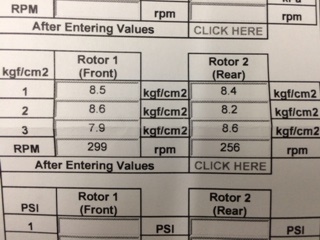
That 7.9 just had to be there....
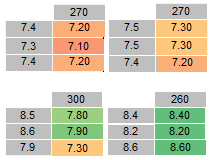
2010 R3 23,xxx miles 37,xxx km's
So the adjusted values are:
Rotor 1 Normalized values
7.8
7.9
7.3
Rotor 2 Normalized Values
8.4
8.2
8.6
Oh and this test was done on a hot engine immediately after driving for around an hour.
Drum roll please.....
Alright alright.....I'll get to posting now.
That 7.9 just had to be there....
2010 R3 23,xxx miles 37,xxx km's
So the adjusted values are:
Rotor 1 Normalized values
7.8
7.9
7.3
Rotor 2 Normalized Values
8.4
8.2
8.6
Oh and this test was done on a hot engine immediately after driving for around an hour.
Sorry Pearl... this better?
Last edited by Gravey; Aug 4, 2015 at 09:49 AM.


Gravey was just being confusing because he posted the normalized values, but kept in parenthesis the non-normalized RPM values, suggesting that those were his non-normalized numbers.
Last edited by RIWWP; Aug 4, 2015 at 11:31 AM.
Having just spent months hunting for an RX-8 without failing compression and finally throwing in the towel and buying back my original RX-8 that I knew still had good compression (because I had tested it myself only 5,000 miles prior) ... Well, I only actually paid to have 4 RX-8s tested, 3 failed, the 4th was sitting right there at the failing line. 3 more had scores from the sellers that were failing that they were trying to pass off as "good". Only one tested good enough for me, but there was too much body damage.
Granted, I wasn't hunting Series2s, I suspect the success rate would climb considerably if I was, but on series 1... I'd guess 80% for sale (at a given point in time) are dead.

Starting it up, getting it warm, and leaving it for 10 minutes so that it's warm isn't the same as what I was responding to:
Did I say anything about about testing a cold engine? No, that was a product of your imagination ...
Did I say anything about about testing a cold engine? No, that was a product of your imagination ...
...
So you say that "Warming up the engine" that implicitly defines "fluids up to operating temperature" is different from a "hot engine from driving" which will always have "fluids up to operating temperature" assuming your thermostats are working correctly?
Or are you saying that warming up an engine and then letting it sit for 10 minutes has a different combustion heat load on the housings at the spark plug holes than driving around on and then letting it sit for 10 minutes?
I fail to see the actual difference here.
So you say that "Warming up the engine" that implicitly defines "fluids up to operating temperature" is different from a "hot engine from driving" which will always have "fluids up to operating temperature" assuming your thermostats are working correctly?
Or are you saying that warming up an engine and then letting it sit for 10 minutes has a different combustion heat load on the housings at the spark plug holes than driving around on and then letting it sit for 10 minutes?
I fail to see the actual difference here.
This is what you posted:
It doesn't say bring it up to full operating temperature, does it?
Warm = Warm
Not hot
Not cold
Just warm.
Regardless, a cold engine that is started and comes up to temp on idle is still not anywhere near as hot as if it had just pulled in from a 1 hour drive. The radiator fan shouldn't even have come on unless you leave it idling long after it's actually warmed. 10 minutes after shutting both off the difference between them is even more substantial. Technically the car is fully operational well below normal ECT operational temperature of 97*C.
or try it and see. I'm just letting you know if the sensor gets too hot it will provide false high readings. No skin off my back otherwise.
Team out ...
It doesn't say bring it up to full operating temperature, does it?
Warm = Warm
Not hot
Not cold
Just warm.
Regardless, a cold engine that is started and comes up to temp on idle is still not anywhere near as hot as if it had just pulled in from a 1 hour drive. The radiator fan shouldn't even have come on unless you leave it idling long after it's actually warmed. 10 minutes after shutting both off the difference between them is even more substantial. Technically the car is fully operational well below normal ECT operational temperature of 97*C.
or try it and see. I'm just letting you know if the sensor gets too hot it will provide false high readings. No skin off my back otherwise.
Team out ...
Ok, so after a 1 hour drive, how long should it have cooled down for before testing?
Hold up guys, my results might be too high due to overheated sensors, and my engine may in fact be just as low as the rest of them S2's, I mean R3's... not S2's... in the UK!
Hold up guys, my results might be too high due to overheated sensors, and my engine may in fact be just as low as the rest of them S2's, I mean R3's... not S2's... in the UK!
Given the lack of precise information in the manual about how how the engine should be, you don't really have any more backing for your argument about how hot "warm" is than I do, and in neither case should the direction you get to that temperature from matter in any way.