


Supercharger performance



Banned
Joined: Jan 2007
Posts: 2,756
Likes: 2
From: everywherez...
Originally Posted by Moon Assad
What you think, 30 40 HP, also more flow for more porting.
I for one think that reworking the rotor design itself would yeild better results. Given the bias of the housing design, and perhaps adding a bit of bias to the rotor to compliment that design would be a better approach.
redesign the rotor while your at it with a few well placed "scores" to increase combustion turbulence a bit while your at it...

Banned
Joined: Jan 2007
Posts: 2,756
Likes: 2
From: everywherez...
Originally Posted by Moon Assad
This is the kind of think tank that im looking for. Arguing dosnt help at all.
All I do for my day job is fix problems given to me by people who dont understand things themselves. Add the complexity of different cultures and languages along with limited to no solid information...and you learn real quick that arguing never gets anyone anywhere...shame others do not prescribe to the same principles...
Server outage apparently for maintinence...seems pretty consistent daily at 4am CST to about 5am CST...



Londons Yellow Peril
Joined: Apr 2005
Posts: 1,340
Likes: 2
From: North London
so u r saying the transition from the ports above to the header is a 90 degree bend and therefore is causing flow/impact issues when overheated?
Because the ports fire directly out wards not raked back type thing.....
Because the ports fire directly out wards not raked back type thing.....

The port flow issue is due to flow area. They are just too small.
The siamesed port does not revert because it is in a constant state of flow.
A flapper would be worse than useless - it would be a flow restriction.
Think about header design - the scavenging effect of sequential ports draws exhaust from the adjoining port. This is what happens at the siamesed port.
Heat retention happens at the port in the irons, not the outlet in the housing, so increased flow will not appreciably affect the port temps.
Then don't argue when you don't know what you are talking about. That is the main issue we have with your methodology.
BTW - isn't this a supercharger thread?
The siamesed port does not revert because it is in a constant state of flow.
A flapper would be worse than useless - it would be a flow restriction.
Think about header design - the scavenging effect of sequential ports draws exhaust from the adjoining port. This is what happens at the siamesed port.
Heat retention happens at the port in the irons, not the outlet in the housing, so increased flow will not appreciably affect the port temps.
Originally Posted by Moon Assad
This is the kind of think tank that im looking for. Arguing dosnt help at all.
BTW - isn't this a supercharger thread?
Last edited by MazdaManiac; Mar 22, 2007 at 05:45 AM.
Banned
Joined: Jan 2007
Posts: 2,756
Likes: 2
From: everywherez...
From the chamber...the energy is directed outwards...as it exits the chamber it immediately has to make an almost 90 degree turn which is currently performed by slamming the energy directly into the port and routed down into the header which then has yet another tight turn before being routed back. As the gas hits the walls for deflection, it will impart some of its energy on the walls...
or to simplify it...turn on a hair dryer and put your hand at 90 degrees in front of it...your hand will heat up in less time than if you held your hand at 45 degrees...
or to simplify it...turn on a hair dryer and put your hand at 90 degrees in front of it...your hand will heat up in less time than if you held your hand at 45 degrees...
Banned
Joined: Jan 2007
Posts: 2,756
Likes: 2
From: everywherez...
Originally Posted by MazdaManiac
The port flow issue is due to flow area. They are just too small.
Originally Posted by MazdaManiac
The siamesed port does not revert because it is in a constant state of flow.
A flapper would be worse than useless - it would be a flow restriction.
A flapper would be worse than useless - it would be a flow restriction.
Originally Posted by MazdaManiac
Heat retention happens at the port, not the outlet, so increased flow will not appreciably affect the port temps.
My bigger gripe is those tight turns...
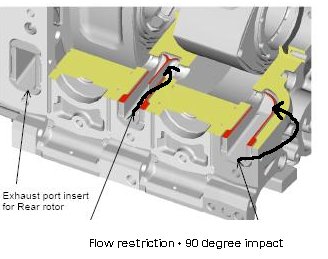
All a flapper would do is keep the port flow area as small as it is before the blending point until it hits the header.
Its commendable that you guys are playing with this stuff, but you are way off base with regards to how the fluid dynamics work in the system as it stands.
Tight turns not withstanding, any progressive increases in actual flow surface are more important than any sort of flow "smoothness" with regards to fluid evacuation from the point of higher pressure.
Its commendable that you guys are playing with this stuff, but you are way off base with regards to how the fluid dynamics work in the system as it stands.
Tight turns not withstanding, any progressive increases in actual flow surface are more important than any sort of flow "smoothness" with regards to fluid evacuation from the point of higher pressure.
Banned
Joined: Jan 2007
Posts: 2,756
Likes: 2
From: everywherez...
Originally Posted by MazdaManiac
Think about header design - the scavenging effect of sequential ports draws exhaust from the adjoining port. This is what happens at the siamesed port.
Does a scavenging effect actually occur considering that they all dump to the same location?
EDIT: Answered by rotarygod..
How can we scavenge when we have no port overlap? Well, what if we have so much velocity from our wonderfully designed exhaust that the exhaust pulse actually pulls more air from the chamber than just the exhaust gasses? This would mean that it pulled the chamber into the negative pressure zone below ambient pressure.
Rotarygod probably knows better than I on that stuff...
The reason I ask is because I've never actually thought about it...glad you kinda brought that up actually...
=)
Originally Posted by MazdaManiac
Heat retention happens at the port in the irons, not the outlet in the housing, so increased flow will not appreciably affect the port temps.
Of course it could simply be the one of the other answers too
Last edited by eviltwinkie; Mar 22, 2007 at 06:24 AM. Reason: bad grammar; update
Banned
Joined: Jan 2007
Posts: 2,756
Likes: 2
From: everywherez...
Originally Posted by MazdaManiac
All a flapper would do is keep the port flow area as small as it is before the blending point until it hits the header.
That siamese port insert...make it flat mentally and allow it move horizontally within that same space between chambers.
I think the toying idea is...due to the pressure inbound from the rotor the plate (insert) would be pushed back and forth giving each rotor as much port volume as possible during each pulse.
So theoretically...its as if each rotor would have the entire siamese port to itself as the space between the current insert and the port opening is tight and appears to be restrictive.
Hopefully I explained his idea correctly...
Originally Posted by MazdaManiac
Tight turns not withstanding, any progressive increases in actual flow surface are more important than any sort of flow "smoothness" with regards to fluid evacuation from the point of higher pressure.
If the above stated idea is correct...then if we look at a single rotor as a thought experiment...and said...you can have the entire siamese port to yourself...would that not be an increase in the volume it could utilize and therefore increase flow?
Banned
Joined: Jan 2007
Posts: 2,756
Likes: 2
From: everywherez...
Originally Posted by california style
So this what u mean?
Rotarygod on exhaust...reading now..
https://www.rx8club.com/series-i-tech-garage-22/another-one-my-insanely-long-exhaust-tech-articles-73332/
Last edited by eviltwinkie; Mar 22, 2007 at 06:22 AM.

Getting back to why these turbo motors failed ...... MM said that he didn't think the turbo choking the flow at high rpm was going to cause additional heat .
MM - Can you elaborate on what you did to check EGTs with the Greddy vs your larger turbo?
MM - Can you elaborate on what you did to check EGTs with the Greddy vs your larger turbo?
I stuck a K-type thermocouple in the manifold right at where it enters the turbo and measured the EGTs under load at all RPM ranges and at cruise and its the same between the two, very different turbos.

Registered
Joined: Feb 2004
Posts: 1,802
Likes: 10
From: QLD .au
here is my predicted c30-94 engine demand if anyone is interested. flow rate is beeing exagerated by the way I calculated air mass

Last edited by rotarenvy; Apr 29, 2007 at 05:55 PM. Reason: errors in flow calculations
Registered
Joined: Feb 2004
Posts: 1,802
Likes: 10
From: QLD .au
true, but it's indicative of the centrifugal sc's out there. maybe the expect you to run low compression high boost? adding the impeller speed dosn't seem to help. it gives more PR but at that PR the engine can flow more air and this compressor can't flow enough.

Destroying Threads
Joined: Mar 2007
Posts: 2,296
Likes: 2
From: (swartsnegga state)
reading this thread has throughroughly convinced me to screw the petit supercharger and buy a damn turbo kit instead @.@
now I need to find that extra 4-5k for all the upgrades for the turbo kit before I install all of them @.@
now I need to find that extra 4-5k for all the upgrades for the turbo kit before I install all of them @.@

Registered User
Joined: Aug 2006
Posts: 792
Likes: 2
Originally Posted by tajabaho1
reading this thread has throughroughly convinced me to screw the petit supercharger and buy a damn turbo kit instead @.@
now I need to find that extra 4-5k for all the upgrades for the turbo kit before I install all of them @.@
now I need to find that extra 4-5k for all the upgrades for the turbo kit before I install all of them @.@

Thread Starter
Registered User
Joined: Apr 2006
Posts: 511
Likes: 0
Just as we were getting comfy with understanding the powerband natures of various air pumps, it turns out a new turbo is in development that will change everything.
Details are a bit sketchy, but the new technology uses a valve & gate system that extends maintains the P/V factors for both the turbine and impeller over a range 4-5 times wider then simple system we have today.
Both Volvo and Smiths are working on gated systems independently, and both have already filed a few patents. Any Turbo wizards who are looking for a really cool job in Ashville NC need to look at Smiths.
Details are a bit sketchy, but the new technology uses a valve & gate system that extends maintains the P/V factors for both the turbine and impeller over a range 4-5 times wider then simple system we have today.
Both Volvo and Smiths are working on gated systems independently, and both have already filed a few patents. Any Turbo wizards who are looking for a really cool job in Ashville NC need to look at Smiths.

