


New York Times Review of the RX-8


Thread Starter
Registered
Joined: Aug 2003
Posts: 589
Likes: 0
New York Times Review of the RX-8
--------------------------------------------------------------------------------
December 21, 2003
BEHIND THE WHEEL | 2004 MAZDA RX-8
A Sports Car With Family Values
By JEFF SABATINI
ONY was the captain of my high school water polo team. Athletic. Popular. And if that wasn't enough to fuel the fires of jealousy, Tony drove a silver second-generation Mazda RX-7 that was the envy of all us red-blooded teenagers with sports car lust in our hearts.
Fifteen years later, most guys like Tony aren't driving sports cars. Instead of stepping up out of something low and sleek, they are hopping down from the running boards of big S.U.V.'s or extended-cab pickups.
Mazda is begging the Tonys of the world to come back to the fold. Recognizing the practical appeal of the utility vehicles that are now often the choice of the cool and uncool alike, the company has added a degree of practicality to the successor to the RX-7, which Mazda pulled from the American market nine years ago. The new RX-8 is a sports car with not two doors, but four, and an equivalent number of seats.
Yes, sedans have been promoted as "four-door sports cars" before, and Saturn has tried to convince us that we should be impressed by the diminutive rear doors on its coupes. But the RX-8 actually delivers the goods: four doors plus styling, handling and performance befitting a sports car.
The RX-8 certainly screams "sports car" - and loudly at that. Its protruding front fenders initially call to mind the Ferrari Enzo supercar, but the more you stare at the front of the RX-8, the more those pontoonlike fenders look as if they belong on a vintage pickup.
The styling is indeed the weakest part of the package, and part of the blame falls on those rear-hinged doors. There is no way to make their seams work in concert with the rest of the car's manic lines. These swoop rearward over the hood, dart up to a crease along the trunk, and bulge over the wheels, all with the reckless styling abandon common in this era of computer-aided design. The rear end, cluttered with Mazda's oversize badges, is especially busy.
As expected from Mazda, handling is where the rear-drive RX-8 excels. A superbly tuned suspension - double-wishbone configuration in the front and multi-link in the rear - makes enjoyable sport out of twists and turns, allowing little of the leaning movement known as body roll. Even more impressive is how well the car soaks up bumps and poor pavement.
The ride is always firm but rarely harsh, and the driver benefits from great road feel and response through the electrically assisted power steering. With perfect 50-50 weight distribution, the car has excellent balance and a nimble feel.
The engine is a 2-rotor, 1.3-liter rotary, or Wankel, so-named after its inventor, Felix Wankel. This design allows for a compact and lightweight engine with prodigious power potential, making it an obvious choice for a sports car. Unlike conventional piston engines, in which the up-and-down motion of pistons turns a crankshaft, rotary engines have triangular rotors that rotate within housings, turning eccentric shafts that run through their centers.
Rotaries have been Mazda's unique calling card since the 1960's, so it is no wonder that its new flagship features the latest developments in rotary technology, which offers lower emissions and higher performance, Mazda says.
The new unit makes 238 horsepower (at a lofty 8,500 r.p.m.) but only 159 pounds-feet of torque (at a high 5,500 r.p.m.). That low torque number means the 3,000-pound RX-8 doesn't move off the line as quickly as you might expect, but satisfaction comes a second or two later as the engine soars toward its 9,000-r.p.m. redline.
For people unaccustomed to urging the tachometer needle that far up the gauge, driving the RX-8 may take some adjustment - by delaying your shifts, for instance. Though indeed high-strung, the mellow-sounding little rotary never feels short of power; Road & Track magazine recorded a 0-to-60 m.p.h. time of 5.9 seconds, compared with 5.8 for a Nissan 350Z. Nor is it a painful aural experience to rev it full-tilt.
The pain comes at the gas pump. My test car had a federal fuel economy rating of 18 miles per gallon in town and 24 on the highway. As they say, your mileage may vary: I achieved only 18 m.p.g. in combined driving and 14 in a strictly urban setting.
The six-speed manual transmission has shift throws short enough to ruin the business plan of an aftermarket supplier. A four-speed automatic, with gear-change paddles on the steering wheel, is also offered, but this version comes only with a detuned 197-horsepower version of the engine.
The brakes are grabby four-wheel discs with an antilock feature and electronic force distribution. Dynamic stability control with traction control is an option, bundled to cost you at least $1,200. Ditto the moonroof; the least expensive package that will get you one is $2,800.
My $31,200 test car included the $4,000 grand touring package, the only way to get a leather interior. A navigation system is also offered, for $2,000. Clearly, Mazda arrived at the reasonable base price - $27,200 for the six-speed model - by being stingy with the standard equipment.
Would you like a spare tire? The scrooges at Mazda give you only a can of flat-tire sealant goo unless you pay an extra $395 for the fifth wheel and additional rubber.
Mazda explains that the spare was left out because it takes up much of the trunk. But the company's Miata roadster, an even smaller car, has always had a standard trunk-mounted spare that owners could choose to leave in the garage to increase luggage capacity.
Inside the RX-8's cozy cockpit, the driver is greeted by a low instrument panel fitted with nicely illuminated gauges, including a large center tachometer with integrated digital speedometer. Visibility to the front and side is excellent, and an over-the-shoulder glance finds the right rear door's small window perfect for checking blind spots before darting into the adjoining lane.
As a whole, the interior is rather plain and functional, well assembled from plastic materials of average quality - though those who judge sports cars based on interior trim are probably not driving enough. One oddity is the parking brake, shaped like a right triangle and resembling a heavy-duty stapler. Even when it's down, it looks as if it's still up.
The center console runs from the dashboard clear back to the cover of the small pass-through to the trunk. Despite this intrusion on the occupants' personal space, the rear buckets do not feel as cramped as they do in many coupes with vestigial back seats. The second row is fairly comfortable for adults, provided they are not tall. Mazda includes rear safety-seat anchors so you can teach your children heel-and-toe downshifts from an early age.
While you wouldn't necessarily want to travel cross-country in the back of an RX-8, it could be done, and the rear doors would make it a lot easier to get out and stretch. It is possible to slide into the rear seats without forcing the front seat occupants to get out first, or to tilt their seats forward, provided no one involved is of large build. Alas, regardless of where they might plan to sit, the big and tall might do well to just pass on the RX-8, as even Mazda calls the interior "comfortably snug."
Which brings us back to Tony and the inevitable question: Is this four-door design the right selling point to put guys like him back in a sports car, or is it just a gimmick?
I would say it is neither. The back seat is a nice feature, though its practicality might have been enhanced if the car were designed to be a hatchback. Regardless, Mazda did an excellent job of packaging, even including a reasonably large trunk.
But while extra doors, seats and trunk space may make the RX-8 easier to live with, they don't necessarily make it cool. After all, practicality is not what sells sports cars - or even, often, trucks.
The RX-8 works because it drives better than competitors like the 350Z and the Audi TT. In the RX-8, Mazda has created a wonderful sports car and a worthy successor to the RX-7. If this doesn't cause the Tonys to take notice, nothing will.
INSIDE TRACK: A sports car good enough to make you forget the back seat.
Copyright 2003 The New York Times Company | Home | Privacy Policy | Search | Corrections | Help | Back to Top
December 21, 2003
BEHIND THE WHEEL | 2004 MAZDA RX-8
A Sports Car With Family Values
By JEFF SABATINI
ONY was the captain of my high school water polo team. Athletic. Popular. And if that wasn't enough to fuel the fires of jealousy, Tony drove a silver second-generation Mazda RX-7 that was the envy of all us red-blooded teenagers with sports car lust in our hearts.
Fifteen years later, most guys like Tony aren't driving sports cars. Instead of stepping up out of something low and sleek, they are hopping down from the running boards of big S.U.V.'s or extended-cab pickups.
Mazda is begging the Tonys of the world to come back to the fold. Recognizing the practical appeal of the utility vehicles that are now often the choice of the cool and uncool alike, the company has added a degree of practicality to the successor to the RX-7, which Mazda pulled from the American market nine years ago. The new RX-8 is a sports car with not two doors, but four, and an equivalent number of seats.
Yes, sedans have been promoted as "four-door sports cars" before, and Saturn has tried to convince us that we should be impressed by the diminutive rear doors on its coupes. But the RX-8 actually delivers the goods: four doors plus styling, handling and performance befitting a sports car.
The RX-8 certainly screams "sports car" - and loudly at that. Its protruding front fenders initially call to mind the Ferrari Enzo supercar, but the more you stare at the front of the RX-8, the more those pontoonlike fenders look as if they belong on a vintage pickup.
The styling is indeed the weakest part of the package, and part of the blame falls on those rear-hinged doors. There is no way to make their seams work in concert with the rest of the car's manic lines. These swoop rearward over the hood, dart up to a crease along the trunk, and bulge over the wheels, all with the reckless styling abandon common in this era of computer-aided design. The rear end, cluttered with Mazda's oversize badges, is especially busy.
As expected from Mazda, handling is where the rear-drive RX-8 excels. A superbly tuned suspension - double-wishbone configuration in the front and multi-link in the rear - makes enjoyable sport out of twists and turns, allowing little of the leaning movement known as body roll. Even more impressive is how well the car soaks up bumps and poor pavement.
The ride is always firm but rarely harsh, and the driver benefits from great road feel and response through the electrically assisted power steering. With perfect 50-50 weight distribution, the car has excellent balance and a nimble feel.
The engine is a 2-rotor, 1.3-liter rotary, or Wankel, so-named after its inventor, Felix Wankel. This design allows for a compact and lightweight engine with prodigious power potential, making it an obvious choice for a sports car. Unlike conventional piston engines, in which the up-and-down motion of pistons turns a crankshaft, rotary engines have triangular rotors that rotate within housings, turning eccentric shafts that run through their centers.
Rotaries have been Mazda's unique calling card since the 1960's, so it is no wonder that its new flagship features the latest developments in rotary technology, which offers lower emissions and higher performance, Mazda says.
The new unit makes 238 horsepower (at a lofty 8,500 r.p.m.) but only 159 pounds-feet of torque (at a high 5,500 r.p.m.). That low torque number means the 3,000-pound RX-8 doesn't move off the line as quickly as you might expect, but satisfaction comes a second or two later as the engine soars toward its 9,000-r.p.m. redline.
For people unaccustomed to urging the tachometer needle that far up the gauge, driving the RX-8 may take some adjustment - by delaying your shifts, for instance. Though indeed high-strung, the mellow-sounding little rotary never feels short of power; Road & Track magazine recorded a 0-to-60 m.p.h. time of 5.9 seconds, compared with 5.8 for a Nissan 350Z. Nor is it a painful aural experience to rev it full-tilt.
The pain comes at the gas pump. My test car had a federal fuel economy rating of 18 miles per gallon in town and 24 on the highway. As they say, your mileage may vary: I achieved only 18 m.p.g. in combined driving and 14 in a strictly urban setting.
The six-speed manual transmission has shift throws short enough to ruin the business plan of an aftermarket supplier. A four-speed automatic, with gear-change paddles on the steering wheel, is also offered, but this version comes only with a detuned 197-horsepower version of the engine.
The brakes are grabby four-wheel discs with an antilock feature and electronic force distribution. Dynamic stability control with traction control is an option, bundled to cost you at least $1,200. Ditto the moonroof; the least expensive package that will get you one is $2,800.
My $31,200 test car included the $4,000 grand touring package, the only way to get a leather interior. A navigation system is also offered, for $2,000. Clearly, Mazda arrived at the reasonable base price - $27,200 for the six-speed model - by being stingy with the standard equipment.
Would you like a spare tire? The scrooges at Mazda give you only a can of flat-tire sealant goo unless you pay an extra $395 for the fifth wheel and additional rubber.
Mazda explains that the spare was left out because it takes up much of the trunk. But the company's Miata roadster, an even smaller car, has always had a standard trunk-mounted spare that owners could choose to leave in the garage to increase luggage capacity.
Inside the RX-8's cozy cockpit, the driver is greeted by a low instrument panel fitted with nicely illuminated gauges, including a large center tachometer with integrated digital speedometer. Visibility to the front and side is excellent, and an over-the-shoulder glance finds the right rear door's small window perfect for checking blind spots before darting into the adjoining lane.
As a whole, the interior is rather plain and functional, well assembled from plastic materials of average quality - though those who judge sports cars based on interior trim are probably not driving enough. One oddity is the parking brake, shaped like a right triangle and resembling a heavy-duty stapler. Even when it's down, it looks as if it's still up.
The center console runs from the dashboard clear back to the cover of the small pass-through to the trunk. Despite this intrusion on the occupants' personal space, the rear buckets do not feel as cramped as they do in many coupes with vestigial back seats. The second row is fairly comfortable for adults, provided they are not tall. Mazda includes rear safety-seat anchors so you can teach your children heel-and-toe downshifts from an early age.
While you wouldn't necessarily want to travel cross-country in the back of an RX-8, it could be done, and the rear doors would make it a lot easier to get out and stretch. It is possible to slide into the rear seats without forcing the front seat occupants to get out first, or to tilt their seats forward, provided no one involved is of large build. Alas, regardless of where they might plan to sit, the big and tall might do well to just pass on the RX-8, as even Mazda calls the interior "comfortably snug."
Which brings us back to Tony and the inevitable question: Is this four-door design the right selling point to put guys like him back in a sports car, or is it just a gimmick?
I would say it is neither. The back seat is a nice feature, though its practicality might have been enhanced if the car were designed to be a hatchback. Regardless, Mazda did an excellent job of packaging, even including a reasonably large trunk.
But while extra doors, seats and trunk space may make the RX-8 easier to live with, they don't necessarily make it cool. After all, practicality is not what sells sports cars - or even, often, trucks.
The RX-8 works because it drives better than competitors like the 350Z and the Audi TT. In the RX-8, Mazda has created a wonderful sports car and a worthy successor to the RX-7. If this doesn't cause the Tonys to take notice, nothing will.
INSIDE TRACK: A sports car good enough to make you forget the back seat.
Copyright 2003 The New York Times Company | Home | Privacy Policy | Search | Corrections | Help | Back to Top

RX-8 Pilot
Joined: Oct 2003
Posts: 392
Likes: 0
From: the OC is where i reside
The styling is indeed the weakest part of the package, and part of the blame falls on those rear-hinged doors. There is no way to make their seams work in concert with the rest of the car's manic lines. These swoop rearward over the hood, dart up to a crease along the trunk, and bulge over the wheels, all with the reckless styling abandon common in this era of computer-aided design. The rear end, cluttered with Mazda's oversize badges, is especially busy.


Registered User
Joined: Aug 2002
Posts: 608
Likes: 0
Originally posted by djmano
eh....not sure if i agree with that but people are entitled to their own opinions, no matter how wrong they are
eh....not sure if i agree with that but people are entitled to their own opinions, no matter how wrong they are

Registered User
Joined: Oct 2003
Posts: 160
Likes: 0
From: Tx
Originally posted by revhappy
Edmunds, now the NY Times say the suicide doors were a bad idea!
Edmunds, now the NY Times say the suicide doors were a bad idea!
Thread Starter
Registered
Joined: Aug 2003
Posts: 589
Likes: 0
While I agree some of the design elements of the car could have been handled better, it is still unique in a world of look-alike cars. As far as styling is concerned, I have always considered the Japanese behind Europe and America. However, they are great engineers, and that counts for a lot.



Registered User
Joined: Dec 2003
Posts: 79
Likes: 0
From: Austin, TX
Originally posted by XK4
This is the NY Times we're talking about. How do we know that they actually saw and drove the car? :p
-Dave
This is the NY Times we're talking about. How do we know that they actually saw and drove the car? :p
-Dave
Anyway, what's the reputation that NYT appearantly has that I haven't heard about?
Guest
Posts: n/a
Woe ... did MP3Guy just say America leads in styling & Mazda falls behind ????
The whole reason I love Mazda is because they lead the world in styling, handling, and value. Plus the only rotary engine provider.
Doesn't the US auto manufacturers just keep modifying their "big sqaure & American" styling by integrating european & japanese styling ?
The whole reason I love Mazda is because they lead the world in styling, handling, and value. Plus the only rotary engine provider.
Doesn't the US auto manufacturers just keep modifying their "big sqaure & American" styling by integrating european & japanese styling ?
Last edited by vaughnc; Dec 22, 2003 at 08:48 PM.

Registered User
Joined: Jul 2003
Posts: 108
Likes: 0
From: Bedford, TX
Originally posted by fan
I was going to say that doesn't really say anything to us Texas boys, but then I see you're in Texas....
Anyway, what's the reputation that NYT appearantly has that I haven't heard about?
I was going to say that doesn't really say anything to us Texas boys, but then I see you're in Texas....
Anyway, what's the reputation that NYT appearantly has that I haven't heard about?
Check this out.
-Dave

Rev Addict
Joined: Nov 2003
Posts: 992
Likes: 0
From: Kawasaki Japan..Rep'n the Shin Maruko!!!!
This is the part of the artical that I am glad got official press recognition.
The pain comes at the gas pump. My test car had a federal fuel economy rating of 18 miles per gallon in town and 24 on the highway. As they say, your mileage may vary: I achieved only 18 m.p.g. in combined driving and 14 in a strictly urban setting.
I realy hope Mazda hears this loud and clear.
9-K Rever
The pain comes at the gas pump. My test car had a federal fuel economy rating of 18 miles per gallon in town and 24 on the highway. As they say, your mileage may vary: I achieved only 18 m.p.g. in combined driving and 14 in a strictly urban setting.
I realy hope Mazda hears this loud and clear.
9-K Rever

UK Owners Club
Joined: Sep 2003
Posts: 402
Likes: 0
From: Gloucester, England
Originally posted by vaughnc
Woe ... did MP3Guy just say America leads in styling & Mazda falls behind ????
The whole reason I love Mazda is because they lead the world in styling, handling, and value. Plus the only rotary engine provider.
Doesn't the US auto manufacturers just keep modifying their "big sqaure & American" styling by integrating european & japanese styling ?
Woe ... did MP3Guy just say America leads in styling & Mazda falls behind ????
The whole reason I love Mazda is because they lead the world in styling, handling, and value. Plus the only rotary engine provider.
Doesn't the US auto manufacturers just keep modifying their "big sqaure & American" styling by integrating european & japanese styling ?
Cheers
---Dave

Registered User
Joined: Nov 2003
Posts: 52
Likes: 0
I had to pick up two friends and drive them home the other night, and I needed to do it in a hurry. If it had not been for the back seats and two back doors I would have needed to drive my big slow truck and it would have taken forever
![[ian]'s Avatar](https://www.rx8club.com/avatars/%5Bian%5D-7794.gif?dateline=1085982887)
Slightly Sane
Joined: Feb 2004
Posts: 13
Likes: 0
From: Texas
those pontoonlike fenders look as if they belong on a vintage pickup.
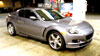
What a shame. I really think that those fenders are one of the best parts of what I see as a work of art (hence my avatar). I suppose Mazda could have made the RX-8 look just like the 350Z, or S2000, or even the Celica (god forbid), but I probably wouldn't have looked twice if they had.
North County Boi
Joined: Sep 2003
Posts: 232
Likes: 0
From: The OC
Re: New York Times Review of the RX-8
Originally posted by MP3Guy
But while extra doors, seats and trunk space may make the RX-8 easier to live with, they don't necessarily make it cool. After all, practicality is not what sells sports cars - or even, often, trucks.
But while extra doors, seats and trunk space may make the RX-8 easier to live with, they don't necessarily make it cool. After all, practicality is not what sells sports cars - or even, often, trucks.
I drove the 350Z and felt incredibly crampt and soon realized that my backpack full of college sized text books wouldn't fit in the "trunk" of the Z and I would be using the passenger seat more often for storage than for a passenger.
Practicality is what sold me on this sports car.

Registered
Joined: Dec 2003
Posts: 235
Likes: 0
From: San Diego
On the styling issue, beauty is obviously in the eye of the beholder. Just look at how many of those paintings of Elvis on black velvet got sold.
For me, the current Nissan/Infiniti use of the strong horizontal lines at the front of their cars was enough by itself to start both the 350Z and the G35 coupe off at a disadvantage to the 8.
Could the 8 be prettier? Yeah, probably. But I think it's the hands-down winner against the cars most often listed as its competition.
For me, the current Nissan/Infiniti use of the strong horizontal lines at the front of their cars was enough by itself to start both the 350Z and the G35 coupe off at a disadvantage to the 8.
Could the 8 be prettier? Yeah, probably. But I think it's the hands-down winner against the cars most often listed as its competition.
Registered User
Joined: Mar 2004
Posts: 354
Likes: 0
From: SW Missouri
Originally posted by revhappy
I think a 2 door (with a little shorter wheelbase and roofline) would be the best looking car south of $40K!
I think a 2 door (with a little shorter wheelbase and roofline) would be the best looking car south of $40K!

Let me guess, you're one of those guys on the edge of your seat waiting for the next RX-7?
I love the styling of the '8, freestyle doors and all. I liked the car the instant I saw one on the dealer's lot, even before I knew who made it or anything about it.

Thread
Thread Starter
Forum
Replies
Last Post
Mxttz0r
New Member Forum
34
Jul 5, 2019 03:19 AM
dbarber
Series I Trouble Shooting
14
Jul 25, 2015 01:34 PM
thedragonrotar
New Member Forum
1
Jul 22, 2015 08:46 PM