


Autoblog article: Next Renesis direct injection?


Thread Starter
Registered
Joined: Apr 2006
Posts: 335
Likes: 0
From: Ohio
Autoblog article: Next Renesis direct injection?
Did a quick search but didn't see this posted. Patent drawings and the original request! Yow...lots to digest. Discuss. 
http://www.autobloggreen.com/2009/05...ect-injection/
http://www.autobloggreen.com/2009/05...ect-injection/
Last edited by Groundrush; May 21, 2009 at 08:10 PM. Reason: Fixed a typo


Registered
Joined: Jun 2007
Posts: 1,134
Likes: 1
From: Sheboygan Falls, Wisconsin
I sure hope this thing can make it into production before it's too late. (relative to the cost of gas) Unfortunately, I'm starting to lean towards the pessimistic side for a more powerful rotary.


Registered
Joined: Apr 2005
Posts: 654
Likes: 4
The inventor found that parameter L/b (aspect ratio) is a critical parameter for improvement in combustion stability, where L is the length of one side of the generally-triangular face of the rotor (i.e., the longitudinal length of a generally-rectangular flank surface of the rotor) and b is the breadth (the lateral length of the flank surface)...
Due to the structure of the rotary piston [sic] engine, the speed of propagation of the flames in the rotor rotation directions is relatively high while the speed of propagation of the flames in the rotor breadth directions is relatively low as compared with the propagation speed in the rotor rotation directions.
Due to the structure of the rotary piston [sic] engine, the speed of propagation of the flames in the rotor rotation directions is relatively high while the speed of propagation of the flames in the rotor breadth directions is relatively low as compared with the propagation speed in the rotor rotation directions.
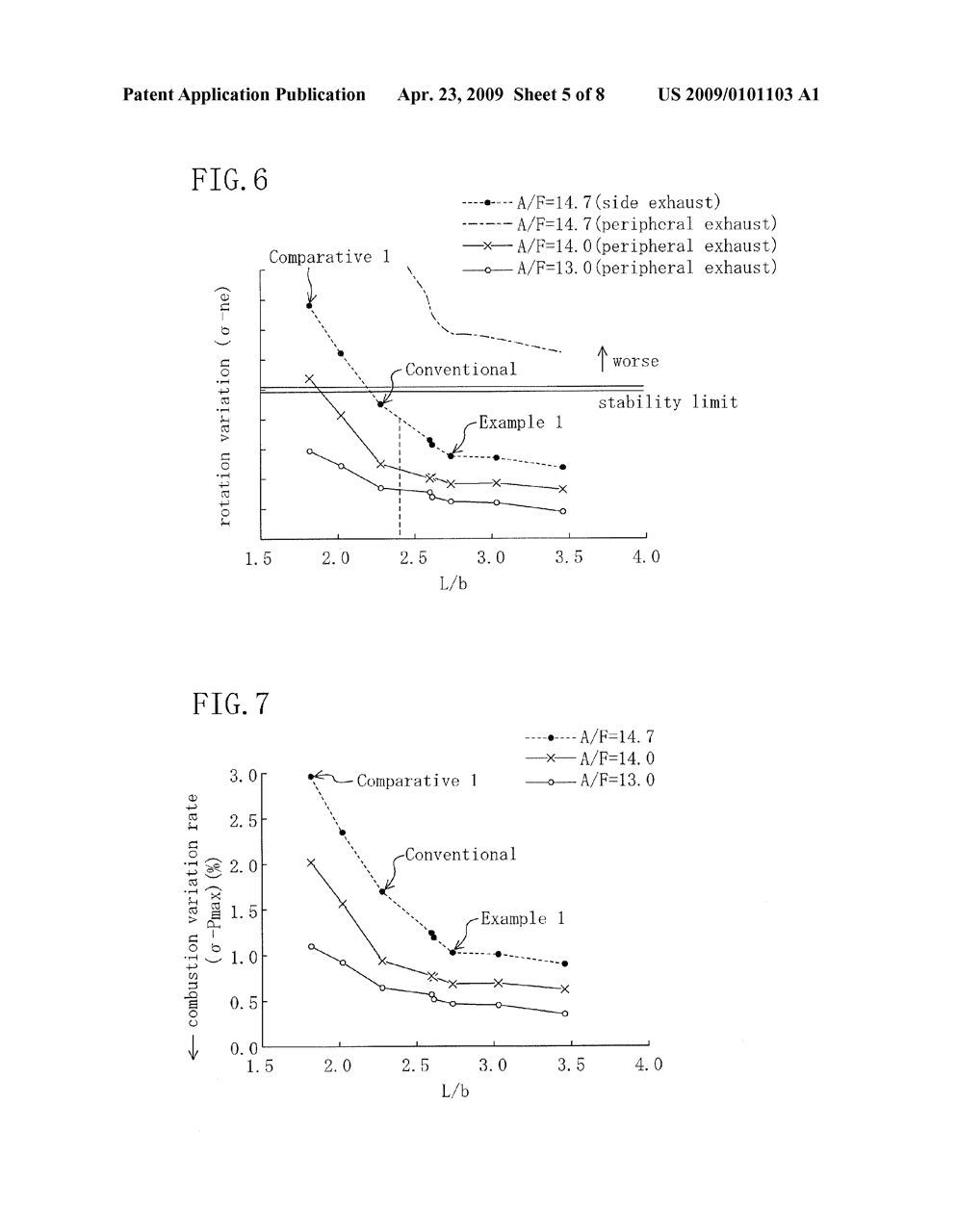
the thinner the rotor the more stable the combustion, up to a point at least
Consider increasing the dimension parameter L/b [as in the 16X]. Increasing the dimension parameter L/b while the displacement is maintained constant corresponds to relatively increasing the length L of one side of the rotor while relatively decreasing the breadth b of the rotor. Namely, the rotor has larger triangular faces but a smaller breadth. Increasing the length L leads to a greater distance between the trailing side spark plug and the leading side spark plug so that the time before the collision of the flames becomes longer.
[0017]Due to the longer time before the collision of the flames and the decreased breadth b, the T-side flame and L-side flame propagating in the rotor breadth directions reach the side housing before the collision of the flames occurs. After the flames reach the side housing, the pressure in the vicinity of the side housing increases so that the flames are redirected to propagate in the rotor rotation directions. As a result, the propagation of the flames in the rotor rotation directions is enhanced. Thereafter, the T-side flame and L-side flame propagating in the rotor rotation directions collide with each other.
[0018]As the combustion stability is improved by increasing the dimension parameter L/b, improvement in the combustion pattern in the working chamber is also expected.
[0017]Due to the longer time before the collision of the flames and the decreased breadth b, the T-side flame and L-side flame propagating in the rotor breadth directions reach the side housing before the collision of the flames occurs. After the flames reach the side housing, the pressure in the vicinity of the side housing increases so that the flames are redirected to propagate in the rotor rotation directions. As a result, the propagation of the flames in the rotor rotation directions is enhanced. Thereafter, the T-side flame and L-side flame propagating in the rotor rotation directions collide with each other.
[0018]As the combustion stability is improved by increasing the dimension parameter L/b, improvement in the combustion pattern in the working chamber is also expected.
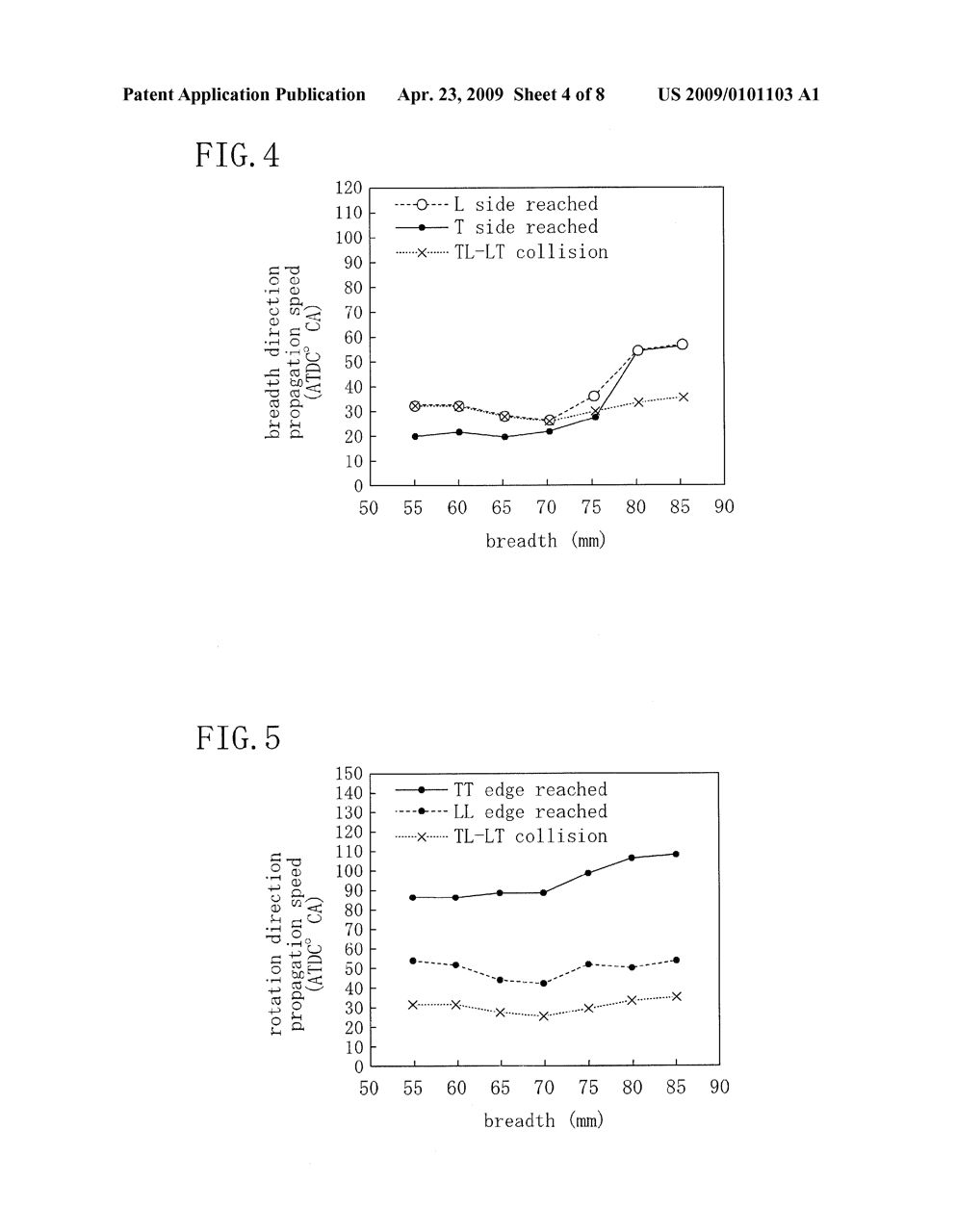
Mazda played around with the width of the rotor to see what dimensions would be optimal for the speed of the flame in the combustion chamber. You have to think about it three-dimensionally. You don't want the leading and trailing flames to collide too soon, or the flames won't spread out toward the side housings quickly enough for complete combustion.
Last edited by arghx7; May 22, 2009 at 09:00 AM.

Registered
Joined: Apr 2003
Posts: 9,134
Likes: 26
From: Houston
I was about to comment on that. The narrower rotor allows the flame front from each plug to reach the sides of the rotors before their flame fronts combine. This allows a stable and more complete combustion and a decrease in fuel consumption which is interesting. If the flame fronts collide before the flame travel has reached the sides of the rotors, the interference is destructive.
I did find another interesting thing buried in there. They have 2 different rotary engine sizes!!! One of them has a 70mm wide rotor which is what a 12A was and the other has a 76mm wide rotor. The Renesis by comparison is 80mm. There are also 2 different dimensions given for two different spacings between the leading and trailing plugs which reinforces this. What are they working on right now that dictates 2 different engines? Perhaps the smaller one is for a hybrid?
They also show an idle rpm of 850 and mention that they can achieve complete combustion stability at 14.7:1 afr's at idle as opposed to richer.
I did find another interesting thing buried in there. They have 2 different rotary engine sizes!!! One of them has a 70mm wide rotor which is what a 12A was and the other has a 76mm wide rotor. The Renesis by comparison is 80mm. There are also 2 different dimensions given for two different spacings between the leading and trailing plugs which reinforces this. What are they working on right now that dictates 2 different engines? Perhaps the smaller one is for a hybrid?
They also show an idle rpm of 850 and mention that they can achieve complete combustion stability at 14.7:1 afr's at idle as opposed to richer.
Registered
Joined: Apr 2005
Posts: 654
Likes: 4
"[0032]The designing method may further include the step of determining a maximum permissible number of revolutions of the rotor, wherein the length of one side of the triangular face of the rotor is determined based on the maximum permissible number of revolutions such that the length of one side of the triangular face of the rotor is greater as the maximum permissible number of revolutions is smaller.
[0033]Increasing the length of one side of the generally triangular face of the rotor means that the size of the rotor is accordingly increased. As a result, the sliding speed of each apex of the rotor to which the apex seal is attached is increased. Therefore, the restriction on the sliding speed then defines the maximum permissible number of revolutions of the rotor. Thus, the upper limit of the length of one side of the triangular face of the rotor may be defined by its maximum permissible number of revolutions. "
[0033]Increasing the length of one side of the generally triangular face of the rotor means that the size of the rotor is accordingly increased. As a result, the sliding speed of each apex of the rotor to which the apex seal is attached is increased. Therefore, the restriction on the sliding speed then defines the maximum permissible number of revolutions of the rotor. Thus, the upper limit of the length of one side of the triangular face of the rotor may be defined by its maximum permissible number of revolutions. "
Registered
Joined: Apr 2003
Posts: 9,134
Likes: 26
From: Houston
That reinforces a hunch I had back when we first started talking about the 16X last year. I said that I thought it would probably have a lower redline than the current engine. While this doesn't directly say that, it does say that the "taller" rotor can't ultimately rev as high. I would say the vehicle redline would probably reflect this though.
One downside to a higher redline is decreased low end power and worse fuel economy at cruising speeds. Everything is a tradeoff.
One downside to a higher redline is decreased low end power and worse fuel economy at cruising speeds. Everything is a tradeoff.

This article is very pleasing. It's the type of evidence of activity that we need to see. The technical aspects are cool as well. They must not be currently considering the third spark plug although I haven't read the whole article (Bean counters?).
Paul.
Paul.

Huge hole is huge
Joined: Feb 2008
Posts: 3,191
Likes: 1
From: Joplin, MO
This is good news. I understand next to nothing in the article, but you guys talking amongst yourselves is helping!
*EDIT* In that patent diagram, I wonder if that distance between the plugs is depicted there.
*EDIT2* That first edit made NO sense. What I meant to say was in that diagram, is the distance between the plugs shown to us what is going to be in the final design, or does that look more like the stock distance? I can't entirely visualize it, because I don't know how much more they are extending+the size difference of the rotor housing.
*EDIT* In that patent diagram, I wonder if that distance between the plugs is depicted there.
*EDIT2* That first edit made NO sense. What I meant to say was in that diagram, is the distance between the plugs shown to us what is going to be in the final design, or does that look more like the stock distance? I can't entirely visualize it, because I don't know how much more they are extending+the size difference of the rotor housing.
Last edited by CyberPitz; May 22, 2009 at 11:03 AM.
Registered
Joined: Apr 2003
Posts: 9,134
Likes: 26
From: Houston
Looking at figure 5 it would appear that the best rotor width (per new rotor diameter) would be 70mm. I wonder what they are working on which has the 76mm dimension that they have listed elsewhere in the paper? Would that mean an even larger engine than the 16X?

Registered
Joined: Dec 2003
Posts: 1,932
Likes: 0
From: Hunterdon County
I've also been wondering about the placement of the injectors since they first showed the 16x model. Wouldn't they get more benefit from DI by placing the injectors closer to the spark? Less condensation of fuel on the chamber walls, more complete combustion. Now I'm wondering if their trying to create more turbulence for better a/f mix. Apologies if that doesn't make much sense--I only had 1 year and two days of engineering.

Momentum Keeps Me Going
Joined: Sep 2002
Posts: 5,036
Likes: 5
From: Colorado
Last October, it seems that Mazda quietly filed a patent for a twin-spark, direct injection version of the automaker's iconic rotary engine. It's taken this long for anyone to actually notice application 20090101103, which appears to have been approved just last month,
Registered
Joined: Apr 2003
Posts: 9,134
Likes: 26
From: Houston
I've also been wondering about the placement of the injectors since they first showed the 16x model. Wouldn't they get more benefit from DI by placing the injectors closer to the spark? Less condensation of fuel on the chamber walls, more complete combustion. Now I'm wondering if their trying to create more turbulence for better a/f mix. Apologies if that doesn't make much sense--I only had 1 year and two days of engineering.
I noticed while reading 0015-0016 they discuss the Length and Breadth of the rotor as being longer and narrower. So this I am assuming is going to be the 16X engine. If that's the case then I would think Mazda is ready for production.

Wiseguy
Joined: Aug 2008
Posts: 1,084
Likes: 37
From: Italy
I did find another interesting thing buried in there. They have 2 different rotary engine sizes!!! One of them has a 70mm wide rotor which is what a 12A was and the other has a 76mm wide rotor. The Renesis by comparison is 80mm. There are also 2 different dimensions given for two different spacings between the leading and trailing plugs which reinforces this. What are they working on right now that dictates 2 different engines? Perhaps the smaller one is for a hybrid?
I bet one pint that the first "real" Mazda hybrid (gasoline run and for mass market) it will be rotary powered.
a serial hybrid.....and not a of Prius , Insight or Volt size...a larger and more luxiorious car....
remember this phrase of Seita Kanai (Mazda R&D chief)
"the challenge (on hybrids n.d.r.) is the appeal of the car itself"
Big question...WHEN?
Last edited by MattMPS; May 22, 2009 at 02:32 PM.
I really don't see a benefit to that. As the new design seems to be maximizing combustion with the narrower/longer rotor size.
Registered
Joined: Apr 2003
Posts: 9,134
Likes: 26
From: Houston
The 2nd gens worked that way. The leadings of each rotor fired at the same time as each other. They had one coil with 2 posts. This was called wasted spark but the "waste" spark was just that. It fired in the exhaust cycle of the other rotor to clean up some leftover emissions.
The thing about the 2 engine sizes that I noticed is that the 16X has to be the SMALLER of the dimensions listed which means there is probably a 2.0L rotary that is being worked on too. That's just speculation of course.
The thing about the 2 engine sizes that I noticed is that the 16X has to be the SMALLER of the dimensions listed which means there is probably a 2.0L rotary that is being worked on too. That's just speculation of course.

Registered
Joined: Jan 2006
Posts: 94
Likes: 2
The 2nd gens worked that way. The leadings of each rotor fired at the same time as each other. They had one coil with 2 posts. This was called wasted spark but the "waste" spark was just that. It fired in the exhaust cycle of the other rotor to clean up some leftover emissions.
On my own 2nd gen, I've seen cases where I'll check the timing on one of the leading wires and spark will be 180 degrees off, then check it on the other, and it's dead-on. If both wires were getting the same current/voltage through them, I'd expect to see 2x the number of flashes on the timing light with half of them being 180 degrees out.
I've seen some people claim that it makes a difference in power, but I've never seen proof of that.
Ken
Thread Starter
Registered
Joined: Apr 2006
Posts: 335
Likes: 0
From: Ohio
Mmm...that would be so nice...let's hope you're right. Unless I missed it, I didn't really see any specifics in the files that speaks to the direct injection feature. It just seems to be more focused on the size of the rotor and the spacing of the spark plugs. Maybe I need to go back and read it again...
Registered
Joined: Apr 2003
Posts: 9,134
Likes: 26
From: Houston
Actually, due to the fact that fully or even mostly burnt fuel is ionized gas, the "wasted" spark probably isn't even actually a "spark" at all... The gas that's there will pass a current pretty easily. This means the "wasted" part of "wasted spark" isn't the misnomer, the "spark" part is.
On my own 2nd gen, I've seen cases where I'll check the timing on one of the leading wires and spark will be 180 degrees off, then check it on the other, and it's dead-on. If both wires were getting the same current/voltage through them, I'd expect to see 2x the number of flashes on the timing light with half of them being 180 degrees out.
I've seen some people claim that it makes a difference in power, but I've never seen proof of that.
Ken
On my own 2nd gen, I've seen cases where I'll check the timing on one of the leading wires and spark will be 180 degrees off, then check it on the other, and it's dead-on. If both wires were getting the same current/voltage through them, I'd expect to see 2x the number of flashes on the timing light with half of them being 180 degrees out.
I've seen some people claim that it makes a difference in power, but I've never seen proof of that.
Ken
Both leadings are firing off of the same coil so they have to both fire at the same time. The leading coil is a single coil with 2 posts. It is the exact same as a trailing coil with an extra post added. It is physically impossible for a 2nd gen leading coil to fire front and rear rotors independently of each other. It can't. There's only 1 coil.
You do see 2X the number of leading flashes when comparing it to the trailing plugs. That's because the trailing plugs do alternate. The leadings don't as they can't. The leading plugs do fire every 180 degrees. Each trailing plug only fires every 360 degrees but 180 degrees off from each other. T1 is what lines up with the timing marks on the pulley. If you try to measure trailing timing with the T2 lead, you won't see the marks. They'll be 180 degrees off.
When you are checking timing with the leading plugs, the flashes light up the timing marks AND 180 degrees off from them. You still see the marks though so it's useful. The T1 lead will only light up the timing marks and not the other side of the pulley and the T2 lead will only light up 180 degrees off from the marks and not the marks themselves.
To further confuse things, if you car is idling too low you won't see any trailing timing as the trailing coils will shut off!

Super Moderator
Joined: Apr 2005
Posts: 10,880
Likes: 340
From: Australia
We were only talking 16X and 13A similarities a few days ago..
Seeing you have two 13A housings there you could measure the distance between the two spark plugs...it should be greater than a 13B and more like the 16X?
And yes if Mazda use the 60 mm Apex seals in a 13A long stroke for 1310CC
Then 70 mm (12A size) would be the 16X.
A 76mm seal .... a 17 or 18X..that is a LARGE rotor.
Ash