


I don't understand...is this rotary design wasting power this way?


Thread Starter
Drop it into 3rd
Joined: Mar 2008
Posts: 462
Likes: 0
From: Chicago
I don't understand...is this rotary design wasting power this way?
When I look at a picture of a rotary engine, there is something I don't understand.
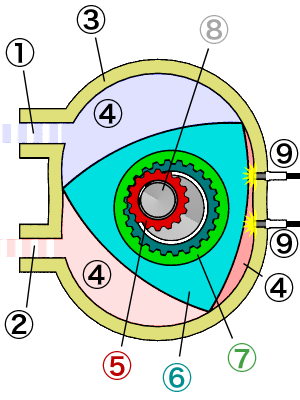
At the ignition, the gas expands, but it looks to me as though some of the energy is directed perpendicular to the desired direction, some of the force looks as if it is traveling straight left from the spark plugs. It looks to me as if much of the useful energy is being absorbed by the shaft and the rotors only turn with the resultant power that has nowhere else to go.
I have a feeling there is something I'm missing, can anyone tell me?
At the ignition, the gas expands, but it looks to me as though some of the energy is directed perpendicular to the desired direction, some of the force looks as if it is traveling straight left from the spark plugs. It looks to me as if much of the useful energy is being absorbed by the shaft and the rotors only turn with the resultant power that has nowhere else to go.
I have a feeling there is something I'm missing, can anyone tell me?
Last edited by Falken; May 17, 2008 at 01:17 AM.



Thread Starter
Drop it into 3rd
Joined: Mar 2008
Posts: 462
Likes: 0
From: Chicago
That's originally what I thought, and it definitely helps, but I don't think there is any way to avoid significant energy loss through the shaft. I have been trying to draw a newly shaped rotor/chamber design that would better avoid this problem, but I'm coming up empty.

Registered
Joined: Aug 2006
Posts: 5,027
Likes: 5
From: Northern Virginia
This geometry isn't all that different from a piston engine near TDC, when the crank is pointing straight up. Not much leverage right then, and it's not the point where power is transmitted to the output. The air/fuel mixture is burning and building pressure, not expanding much right at that time.
Power is transmitted to the shaft during the stroke as the volume of the burned mixture expands.
The Wankle never has a position with great leverage, like a piston engine at 90 degrees after TDC, which is why they're not known for torque. (Just like short stroke piston engines aren't torque monsters.) But the power that you get out them is still the energy associated with the burned mixture expanding through its volume, just like in a piston engine. The Wankel's inefficiency comes from the surface areas involved with the combustion chamber and the separate intake and compression regions.
Ken
Power is transmitted to the shaft during the stroke as the volume of the burned mixture expands.
The Wankle never has a position with great leverage, like a piston engine at 90 degrees after TDC, which is why they're not known for torque. (Just like short stroke piston engines aren't torque monsters.) But the power that you get out them is still the energy associated with the burned mixture expanding through its volume, just like in a piston engine. The Wankel's inefficiency comes from the surface areas involved with the combustion chamber and the separate intake and compression regions.
Ken
Thread Starter
Drop it into 3rd
Joined: Mar 2008
Posts: 462
Likes: 0
From: Chicago
This geometry isn't all that different from a piston engine near TDC, when the crank is pointing straight up. Not much leverage right then, and it's not the point where power is transmitted to the output. The air/fuel mixture is burning and building pressure, not expanding much right at that time.
Power is transmitted to the shaft during the stroke as the volume of the burned mixture expands.
The Wankle never has a position with great leverage, like a piston engine at 90 degrees after TDC, which is why they're not known for torque. (Just like short stroke piston engines aren't torque monsters.) But the power that you get out them is still the energy associated with the burned mixture expanding through its volume, just like in a piston engine. The Wankel's inefficiency comes from the surface areas involved with the combustion chamber and the separate intake and compression regions.
Ken
Power is transmitted to the shaft during the stroke as the volume of the burned mixture expands.
The Wankle never has a position with great leverage, like a piston engine at 90 degrees after TDC, which is why they're not known for torque. (Just like short stroke piston engines aren't torque monsters.) But the power that you get out them is still the energy associated with the burned mixture expanding through its volume, just like in a piston engine. The Wankel's inefficiency comes from the surface areas involved with the combustion chamber and the separate intake and compression regions.
Ken
Last edited by Falken; May 17, 2008 at 11:58 AM.
Registered
Joined: Aug 2006
Posts: 5,027
Likes: 5
From: Northern Virginia
You really need to consider the entire power stroke, not just what happens at one position. Think about Diesels, where all the combustion takes place close to TDC.
Ken

Lubricious
Joined: Oct 2003
Posts: 3,425
Likes: 4
From: SF Bay Area, California

Due to the necessary geometry, elongated rotors would simply mean a larger rotor housing, and a larger engine. Very large rotary engines have been built, but they suffer the same fundamental issue -- the combustion zone is moving. The larger the rotary engine the lower the rpm because otherwise the air/fuel mixture moves faster than the flame front can propagate.
From your last question I get the feeling that you are thinking of force being directed outward from the spark plug. The plug simply begins the combustion process. The location and timing of that initial spark have to take into account the movement that occurs. This is already timed in such a way as to optimize the energy transfer as the rotor continues its movement and the gasses burn and expand.
Thread Starter
Drop it into 3rd
Joined: Mar 2008
Posts: 462
Likes: 0
From: Chicago
The force that is perpendicular has nowhere to go because the rotor can't move that way. Work only occurs if there is movement -- i.e., force through a distance. The rotor does move, and the energy of combustion drives that movement. Consider a piston. There's plenty of force against the cylinder walls trying to expand the cylinder. That energy is not wasted when the cylinder refuses to expand.
Due to the necessary geometry, elongated rotors would simply mean a larger rotor housing, and a larger engine. Very large rotary engines have been built, but they suffer the same fundamental issue -- the combustion zone is moving. The larger the rotary engine the lower the rpm because otherwise the air/fuel mixture moves faster than the flame front can propagate.
From your last question I get the feeling that you are thinking of force being directed outward from the spark plug. The plug simply begins the combustion process. The location and timing of that initial spark have to take into account the movement that occurs. This is already timed in such a way as to optimize the energy transfer as the rotor continues its movement and the gasses burn and expand.
Due to the necessary geometry, elongated rotors would simply mean a larger rotor housing, and a larger engine. Very large rotary engines have been built, but they suffer the same fundamental issue -- the combustion zone is moving. The larger the rotary engine the lower the rpm because otherwise the air/fuel mixture moves faster than the flame front can propagate.
From your last question I get the feeling that you are thinking of force being directed outward from the spark plug. The plug simply begins the combustion process. The location and timing of that initial spark have to take into account the movement that occurs. This is already timed in such a way as to optimize the energy transfer as the rotor continues its movement and the gasses burn and expand.


Thread
Thread Starter
Forum
Replies
Last Post
Audio Concepts ATL
New Member Forum
21
Sep 26, 2021 01:59 PM
RAVSPEC
Vendor Classifieds
0
Aug 5, 2015 02:53 PM
thedragonrotar
New Member Forum
1
Jul 22, 2015 08:46 PM
