


5W30 Oil Don't Cut it, Engine Bearing Pics 58K S1 RX-8 from England.


Registered
Joined: Dec 2007
Posts: 863
Likes: 0
From: UK
You shouldn't do B, because the oil then takes so long to warm through that you end up doing even more damage through reduced flow than you would if you just drove off and kept the throttle openings/rpms sensible and go he oil up to temperature quicker.
3-wheeler
Joined: Dec 2005
Posts: 2,734
Likes: 1
From: Phoenix
Even if (and I say if only because I'm not certain myself) our oil pump is positive displacement and pumps a fixed volume at a particular RPM, increases in pressure will result in cavitation. The less pressure you have on the system the better your flow and little risk of cavitation. With heavier viscosity oils at startup you're talking about trying to push pretty thick liquid through the motor.
Again, this isn't a "use 0w or you'll blow up" kind of argument. It's more or less that if you have the option to use a 0w oil within your viscosity range then go for it. Currently I'm using Eneos fluids and they don't have a 0w variant in their 30 weight or 40 weight viscosity range. So I'll be using a 5w which will be fine as well.
For anyone who is lurking or just unsure, these arguments are not going to be a factor of whether your rotary engine sees 50,000 miles or not. Any oil will keep this motor running. I'm looking at 100,000+ miles and the ability to reuse most if not all your parts during a rebuild. I want to rebuild my motor before I hit 120,000 miles and I don't have $5,000 to do it. Once it is rebuilt, I expect another 100,000+ miles out of it. This is where my thinking is.

Paul.

This is what I've been saying for decades (Whew, I'm showing my age!). Start your car and drive mildly. Sitting around in accelerated warm-up/enrichment mode is not ideal. The low winter vis numbers are partially to facilitate people who are going to start a car and apply too much load and throttle immediately and are un-necessary in most climates.
Paul.
Paul.

and in case you havent notice, from time to time there are Dumbasses who just ask "is 5w20 good enough for this car" ? and guess what, there are people in this thread "still" support 5w20 idea "not so long ago."

I installed my oil temp gauge Saturday and I am really, really surprised how long it takes to get to even 170 degrees or so and this in Texas in 65-70 degree weather. I let my car warm up to 150 (Water Temp) before I start moving and even after a 6 mile leisurely drive home (mostly highway 70MPH) my oil temp was barely at 170 degrees.
3-wheeler
Joined: Dec 2005
Posts: 2,734
Likes: 1
From: Phoenix
so? I just want to "make sure" people knows that 5w20 is garbage,
and in case you havent notice, from time to time there are Dumbasses who just ask "is 5w20 good enough for this car" ? and guess what, there are people in this thread "still" support 5w20 idea "not so long ago."
and in case you havent notice, from time to time there are Dumbasses who just ask "is 5w20 good enough for this car" ? and guess what, there are people in this thread "still" support 5w20 idea "not so long ago."
Either way, I've pretty much laid out the case for not using any 20 weight oil in the RX8.

Registered User
Joined: Apr 2009
Posts: 239
Likes: 0
From: michigan
Yes, there will be reduced flow but I highly doubt there is an oiling issue under idling "warm up" conditions anyways. Of course, the oil viscosity is the most important variable here.
Even if (and I say if only because I'm not certain myself) our oil pump is positive displacement and pumps a fixed volume at a particular RPM, increases in pressure will result in cavitation. The less pressure you have on the system the better your flow and little risk of cavitation. With heavier viscosity oils at startup you're talking about trying to push pretty thick liquid through the motor.
This is what I've been saying for decades (Whew, I'm showing my age!). Start your car and drive mildly. Sitting around in accelerated warm-up/enrichment mode is not ideal. The low winter vis numbers are partially to facilitate people who are going to start a car and apply too much load and throttle immediately and are un-necessary in most climates.
I'm also with you on the expectations out of my car. I'm hoping it will be fine all of next season (and I think it will be 80k+ miles on original engine) and then maybe I'll rebuild it and supercharge after that.
Paul.
I'm also with you on the expectations out of my car. I'm hoping it will be fine all of next season (and I think it will be 80k+ miles on original engine) and then maybe I'll rebuild it and supercharge after that.
Paul.
You also reinforced my thoughts about low cold viscosity oils. I would imagine that a 15W-40 with several minutes of idle warm up is already providing significant more protection than a cold engine running 0W. I think i'm just realistically trying to figure out whether 10W or 15W is even in issue in fairly cold climates, as long as you take the proper precautions.
You also reinforced my thoughts about low cold viscosity oils. I would imagine that a 15W-40 with several minutes of idle warm up is already providing significant more protection than a cold engine running 0W. I think i'm just realistically trying to figure out whether 10W or 15W is even in issue in fairly cold climates, as long as you take the proper precautions.
This is why I am liking Redline 5w30 - it's lighter than 15w40 when the oil is still in the warming phase, which means it will be more forgiving of the occasional trangression of the "full warm up" rule, but yet it has the same protection of dino 15w40 when the oil is up to temp. Seems like a win-win scenario, other than cost, of course.
Phillip, your comments about cavitation being inevitable would explain why it is more common to see foam on the dipstick in the winter vs. summer, no?

and herein is another one of the problems. imho a lot of rx8's out there do not have oil pressure and oil temps gauges. So they go by the engine coolant gauge in determining whether or not the engine is "warm". Those of us with gauges know that after that 1st warm up period of the day, the engines oem gauge is will show normal operating temperture BUT the oil temps will not be barely 140F. So the 9K rpm range could have a "green light" as the driver is thinking the engine is good and warm, but the oil is actually not hot enough to handle that high of a rpm range. Thats a problem.
Heck- now that the temps have cooled in Ga, on a morning when it is 60F, it takes me a good 5 miles to get the oil temps up to 160F.
It would be really trick to have thermostaticly controlled oil cooler doors for a quicker oil warm up.
OD
Heck- now that the temps have cooled in Ga, on a morning when it is 60F, it takes me a good 5 miles to get the oil temps up to 160F.
It would be really trick to have thermostaticly controlled oil cooler doors for a quicker oil warm up.
OD
I guess the important question is - what are the failure modes to reving the motor when the oil is too thick? In general, cavitation is the answer, but you can get cavitation in the pump and the bearing, correct?
Cavitating at the pump is bad, presumably, because it results in a reduction in oil flow rate. Of course, if the oil isn't fully up to temp yet, this may not be a bad thing, as long as there is sufficient oil to keep an uninterrupted flow to the bearings.
Cavitation at the bearing, if it happens, seems much worse.
Anybody have any insight into this?
Cavitating at the pump is bad, presumably, because it results in a reduction in oil flow rate. Of course, if the oil isn't fully up to temp yet, this may not be a bad thing, as long as there is sufficient oil to keep an uninterrupted flow to the bearings.
Cavitation at the bearing, if it happens, seems much worse.
Anybody have any insight into this?

Registered
Joined: Sep 2009
Posts: 250
Likes: 1
From: SF Bay Area
This is why I am liking Redline 5w30 - it's lighter than 15w40 when the oil is still in the warming phase, which means it will be more forgiving of the occasional trangression of the "full warm up" rule, but yet it has the same protection of dino 15w40 when the oil is up to temp. Seems like a win-win scenario, other than cost, of course.

Thread Starter
Super Moderator
Joined: Apr 2005
Posts: 10,880
Likes: 340
From: Australia
You have to look at it from a Factory and Dealer point of view with guages.
As we know there can be a 8C ( 14 F) variation in engine coolant temps (at water pump) before and after cooling fans cut in, imagine if this info was shown on a dash guage?..
You would have the noobs visiting Dealers in droves..
Same goes for the lame Oil Pressure Guage (now deleted in S2).
But this has always been the way with Mazda's and many other cars (most).
As we also know most of the "Real" info is there is you have an OBD reader.
What I would like to see (soon) are manufacturers who mainstream Diagnostic Info in real time on your dash with a switching/programming option for "advanced" owners.
As we know there can be a 8C ( 14 F) variation in engine coolant temps (at water pump) before and after cooling fans cut in, imagine if this info was shown on a dash guage?..
You would have the noobs visiting Dealers in droves..
Same goes for the lame Oil Pressure Guage (now deleted in S2).
But this has always been the way with Mazda's and many other cars (most).
As we also know most of the "Real" info is there is you have an OBD reader.
What I would like to see (soon) are manufacturers who mainstream Diagnostic Info in real time on your dash with a switching/programming option for "advanced" owners.
Last edited by ASH8; Nov 17, 2009 at 03:33 PM.
Exactly.
Just a note - a 8C variation is a 14F variation, not 45. There are different conversion scales depending on whether you are doing a scale conversion (i.e. - if it's 8C outside, it's 45F) or a delta conversion (i.e., if it warms up by 8C, it has warmed up by 14F).
George
Just a note - a 8C variation is a 14F variation, not 45. There are different conversion scales depending on whether you are doing a scale conversion (i.e. - if it's 8C outside, it's 45F) or a delta conversion (i.e., if it warms up by 8C, it has warmed up by 14F).
George

I guess the important question is - what are the failure modes to reving the motor when the oil is too thick? In general, cavitation is the answer, but you can get cavitation in the pump and the bearing, correct?
Cavitating at the pump is bad, presumably, because it results in a reduction in oil flow rate. Of course, if the oil isn't fully up to temp yet, this may not be a bad thing, as long as there is sufficient oil to keep an uninterrupted flow to the bearings.
Cavitation at the bearing, if it happens, seems much worse.
Anybody have any insight into this?
Cavitating at the pump is bad, presumably, because it results in a reduction in oil flow rate. Of course, if the oil isn't fully up to temp yet, this may not be a bad thing, as long as there is sufficient oil to keep an uninterrupted flow to the bearings.
Cavitation at the bearing, if it happens, seems much worse.
Anybody have any insight into this?
So, I don't think we have too big of a cavitation situation except those who forget to keep their oil levels topped up (Run too low actually) and the serious racer possibly can. Nobody should redline their car prior to 160deg F and I prefer 180. Redlining a dead cold motor with too thick of an oil would cause a problem but I hope we don't have anyone on this forum so dumb.
Paul.

Surf Hard, Drive Hard
Joined: Feb 2007
Posts: 7,840
Likes: 13
From: Indialantic, Florida
The problem is that the cavitation (Embolism) has to move through to the bearing. If you get off the throttle after causing this cavitation you might be alright however on the race track sometimes conditions like a pickup problem due to some tremendous cornering forces followed by a nice long straightaway with high revs can spell doom for bearings. This does not happen very often for street situations except if you're running low on oil and applying throttle hard after a hard corner. The oil pan baffles are pretty good on the RX8 and so is the pickup design.
So, I don't think we have too big of a cavitation situation except those who forget to keep their oil levels topped up (Run too low actually) and the serious racer possibly can. Nobody should redline their car prior to 160deg F and I prefer 180. Redlining a dead cold motor with too thick of an oil would cause a problem but I hope we don't have anyone on this forum so dumb.
Paul.
So, I don't think we have too big of a cavitation situation except those who forget to keep their oil levels topped up (Run too low actually) and the serious racer possibly can. Nobody should redline their car prior to 160deg F and I prefer 180. Redlining a dead cold motor with too thick of an oil would cause a problem but I hope we don't have anyone on this forum so dumb.
Paul.
^.........never under-estimate people's stupidity.
I've seen threads on people doing exactly this!
These are the same people that never read any manual at all and don't even add any oil until the light comes on.
Then they whine when they F-up their motor.
Yeah......180 degrees if possible, but I wait for at least 170 for sure.
BTW....this is one of the(if not the only) heavily oil related threads I've enjoyed keeping up with.

Last edited by Mazurfer; Nov 17, 2009 at 07:14 PM.

Registered User
Joined: Aug 2009
Posts: 98
Likes: 0
From: Northwest
I installed my oil temp gauge Saturday and I am really, really surprised how long it takes to get to even 170 degrees or so and this in Texas in 65-70 degree weather. I let my car warm up to 150 (Water Temp) before I start moving and even after a 6 mile leisurely drive home (mostly highway 70MPH) my oil temp was barely at 170 degrees.
I have also really enjoyed this thread. I know much more now than I did before I had the R3 about oil pressure, flow vs. viscosity, actual composition of oil, additives, shearing, positive displacement pumps, cavitation, separation pressure etc.etc. Very interesting stuff.
It's also become very clear that without specific training or vast amounts of experience many of the conclusions are conjecture. But I don't see that as a bad thing. It is very motivating to go explore and find adequate technical explanations to confirm or dismiss a point. Ultimately new and more pointed questions are being asked all the time. This is good. More data please.
Last edited by TZ250; Nov 17, 2009 at 08:32 PM.
Thread Starter
Super Moderator
Joined: Apr 2005
Posts: 10,880
Likes: 340
From: Australia
So, I don't think we have too big of a cavitation situation except those who forget to keep their oil levels topped up (Run too low actually) and the serious racer possibly can. Nobody should redline their car prior to 160deg F and I prefer 180. Redlining a dead cold motor with too thick of an oil would cause a problem but I hope we don't have anyone on this forum so dumb.
Paul.
Paul.
I believe there are many RENESIS 1 engines which have suffered either severe Bearing Wear/ Engine failures because Owners failed in checking their Oil levels, like waiting for Low/Oil Light to come on.
Part of the reason why Mazda increase oil pan capacity and an extra or larger Oil Baffle in S2's.
Something I have just found out Guys....
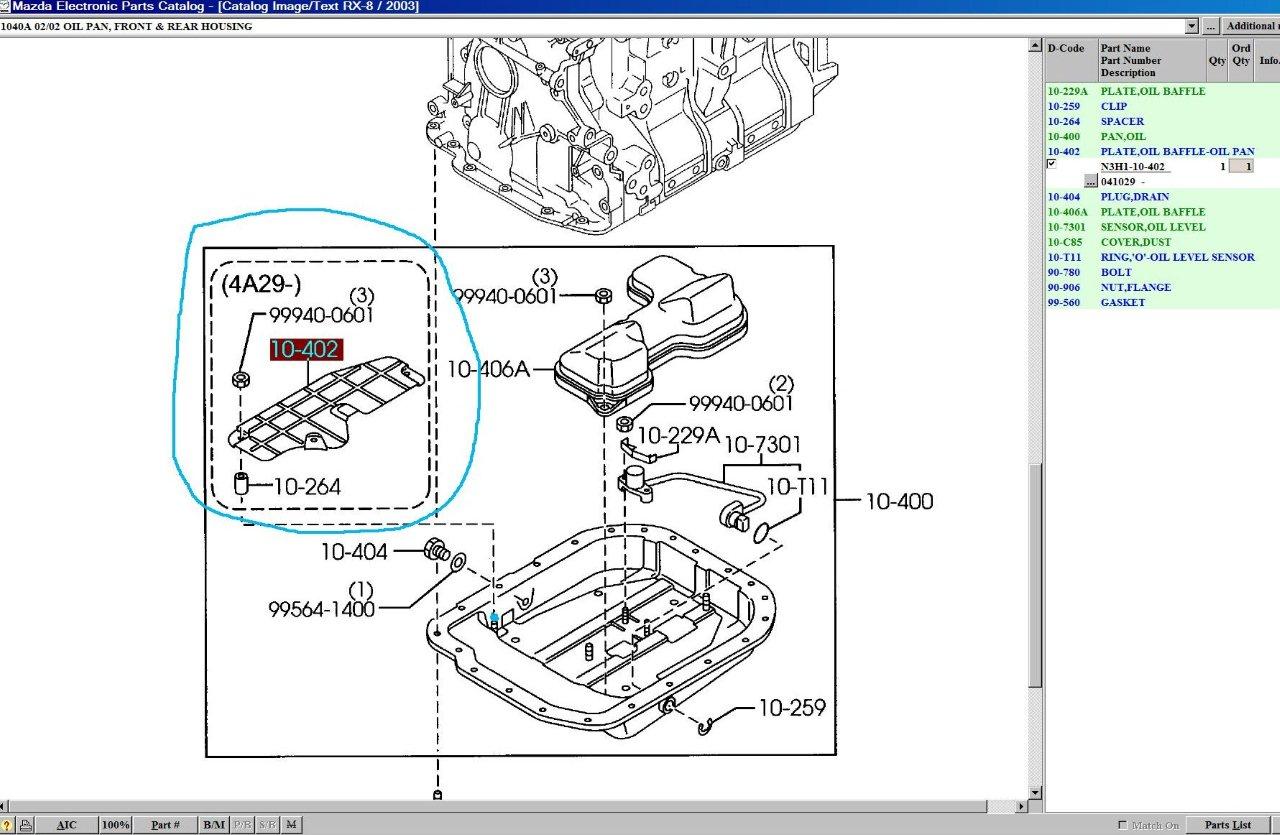
Mazda Introduced an extra Oil Pan Baffle in S1's!!....from a VIN ~..
Mazda Part # N3H1-10-402 Baffle $17.90 MSRP.
With 3 spacers (N3H1-10-264 and nuts..99940-0601)
This extra baffle came in production from October 29Th, 2004.
You may have to replace the Complete Oil Pan as the Mounting Bolts (threads) looks like it is part of and welded to the "revised" Sump/Oil Pan Assembly.
The N3H8-10-4AXD Oil Pan Assembly with ALL baffles and Senor changed at October 29th, 2004, and is the one used right up to the end of 2008 S1's..
Price....is a reasonable $127.83 MSRP.
So I would be seriously looking at at the N3H8-10-4AXD Oil Pan assembly, rather than trying to change to the S2 Oil pan which is around $1000 MSRP.
IF your RX-8 was made after October 29th, 2004 you would already have this extra baffle in your Oil Pan.
Last edited by ASH8; Nov 17, 2009 at 08:36 PM.
Thread Starter
Super Moderator
Joined: Apr 2005
Posts: 10,880
Likes: 340
From: Australia
I think this is a very interesting point. Basically, a 5w-30 running at 170-180F has the same viscosity characteristics as a 5w-40 weight oil at the standard rating temp of 212F. I have not heard anyone say their oil actually runs in the 200+F range on the street. So most of us NA street drivers are running oil at a full viscosity grade higher, or possibly more, than we may believe. Maybe a better way to say this is that the oil performs as if it were a full viscosity grade higher. So a 30 weight, which would run at about 9-12 cSt at 212 is running in the 40 wt 12-16 cSt range in real world operating conditions of around 180F.
I have also really enjoyed this thread. I know much more now than I did before I had the R3 about oil pressure, flow vs. viscosity, actual composition of oil, additives, shearing, positive displacement pumps, cavitation, separation pressure etc.etc. Very interesting stuff.
It's also become very clear that without specific training or vast amounts of experience many of the conclusions are conjecture. But I don't see that as a bad thing. It is very motivating to go explore and find adequate technical explanations to confirm or dismiss a point. Ultimately new and more pointed questions are being asked all the time. This is good. More data please.
I have also really enjoyed this thread. I know much more now than I did before I had the R3 about oil pressure, flow vs. viscosity, actual composition of oil, additives, shearing, positive displacement pumps, cavitation, separation pressure etc.etc. Very interesting stuff.
It's also become very clear that without specific training or vast amounts of experience many of the conclusions are conjecture. But I don't see that as a bad thing. It is very motivating to go explore and find adequate technical explanations to confirm or dismiss a point. Ultimately new and more pointed questions are being asked all the time. This is good. More data please.
Degradation I am talking like, Carbon, Metal, Humidity/Moisture, Fuel wash, Hot and Cold Temperature Cycles, Time, etc.
Thread Starter
Super Moderator
Joined: Apr 2005
Posts: 10,880
Likes: 340
From: Australia
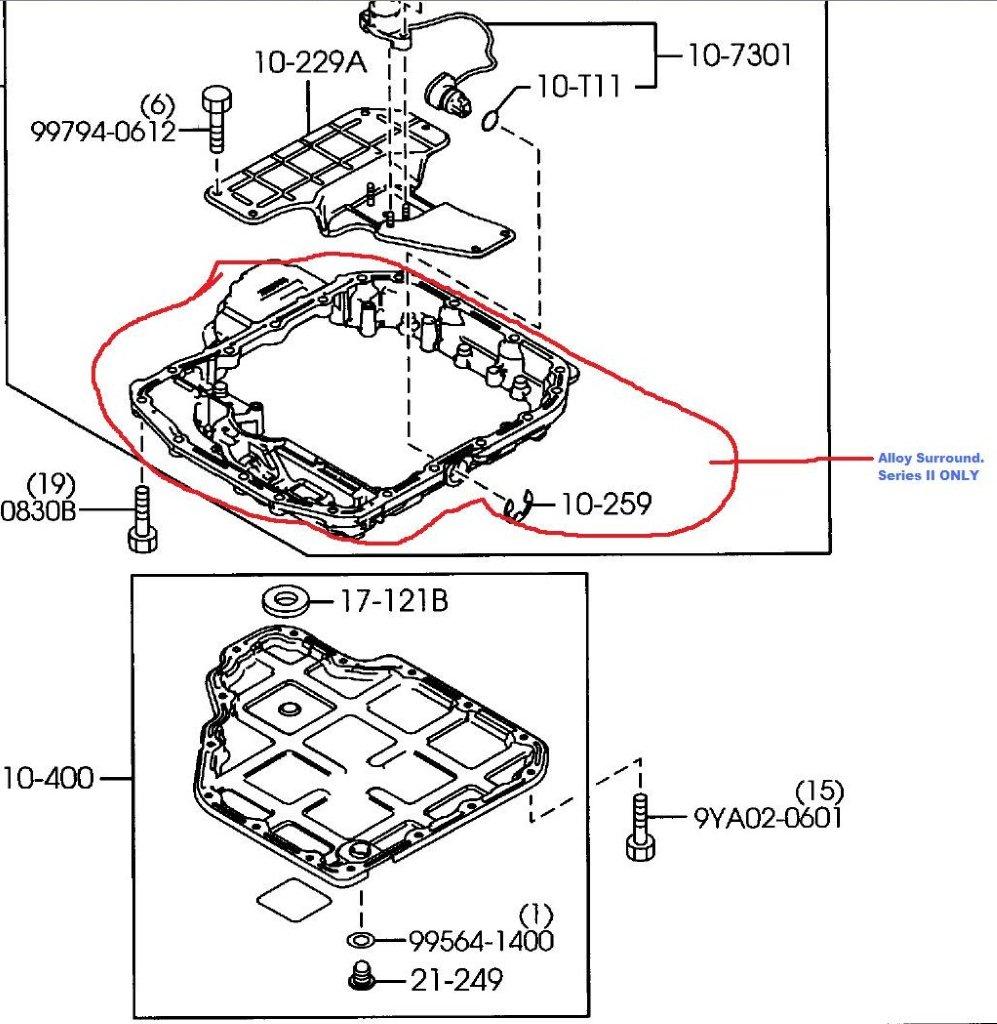
I think we would be talking of a very small number of 2003-Oct 2004, that would not have this "new" S1 ONLY internal baffle (see Above) installed.
Last edited by ASH8; Nov 17, 2009 at 09:05 PM.

