


5W30 Oil Don't Cut it, Engine Bearing Pics 58K S1 RX-8 from England.


on syn--maybe i need to state myself better---i do believe a good syn oil is ok for our cars. I just dont see the cost benefit from the syn versus good dino yet.
Flash I dont understand how a lower viscosity will increase flow? The pump has a fixed volume-- so regardless of the thickness of the oil that volume will be pumped---right? Or are you speaking of the flow through the bearings and drip down stuff?
OD
Flash I dont understand how a lower viscosity will increase flow? The pump has a fixed volume-- so regardless of the thickness of the oil that volume will be pumped---right? Or are you speaking of the flow through the bearings and drip down stuff?
OD

Thread Starter
Super Moderator
Joined: Apr 2005
Posts: 10,880
Likes: 340
From: Australia
I really think it's important to find out the oil pressure range in the new S2 RX-8s, as it might give us a little insight as to what Mazda thinks was the issue in the S1.
But , yes, it would be good to see actual S2 Owner OP info at various RPM's and with different oil weights other than 5W20.
Good info "Flash" BTW, Thank You...I will stick with my 15W40...


I'm increasingly agreeing with you, although I see Redline 5w30 as perhaps an even better solution - similar protection at the bearing (assuming the localized oil temps at the bearing are closer to 150c than 100c) but lower viscosity during the warm-up period.
Of course, this comes at a cost...
Of course, this comes at a cost...

Registered User
Joined: Aug 2009
Posts: 98
Likes: 0
From: Northwest
Well, there are only two ways to increase flow. Decrease viscosity or increase pressure. I honestly believe the aspect of increasing pressure is barking up the wrong tree. You only need to provide enough pressure to keep replacing oil in the bearings. After that any pressure increases have no additional benefits.
Lubrication is used to separate moving parts, to keep them from touching. There is a one to one relationship between flow and separation. If you double the flow you will double the separation pressure in a bearing. The pressure at the bearing entrance is irrelevant.
In fact the relationship between pressure and flow is in opposition. If you change your oil to a thicker formula the pressure will go up. It goes up because the resistance to flow is greater and in fact the flow must go down in order for the pressure to go up. They are inversely related. Conversely if you choose a thinner oil then the pressure will go down. This can only occur if the flow has increased.
It would seem to indicate that lower viscosity, within reason, is better, at least in a plain bearing. Hmmmm..............
Thread Starter
Super Moderator
Joined: Apr 2005
Posts: 10,880
Likes: 340
From: Australia
Oil Weight not a Problem???
Oil Weight or Viscosity CAN have an effect on Oil Pressure and Oil/Engine Temperatures...
I have found from two separate References the Factory Listing for Oil Pressure in the Series I RX-8, and it CONFIRMS what the 09 Service Highlights say.
Keep in mind this S1 Oil Pressure Information was Published back in 2003-4, so I doubt we are seeing "errors" in publications over a 5 year period.
As we can see the S1 OP @ 3000 RPM is 50.8 PSI AT 212 F...
The last page is of S2 OP @ 3000 RPM is 72.5 PSI AT 212 F...
Series 1
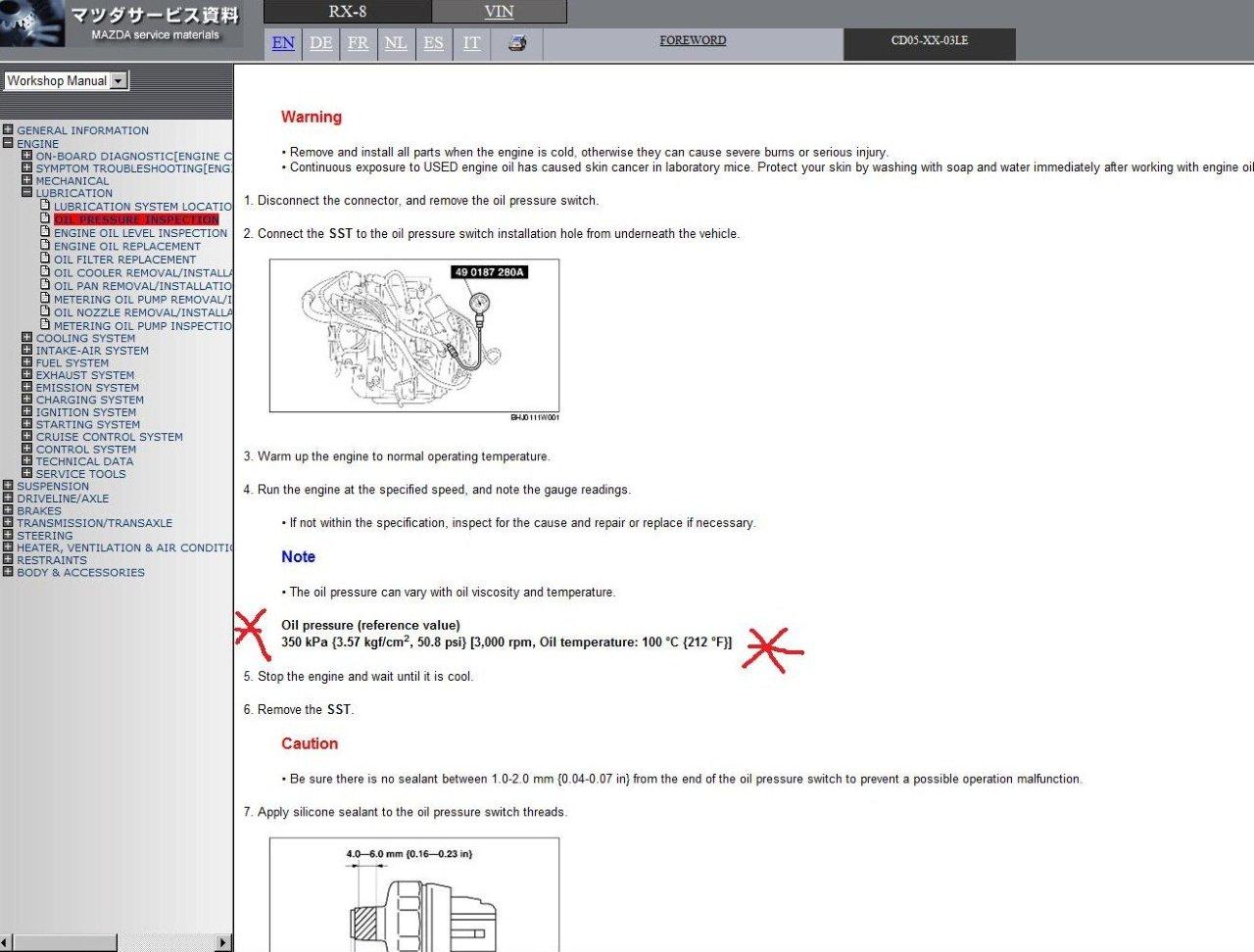
Series 1

Series II

I have found from two separate References the Factory Listing for Oil Pressure in the Series I RX-8, and it CONFIRMS what the 09 Service Highlights say.
Keep in mind this S1 Oil Pressure Information was Published back in 2003-4, so I doubt we are seeing "errors" in publications over a 5 year period.
As we can see the S1 OP @ 3000 RPM is 50.8 PSI AT 212 F...
The last page is of S2 OP @ 3000 RPM is 72.5 PSI AT 212 F...
Series 1
Series 1
Series II

Registered User
Joined: Apr 2009
Posts: 239
Likes: 0
From: michigan
Without having to "chew" over old ground Mazda have recognised and published in their documents that Oil Pressure has increased in Series II's at 3000 RPM by 50% at the rear Oil Intake area when compared to their publicised Series I information, remember at 212F and with 5W20 Oil.
This would help my case where I suggested that low viscosity oil may have been seeing excessive "stress" under the net torque rev range, and causing metal to metal impact. Unless the rest of the rev range has a drastic increase in OP, that's the explanation I might have to stick with.
Registered User
Joined: Apr 2009
Posts: 239
Likes: 0
From: michigan
What do you think about this comment from the Dr. Haas article regarding flow vs. pressure?
Lubrication is used to separate moving parts, to keep them from touching. There is a one to one relationship between flow and separation. If you double the flow you will double the separation pressure in a bearing. The pressure at the bearing entrance is irrelevant.
In fact the relationship between pressure and flow is in opposition. If you change your oil to a thicker formula the pressure will go up. It goes up because the resistance to flow is greater and in fact the flow must go down in order for the pressure to go up. They are inversely related. Conversely if you choose a thinner oil then the pressure will go down. This can only occur if the flow has increased.
It would seem to indicate that lower viscosity, within reason, is better, at least in a plain bearing. Hmmmm..............
Lubrication is used to separate moving parts, to keep them from touching. There is a one to one relationship between flow and separation. If you double the flow you will double the separation pressure in a bearing. The pressure at the bearing entrance is irrelevant.
In fact the relationship between pressure and flow is in opposition. If you change your oil to a thicker formula the pressure will go up. It goes up because the resistance to flow is greater and in fact the flow must go down in order for the pressure to go up. They are inversely related. Conversely if you choose a thinner oil then the pressure will go down. This can only occur if the flow has increased.
It would seem to indicate that lower viscosity, within reason, is better, at least in a plain bearing. Hmmmm..............
This is basically Bernoulli's Principal.
I'm not going to lie; Lubrication is a VERY complex subject, and I'm just at the tip of the iceberg, so take my words perhaps with a grain of salt. With all systems being equal, lower viscosity oils have a greater flow rate than higher ones at equal units of pressure. Is an increase in the flow rate of a lubricant more beneficial than a lower flow rate from an oil with certain better lubrication properties?
FWIW, I believe nascar teams use very low viscosity oils, but only for qualifying. I have also heard that F1 cars use very low viscosity oils. In reality, there's multiple ways to skin a cat, it just comes down to proper implementation.

Registered
Joined: Dec 2007
Posts: 863
Likes: 0
From: UK
The friction modifiers are for dry starts, but the also help in the case of bearing-to-housing contact wear, so I wouldn't be too hasty to try it until the cause of the bearing wear has been properly ascertained.
Registered
Joined: Dec 2007
Posts: 863
Likes: 0
From: UK
There's a reason the engineers call it 'cat ****', it really is like yellow water. Smells like cat **** too 
They're high-revving engines, they need a lightweight oil, decent precision high-speed bearings these days are lubricated by high-pressure air with just an oil mist dripped into them.
They're high-revving engines, they need a lightweight oil, decent precision high-speed bearings these days are lubricated by high-pressure air with just an oil mist dripped into them.
Last edited by PhillipM; Nov 16, 2009 at 04:42 AM.
F1 engines also are made to such tight tolerances they cannot be started at room temperature. They are made to very tight tolerances, which is one of the variables that allows the use of low viscosity oils.
correct--and their engine life expectancy is NOT 100K--I bet they wish their engine would last that long. + they have precision warm up's , pre lubing, realitivly narrow operating rpm range (they keep it high) etc etc.
No doubt that a lower vis oil will "flow" better. Laymans interpretation --will water or oil run down a window pane faster? No doubt water will.
Just so not to confuse things for me and maybe some others --we are not speaking of the flow out of the oil pump--but the flow across the surface that need the lubrication, bearing, etc. And flow rate is just one of the factors involved in proper lubrication.
We can talk about all this til the cows come home (i dont even own a cow now), but I think the main fact has been accepted. That being:
5W/20 oil is too thin of a oil to properly lubricate the renasis engine.
Since a 30 wgt will drop to a 20w (per uoa's) at approx 1K miles a 40 wgt is the consensus?
OD
No doubt that a lower vis oil will "flow" better. Laymans interpretation --will water or oil run down a window pane faster? No doubt water will.
Just so not to confuse things for me and maybe some others --we are not speaking of the flow out of the oil pump--but the flow across the surface that need the lubrication, bearing, etc. And flow rate is just one of the factors involved in proper lubrication.
We can talk about all this til the cows come home (i dont even own a cow now), but I think the main fact has been accepted. That being:
5W/20 oil is too thin of a oil to properly lubricate the renasis engine.
Since a 30 wgt will drop to a 20w (per uoa's) at approx 1K miles a 40 wgt is the consensus?
OD

There seems to be a concensus developing
Anthropogenic Global Warming is the most established science ever
Oh wait, wrong topic!
The people who are sharp and taking the time to research are all beginning to agree that 5W20 is not the ideal oil for the RX8.
I would suggest Red Line 5W30 with a Sohn adaptor and some pre-mix to supplement the system so that the apex seals see more coverage. The reason for the Sohn is so you can keep the 'crankcase' oil separate from metering and do much longer oil change intervals. This would be good for most people even in the cost factor long term. I agree that XW40 would be good as well but not as necessary with Red Line. On the turbo apps I would use 40 or 50. Again, for those wanting to use dino oils and change it regularly, I would go with XW40 as a minimum since it will become a 30 in time.
Paul.
Anthropogenic Global Warming is the most established science ever
Oh wait, wrong topic!
The people who are sharp and taking the time to research are all beginning to agree that 5W20 is not the ideal oil for the RX8.
I would suggest Red Line 5W30 with a Sohn adaptor and some pre-mix to supplement the system so that the apex seals see more coverage. The reason for the Sohn is so you can keep the 'crankcase' oil separate from metering and do much longer oil change intervals. This would be good for most people even in the cost factor long term. I agree that XW40 would be good as well but not as necessary with Red Line. On the turbo apps I would use 40 or 50. Again, for those wanting to use dino oils and change it regularly, I would go with XW40 as a minimum since it will become a 30 in time.
Paul.

5w20 is a joke. People just dont want to believe/accept it.
Its a pathetic product created for tree huggers. how many times I gotta say that ?
DAMN, what am I doing in here anyway, Im on f-ing vacation ... jeeze.
Its a pathetic product created for tree huggers. how many times I gotta say that ?
DAMN, what am I doing in here anyway, Im on f-ing vacation ... jeeze.
And, I still think 15w40 should be the target, at least if one wants to run dino oil, as that is the only way you can be sure you are getting a HTHS viscosity above that of a xw30 oil. 5w30, 0w40, 5w40, and 10w40 all have the same SAE HTHS spec, wich, in turn, are only marginally thicker than 5w20 at 150c.
But perhaps I am focusing too much on this?
But perhaps I am focusing too much on this?
NYCGPS, have you done any UOA's of your oil? Has anyone besides OD that uses heavier weight oil? He is supercharged so you cannot compare his UOA's to stock guys. How can you blindly support an oil without seeing how it performs?
Last edited by 9krpmrx8; Nov 16, 2009 at 01:27 PM.
UOA is an interesting question - with all this bearing wear going on, you'd think somebody's UOA would show too much wear metals.
Ash, do you know if the owner of the engine that started this thread did any UOAs?
Ash, do you know if the owner of the engine that started this thread did any UOAs?

3-wheeler
Joined: Dec 2005
Posts: 2,734
Likes: 1
From: Phoenix
Unless you're going to provide some kind of factual based information or thoughts please just stop.

Lubricious
Joined: Oct 2003
Posts: 3,425
Likes: 4
From: SF Bay Area, California

Thread Starter
Super Moderator
Joined: Apr 2005
Posts: 10,880
Likes: 340
From: Australia
No, not that I am aware of... not the norm in the UK AFAIK.

Registered User
Joined: Apr 2009
Posts: 239
Likes: 0
From: michigan
http://www.zddplus.com/TechBrief11%2...ubrication.pdf has been a very interesting read. Here are a few things that really stuck out (my pdf viewer is no longer allowing copy and pasting, so I won't quote). On page 4, the paper discusses how a cold start is better than a warm re-start due to oil viscosity. And while the paper was only mentioning how the higher viscosity (but colder) was better while there was no flow from the oil pump, it got me thinking about 0w oils for a minute. Aside from perhaps *very* harsh cold climates, these oils may even be a little detrimental in cold start conditions (I know I'm really going against the grain with this one). What is the main benefit of 0W-XX oils? Pumpability? This would only be an issue if you plan on driving the car prior to the oil warming up. I'm going to assume that around idle speeds, even 10W oil will flow sufficiently in most cold climates (no extremes). 0W would just prove more beneficial if I didn't let the car warm up.
Just a thought.
Just a thought.
3-wheeler
Joined: Dec 2005
Posts: 2,734
Likes: 1
From: Phoenix
0w oils are not going to post any danger to your motor. They still have a might higher viscosity at a cold temperature than they do when warm. The aspect the paper was talking about is a hot start will pose greater danger to a motor (assuming there is no boundry layer protection) than a cold start.
Now, using oils which are polarized will prevent hot start damage. If the oil has little to no polarization then you'll have a dry start situaton.
Now, using oils which are polarized will prevent hot start damage. If the oil has little to no polarization then you'll have a dry start situaton.
Registered User
Joined: Apr 2009
Posts: 239
Likes: 0
From: michigan
0w oils are not going to post any danger to your motor. They still have a might higher viscosity at a cold temperature than they do when warm. The aspect the paper was talking about is a hot start will pose greater danger to a motor (assuming there is no boundry layer protection) than a cold start.
Now, using oils which are polarized will prevent hot start damage. If the oil has little to no polarization then you'll have a dry start situaton.
Now, using oils which are polarized will prevent hot start damage. If the oil has little to no polarization then you'll have a dry start situaton.
A) Live in VERY cold climate
and/or
B) Don't let your oil warm up before driving.

