


leading sparkplug hole modification


Heating the fuel without vaporizing it in the lines does very little. The specific heat capacity of gasoline is so low compared to the latent heat of vaporization. In the end it might have a noticeable effect, but the risk of vapor binding injectors is too great. (unless you run a high pressure fuel pump) Why do you think I never tried it. 
FI however does some very interesting things, many of them good.
A bubbler system does get fuel into the engine as a vapor, but it has very little control over the fuel air mixture. Also liquid fuel is carried over with the vapor. Because gasoline does not have a single boiling point it's the high temperature stuff that's the problem. The aromatics are going to vaporize regardless of what method you use, that's why they're there. This is also why there are different blends for summer and winter. Winter blend has more aromatics to keep the fuel vaporizing at low temperatures. Summer blends have more of the heavier oils and that's why they give better fuel economy. This may also give some hint as to why people claim to get better fuel economy when they add acetone to gas.
FI however does some very interesting things, many of them good.
A bubbler system does get fuel into the engine as a vapor, but it has very little control over the fuel air mixture. Also liquid fuel is carried over with the vapor. Because gasoline does not have a single boiling point it's the high temperature stuff that's the problem. The aromatics are going to vaporize regardless of what method you use, that's why they're there. This is also why there are different blends for summer and winter. Winter blend has more aromatics to keep the fuel vaporizing at low temperatures. Summer blends have more of the heavier oils and that's why they give better fuel economy. This may also give some hint as to why people claim to get better fuel economy when they add acetone to gas.

Registered
Joined: Jan 2012
Posts: 137
Likes: 0
From: G'vegas, SC
Heating the fuel without vaporizing it in the lines does very little. The specific heat capacity of gasoline is so low compared to the latent heat of vaporization. In the end it might have a noticeable effect, but the risk of vapor binding injectors is too great. (unless you run a high pressure fuel pump) Why do you think I never tried it.
FI however does some very interesting things, many of them good.
A bubbler system does get fuel into the engine as a vapor, but it has very little control over the fuel air mixture. Also liquid fuel is carried over with the vapor. Because gasoline does not have a single boiling point it's the high temperature stuff that's the problem. The aromatics are going to vaporize regardless of what method you use, that's why they're there. This is also why there are different blends for summer and winter. Winter blend has more aromatics to keep the fuel vaporizing at low temperatures. Summer blends have more of the heavier oils and that's why they give better fuel economy. This may also give some hint as to why people claim to get better fuel economy when they add acetone to gas.
FI however does some very interesting things, many of them good.
A bubbler system does get fuel into the engine as a vapor, but it has very little control over the fuel air mixture. Also liquid fuel is carried over with the vapor. Because gasoline does not have a single boiling point it's the high temperature stuff that's the problem. The aromatics are going to vaporize regardless of what method you use, that's why they're there. This is also why there are different blends for summer and winter. Winter blend has more aromatics to keep the fuel vaporizing at low temperatures. Summer blends have more of the heavier oils and that's why they give better fuel economy. This may also give some hint as to why people claim to get better fuel economy when they add acetone to gas.
Also what interestingly good things does FI give ya besides hp/tq?
Last edited by RX what?; Apr 13, 2013 at 09:48 AM.
A second throttle might give some control, but it would have to be tied into the computers fuel control just like the injectors are. I don't think it would gain enough to be worth it.
FI increases burn speed, this can actually prevent knock. It's countered by the fact that it increases temperature in the chamber, but there are some neat forces going on there.
FI increases burn speed, this can actually prevent knock. It's countered by the fact that it increases temperature in the chamber, but there are some neat forces going on there.

no--heating fuel in the correct way can increase the homogeneity within the combustion chamber---resulting in a more efficient engine ( power and gas mileage). read about Smokey Y's stuff in the older hotrodding days! But you are right--it is not as simple as "boiling the fuel"--that is bad.
velocity of the intake air helps! That is one reason FI works so well on this engine.
velocity of the intake air helps! That is one reason FI works so well on this engine.

Registered
Joined: Jan 2012
Posts: 137
Likes: 0
From: G'vegas, SC
A second throttle might give some control, but it would have to be tied into the computers fuel control just like the injectors are. I don't think it would gain enough to be worth it.
FI increases burn speed, this can actually prevent knock. It's countered by the fact that it increases temperature in the chamber, but there are some neat forces going on there.
FI increases burn speed, this can actually prevent knock. It's countered by the fact that it increases temperature in the chamber, but there are some neat forces going on there.
How is the amount of vapor dependent on rpm? It should be dependent on load/airflow.
Adding a second throttle to prevent it from going rich means the second throttle is controlling fueling. Without tying it to the computer you have just added fuel to the engine in an uncontrolled way.
It really sounds like you want to use the bubbler as a carburetor, but the way you have described it won't work at all. All you'll end up with is an uncontrolled fueling strategy a confused ECU and an engine that will eat itself under any load other than what you set the system up for.
But you did give me an idea for vapor injection.
Adding a second throttle to prevent it from going rich means the second throttle is controlling fueling. Without tying it to the computer you have just added fuel to the engine in an uncontrolled way.
It really sounds like you want to use the bubbler as a carburetor, but the way you have described it won't work at all. All you'll end up with is an uncontrolled fueling strategy a confused ECU and an engine that will eat itself under any load other than what you set the system up for.
But you did give me an idea for vapor injection.
Registered
Joined: Jan 2012
Posts: 137
Likes: 0
From: G'vegas, SC
How is the amount of vapor dependent on rpm? It should be dependent on load/airflow.
Adding a second throttle to prevent it from going rich means the second throttle is controlling fueling. Without tying it to the computer you have just added fuel to the engine in an uncontrolled way.
It really sounds like you want to use the bubbler as a carburetor, but the way you have described it won't work at all. All you'll end up with is an uncontrolled fueling strategy a confused ECU and an engine that will eat itself under any load other than what you set the system up for.
But you did give me an idea for vapor injection.
Adding a second throttle to prevent it from going rich means the second throttle is controlling fueling. Without tying it to the computer you have just added fuel to the engine in an uncontrolled way.
It really sounds like you want to use the bubbler as a carburetor, but the way you have described it won't work at all. All you'll end up with is an uncontrolled fueling strategy a confused ECU and an engine that will eat itself under any load other than what you set the system up for.
But you did give me an idea for vapor injection.
What are you thinking with vapor injection?
At WOT vacuum is the lowest. It doesn't work well for a water bubbler system and it would work even worse for a gas bubbler system.
My idea was to go back to early technology. Have a fuel injector spraying on a hot plate. Possibly a very bad/dangerous idea, but it would allow you to completely vaporize the fuel while maintaining computer control.
My idea was to go back to early technology. Have a fuel injector spraying on a hot plate. Possibly a very bad/dangerous idea, but it would allow you to completely vaporize the fuel while maintaining computer control.
no--heating fuel in the correct way can increase the homogeneity within the combustion chamber---resulting in a more efficient engine ( power and gas mileage). read about Smokey Y's stuff in the older hotrodding days! But you are right--it is not as simple as "boiling the fuel"--that is bad.
velocity of the intake air helps! That is one reason FI works so well on this engine.
velocity of the intake air helps! That is one reason FI works so well on this engine.
Registered
Joined: Jan 2012
Posts: 137
Likes: 0
From: G'vegas, SC
Yeah, i'm wondering if a copper (or proper metal) coil wrapped around an exhaust component with fuel passing through it will heat up the gasoline passing to a temperature that results in better if not full vaporization. Ignition temp is around 500F but i'm not sure how hot the exhaust is.

Thread Starter
Registered
iTrader: (3)
Joined: Apr 2004
Posts: 10,828
Likes: 40
From: macon, georgia
This has merit--but more difficult to control, more difficult to design for a high performance engine---but if a secondary system for cruising could be designed in a practical way--then gas mileage would shoot through the roof.
Registered
Joined: Jan 2012
Posts: 137
Likes: 0
From: G'vegas, SC
That's what I was thinking normal city driving until you flip a switch that turns on the vapor section then bam suck it oil companies
Did a bit more homework. Ultimately heating the fuel alone will have negligible effect unless you are cracking the gasoline into lighter components. I added much more heat to the fuel air mixture with steam injection then could have been added by heating the fuel alone and it didn't positively effect fuel economy.
The real gain is from causing a faster burn, and the only ways to do that are high volumes of hydrogen (or another faster burn fuel), much more than can be made with an electrolysis unit efficiently. Or cracking the gasoline into lighter components.
It's a nice idea, but limited in application.
The real gain is from causing a faster burn, and the only ways to do that are high volumes of hydrogen (or another faster burn fuel), much more than can be made with an electrolysis unit efficiently. Or cracking the gasoline into lighter components.
It's a nice idea, but limited in application.
Registered
Joined: Jan 2012
Posts: 137
Likes: 0
From: G'vegas, SC
Yeah unfortunately annoying physics says that it will take more energy to produce hydrogen then the combustion of hydrogen would provide to repeat the process. That would be over unity.
I still believe that the white vapor method could be utilized when a cruising speed is reached i.e. cruise control on the highway. I mean geet small engines in lawnmowers and generators run off bubbled vapor. Those are at a constant rpm and report equal to better performance.
I still believe that the white vapor method could be utilized when a cruising speed is reached i.e. cruise control on the highway. I mean geet small engines in lawnmowers and generators run off bubbled vapor. Those are at a constant rpm and report equal to better performance.
The key to those small engines working is constant load. It wont work well for a car. Even cruising load changes quite a bit. I guess you could supplement some of the fuel from the injectors and let fuel trim sort it out, but you'd be limited to 25% of fuel and it would be a big hassle.


Registered
Joined: Jan 2012
Posts: 137
Likes: 0
From: G'vegas, SC
The key to those small engines working is constant load. It wont work well for a car. Even cruising load changes quite a bit. I guess you could supplement some of the fuel from the injectors and let fuel trim sort it out, but you'd be limited to 25% of fuel and it would be a big hassle.

Driving my unreliable rx8
Joined: Oct 2012
Posts: 2,051
Likes: 7
From: Alvarado, Tx
This is done with oil all day long and produce a net positive energy.
Last edited by logalinipoo; Apr 15, 2013 at 02:49 AM.
This misconception is one of the cornerstones of the fake free energy movement. Sorry but whenever I hear the words "Browns Gas" I shudder a little, when I see someone claiming using electricity from the alternator doesn't increase engine load I want to slap their physics teacher, and when I see a clamp on amp meter used to read DC current I pity the fool who knows no better.
Don't get me wrong, I'm willing to try wild and crazy things if there is potential, but violating thermodynamics has no potential.
Registered
Joined: Jan 2012
Posts: 137
Likes: 0
From: G'vegas, SC
Really liking the discussion of alternate fueling methods, however back to the original topic.
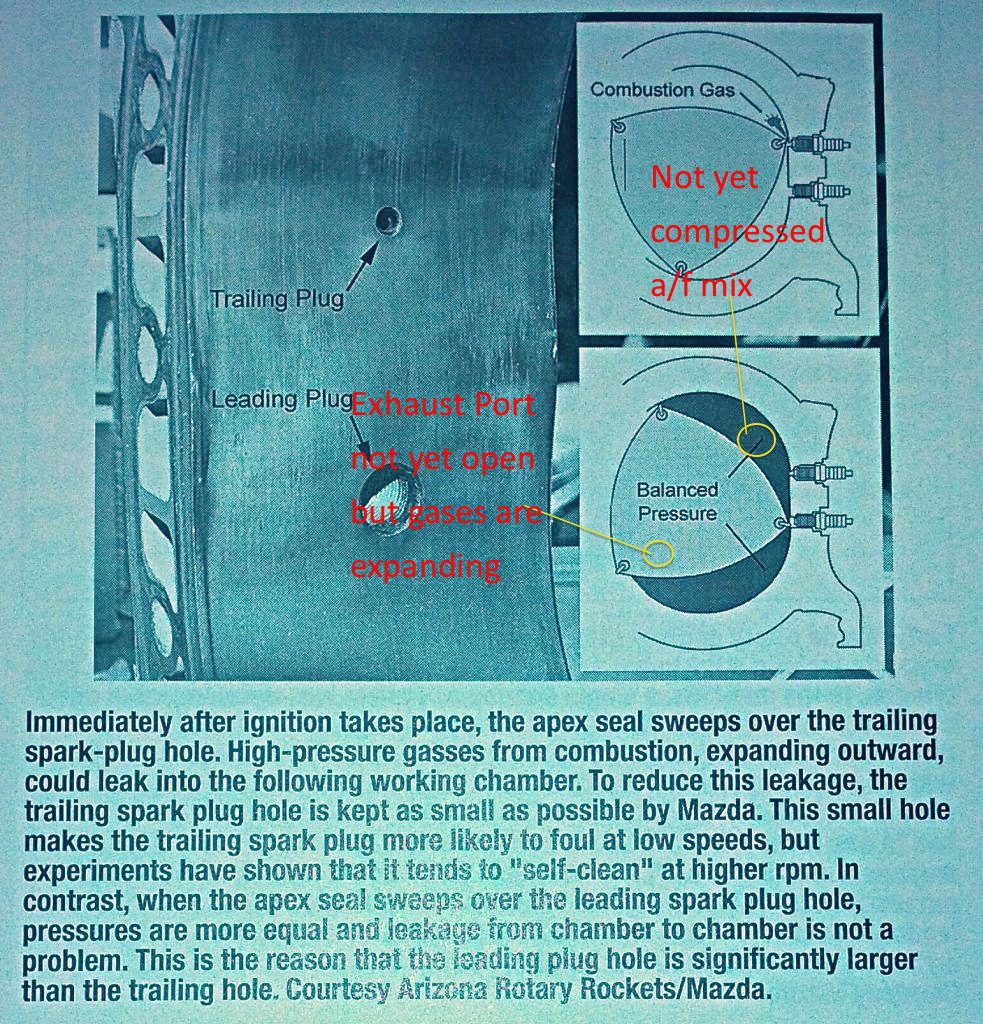
I've read through here and other places where this has been discussed, but still can't seem to wrap my head around how these pressures are balanced.
Intake hasn't been compressed yet, but exhaust is expanding. Is there not some leakage? Maybe negligible, but any at all?
I've read through here and other places where this has been discussed, but still can't seem to wrap my head around how these pressures are balanced.
Intake hasn't been compressed yet, but exhaust is expanding. Is there not some leakage? Maybe negligible, but any at all?
Intake has been compressed a bit and the exhaust port is opening. The pressures only balance for an instant, the leading plug is actually at the point where the differential pressure reverses.