

View Full Version : Turbo Information
Icemastr 11-16-2004, 03:06 PM A few turbo kits are coming out for the RX-8 soon so I wanted to share a little bit of information and maybe get soem discussion going about how the Renesis will respond to turbos. Hopefully some people on here might have already experimented with turbos and share some information on how the side ports affect turbos which is what I am most interested in finding out.
My knowledge of turbochargers comes from working on a few different turbo charged cars on a few different types of motors and work including making my own custom turbo kits, bending and welding my own exhaust piping, tuning stand alone ecus, and dyno testing. I am by no means a turbo expert but here are some of my opinions about turbochargers from my own experience and research of compressor maps, boost response, dyno plots etc.
When comparing the difference between turbocharging the renesis over the old 13B there are three major factors, the new ECU which is difficult to replace with a standalone ecu like the older rotaries, and is proving to be difficult to reflash or piggyback. The side ports instead of peripheral ports and the higher compression of 10:1.
The ECU is a factor that may be easily changed in time, however the compression and side ports are not things that can be easily changed. Lowering the compression on a renesis is accomplished by changing the rotors to different ones, this in short requires removing the engine, dismantling it, putting the new rotors in, and then rebuilding the motor and reinstalling it. Not something easily or cheaply accomplished. This can easily by a $3000-$5000 job meaning lowering the compression is not something that can be done with a "bolt-on" turbo kit. How does the compression affect things? Well advantage wise it will spool a turbo faster as well as create more HP, making the turbo more streetable, however on pump gas this means you are limited to low boost (7-8psi) where as 9:1 compression rotaries are generally known for running 15PSI pretty safely. Tuning also becomes much more dangerous as there is less margin for error in tuning (as if if wasn't bad enough with the 9:1 compression).
The problem that is most often see with turbo rotaries is detonation casuing the apex seal to break or crack, usually a good piston engine can handle a good bit of detonation before breaking a seal or gasket, however with my experience with rotaries twice it only took one detonation to break the apex seal, thus losing compression and needing to rebuild the motor. Many different materials have been tried to make stronger seals, however there is no seal that has shown up to suddenly be capable of handling more than a tad bit of detonation. In addition with those seals when the motor does blow, most often the rotors or housing will be damaged resulting in a more expensive rebuild because you need to replace more parts. In short no "magic" seal has been found to my knowledge that solves this issue.
Another thing to consider is the side ports and how they will affect turbos, this is the key difference between the renesis and the older 13B's, as they had peripheral ports. For anyone who doesn't understand ports check out http://www.rotaryengineillustrated.com. Side ports are smaller ports that come in through the side of where the rotar spins, where as peripheral ports are just a big hole for the air to directly come in or come out of the rotor chamber. The advantage of peripheral exhaust ports on a turbo rotary was that the exhaust gases were at a high velocity and very hot going right into the turbo. Since the old 13B's only had two exhaust ports you could make a fully divided equal length manifold to your turbo and use a divided inlet (just like the twin scroll turbo on the Mitsubishi Evolution 8, the rotary had it back in the 80's) so each rotor is in effect sending its exhaust pulse to one side of the turbo allowing you to tune the exhaust pulses for maximum spoolup.
Two things thats greatly affect turbos, displacement and exhaust. The exhaust is what gives the turbo its power to spin and force air into the engine. Displacement will allow you to make more power on lower boost. A lot of people overlook this and just think boost is boost but this is an error. Comparing the rotary to a piston engine turbo wise becomes complicated because of the characteristics of the rotary. Previous 13B's displacement wise to me compare similar to a 2.0-2.2L engine in that they make similar power naturally aspirated depending on the modifcations. Both max out in race trim around 300HP. When you put a turbo into the mix, the rotary tends to make the same power using the same turbo as a 2.0L piston engine with the same boost. However what I have found with the peripheral port exhaust the rotary engine spools up a turbo much quicker than the 4 cylinder piston engine.
A GT35R would not even be considered streetable on a 4 cylinder engine because it would not reach full boost until around 4500RPM or more however a rotary reaches full boost with a GT35R around 3200-3600RPM. In fact same turbos on 13B's reach boost faster than even the Skyline RB26DETT 2.6L engine, and the Supra 2JZ 3.0L engine. Boost response is really closer to a 3.8L-4.0L piston engine. Which is great, it means you can run a larger turbo and still have great boost response. However a 3.0L piston engine tends to make around 10-15% more HP at the same boost levels with the same turbo.
This is why I am interested in finding out how the side port exhaust affects turbos on the renesis.
RXE16T 11-16-2004, 07:47 PM Very comprehensive info you've posted there, Icemastr.
So in theory, a HKS T51R or a Trust T88SPL would almost be a streetable turbo if what you say about rotaries reaching max boost at lower rpm is correct.
Icemastr 11-16-2004, 08:26 PM The HKS T51R KAI has shown to reach 15PSI around 4000RPM on a street ported 13B, this turbo is generally considered not streetable on a supra, where it doesnt reach 15psi until almost 5000RPM. Big difference, now you can make the decision of what you think is streetable. Some people don't like a turbo that hits peak boost 4000+RPM. Some people dont even like a turbo that starts making boost around 2000RPM and hits peak by 3000.
For reference the T78 on a 13B hits 15 psi just under 4000RPM and is considered a decent compromise between streetability, big power, and cost effectiveness, however a T78 on a supra is not considered streetable because it doesn't reach the same boost until past 4500RPM.
The things I consider important with a streetable turbo are what RPM does the manifold see positive pressure at full throttle, what RPM does the turbo reach peak boost, and if I am in higher RPMS, let off throttle, then step back on it how quickly will the turbo create boost again. These are your key factors in determining the turbos streetability, and people's opinions will vary greatly on what they consider acceptable.
Of course lots of factors including porting, internal engine work, exhaust etc. can all affect boost response. What I am curious about with the new renesis is, does it still have this same advantage with the side ports? If not, it will really suck to run a 60-1 or T04S turbo at 7 psi and only make 300RWHP but not even have the turbo reaching peak boost until 5000RPM. If this is the case to get good streetable you would have to run a turbo sized for a 2.0 4 cylinder, like the GT28RS or T28, something that would see peak boost a little after 3000RPM and be lucky to make 250whp @7 psi. Any of these companies developing turbo kits care to chime in with what they have found so far?
RXE16T 11-16-2004, 08:34 PM The things I consider important with a streetable turbo are what RPM does the manifold see positive pressure at full throttle, what RPM does the turbo reach peak boost, and if I am in higher RPMS, let off throttle, then step back on it how quickly will the turbo create boost again. These are your key factors in determining the turbos streetability, and people's opinions will vary greatly on what they consider acceptable.
Might I also add that how much useable power band following peak boost is also a consideration of how streetable a turbo is.
For example, no point having a T51R reach peak boost at 5000rpms on a Supra if the rev ceiling is only 2000-2500rpms more.
Icemastr 11-16-2004, 08:42 PM Pssst... don't tell the Supra guys that!
T77 - Look ma 350whp @ 5000RPM but 800+ by 7000!
http://www.to4r.com/media/jinfurnadyno.jpg
GT42 (Considered streetable on a 13B with 4" exhaust and 9:7 rotors)
http://www.to4r.com/media/peterbdyno.jpg
RXE16T 11-16-2004, 08:49 PM :eek: Is that 1100hp with the GT42 or am I not reading it correctly?
Icemastr 11-16-2004, 08:54 PM Yeah, hes on the juice too.
RXE16T 11-16-2004, 08:56 PM That doesn't happen to be your FD does it?
What have you done to get 848whp?
Icemastr 11-16-2004, 09:01 PM LS1, big turbo, alcohol injection :D
I didn't want a peaky powerband
Thats 18PSI, pump gas, turbo lag is the amount of time it takes to go really fast to ludicrously fast. About 1500 RPM.
RXE16T 11-16-2004, 09:08 PM LS1, big turbo, alcohol injection :D
I didn't want a peaky powerband
Thats 18PSI, pump gas, turbo lag is the amount of time it takes to go really fast to ludicrously fast. About 1500 RPM.
:eek: That ain't a rotary!
Icemastr 11-16-2004, 09:13 PM Don't worry I got plenty of rotary power :D I got something special I plan on starting work on next year. Lets just say it has more than a few rotors hehe.
RXE16T 11-16-2004, 09:17 PM I got something special I plan on starting work on next year. Lets just say it has more than a few rotors hehe.
:confused: Keep us updated.... it's always refreshing to see what rotorheads do around the world since unfortunately everything downunder consists of dropping in a 20B.
colin204 11-18-2004, 10:17 PM Icemastr or anybody else
What turbo would you put on a RX8 running 6-8PSI looking for 300-325 rwhp
globi 11-18-2004, 11:47 PM Icemastr, In order to reduce the compression ratio of the Renesis couldn't you, instead of replacing the rotors, just enlarge the intake side ports?
(If you'd close the intake valve later in a piston engine you'd automatically reduce the compression ratio as well.)
MazdaManiac 11-19-2004, 12:17 AM Icemastr or anybody else
What turbo would you put on a RX8 running 6-8PSI looking for 300-325 rwhp
Your "out of the box" choices are:
Garrett T04E Super 50
Garrett GT20 (which, I think, is perfect)
Mitsubishi TD04-15 or -18
KKK K16 or RS2
Other possibilities as I see it are a T4/T3 hybrid (an "upside-down" Grand National turbo) or the KKK sK26.
SpeedDemonSoldier 11-19-2004, 09:28 AM So what all would you have to do to make your 8 run with the Garrett GT20 without any problems?
MazdaManiac 11-19-2004, 09:37 AM So what all would you have to do to make your 8 run with the Garrett GT20 without any problems?
:p
Read "Maximum Boost" and check back with us in the next month or three.
Icemastr 11-19-2004, 03:03 PM Your "out of the box" choices are:
Garrett T04E Super 50
Garrett GT20 (which, I think, is perfect)
Mitsubishi TD04-15 or -18
KKK K16 or RS2
Other possibilities as I see it are a T4/T3 hybrid (an "upside-down" Grand National turbo) or the KKK sK26.
How do you figure the GT20 is perfect? Its a 140-260HP turbo meant for 1.4-2.0L 4 cylinders. It would choke the renesis. The Super 50 is also small, in fact all the turbos you listed are under 300Hp turbos and thats at 15psi.
What makes them out of the box choices? No one has a turbo kit (complete bolt on nothing else needed) out yet which is what I would consider out of the box.
I have seen a Greddy T78 make 315WHP @ 7psi on a mild port 13B-REW. Also seen a GT35R make 285@ 8 psi.
Is this good or bad news? Well the Renesis has tertiary ports which will allow it to flow more air in the higher RPMS, and since it can go to 9000RPM instead of 7500RPM like the older 13B-Ts as long as you can keep the torque up, 200lb ft of torque at 7500RPM = 314HP 200lb ft of torque at 9000RPM = 342HP. The GT35R is considered a fairly quick spooling turbo on a 13B-REW, I think there would be a good chance it could get you into the 300+RWHP range on pump gas with low boost. However the GT35R is a very large turbo for a 2.0-2.5 4 cylinder.
Like I said, how the ports affect turbo spoolup will play a large role in what size of turbo you can use. Running something like a GT28R (which is comparably in spool on a 2.0L to the GT35R on the 13B-REW) you would only be making around 250WHP around 8 psi.
Of course this is all hypothesis based on experience with other motors, I wish I had a dyno at my house so I could test some of this stuff out.
Icemastr 11-19-2004, 03:23 PM Icemastr, In order to reduce the compression ratio of the Renesis couldn't you, instead of replacing the rotors, just enlarge the intake side ports?
(If you'd close the intake valve later in a piston engine you'd automatically reduce the compression ratio as well.)
I am a novice on these type of things so I could be incorrect but I have never heard anything about changing the ports affecting compression ratio or allowing more boost on a rotary.
MazdaManiac 11-19-2004, 04:05 PM How do you figure the GT20 is perfect?
Typo, was supposed to read GT28.
What makes them out of the box choices? No one has a turbo kit (complete bolt on nothing else needed) out yet which is what I would consider out of the box.
I meant out of the box like "out of the starting box", not "bolt on". Implicit understanding of where that expression comes from was assumed. Sorry.
I'm not using other people's past experiences to define what the correct turbo would be. I'm just doing the math and using the compressor maps.
If I used everyone's suggestions (especially the RX-7 guys), I'd be using a T58 or something similarly over-sized.
On that note, the GT20 would actually be a good choice.
The map for 9 psi based on the Renesis flow rates looks like this:
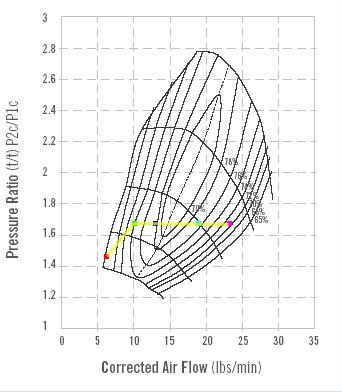
http://www.mazdamaniac.com/images/rx8/misc/GT20.jpg
Plenty of headroom to up the boost.
The turbo I am probably going to use is the T3 "Super 60":
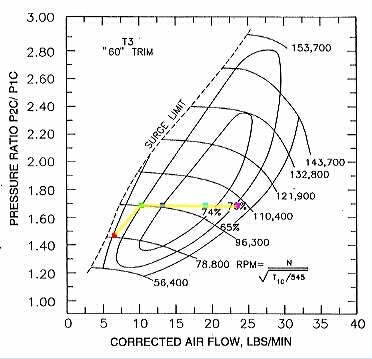
http://www.mazdamaniac.com/images/rx8/misc/T360.jpg
Remember, the Renesis only consumes about 20 lbs/min of air at redline. At 9 PSI of boost, that only climbs to 30 lbs/min or so. It is only an 80 cu/in motor. That is a max of 400 CFM or so.
globi 11-19-2004, 04:16 PM Icemastr wrote: I am a novice on these type of things so I could be incorrect but I have never heard anything about changing the ports affecting compression ratio or allowing more boost on a rotary.
When you enlarge the intake port to a certain extend you compress less air which is essentially the same as reducing the compression ratio. I guess this concept could be considered a miller cycle rotary engine just that the mechanical supercharger is substituted by a exhaust driven supercharger (or turbocharger).
http://www.wordiq.com/definition/Miller_cycle
The advantage of the miller cycle (as far as I understand it) is that the engine still does 10:1 expansion (work cycle) but with a shorter compression cycle maybe (8:1) and therefore allowing more boost without giving up the expansion ratio which is partly responsible for the efficiency of any engine.
I'm sure it has its disadvantages too. It's too obvious that this wouldn't have been considered before.
Icemastr 11-19-2004, 04:52 PM When considering the 13B-REW engine it comes with twin turbos that allow it to make about 220RWHP @ 10 psi stock, removing the restrictions in intake and exhaust and providing enough fuel you can easily make about 300+ RWHP at 10 psi. 350 @ 15 psi. You say if you used RX-7 user suggestions you would be going with a much oversized turbo, however when you consider how much HP the 93+ RX-7s make on the stock turbos, who is going to "upgrade" to a single turbo to make less HP than the stock twins? A T60 or a T04E don't even flow all that much more air than the stock twin turbos.
I have a GT28R turbo on a 1.8L engine, its making about 200whp @ 9 psi. The turbo maxes out about 15PSI making 280whp.
Now if you are basing sizing and compressor maps off the Renesis being 1.3L how would you expect the Renesis with smaller displacement to make more power with less boost?
I have toyed with the idea of using a GT28R on a 13B-REW for an autocross car, but I don't see how the car would possibly be able to make more than 300whp if that, and thats at 15PSI. Yes it would be amazingly quick spoolup, but it would make quite a bit less power than the stock turbos. I haven't tried this though so I don't have any actual results.
It seems like you are comparing the renesis with piston engines, however they are different animals and the 1.3L of displacement doesn't = a 1.3L piston motor.
Snoochie 11-19-2004, 05:05 PM Wouldn't fiddling with the intake ports cause overlapping and idling problems?
Icemastr 11-19-2004, 05:12 PM The intake ports where they open into the combustion chamber are already about as wide as they can go from what I have seen, the best thing to do would be cleaning it up and enlarging the passage, then smoothing it out. Or you can make a bridge and add another port. Once again, I am not an expert on porting, just a tiny bit knowledgeable.
MazdaManiac 11-19-2004, 05:12 PM I'm not "comparing" it with anything.
The Renesis flows an absolute amount of air. You can calculate this. It doesn't matter what a piston engine does at any given displacement, I am not considering it.
The object is to produce a turbo system that almost immediately produces 7 PSI to 9 PSI and holds it through 9000 RPM. That is all. The net power will be the net power. I'm not building a dyno queen, I am building a system that enhanses the already fantastic drivability of the RX-8. No more. If I only get 50 HP peak that is fine., but I'll bet you that I'll see 30% - 50% more torque across the entire REV band.
The OEM EFI on the RX-8 wont support more than this, so why engineer for it?
The RX-8 isn't an RX-7. Stop trying to use that comparison.
No doubt, the Renesis is capable of a lot of power, but not under the restrictions of the existing fuel system. I am building under these restrictions.
Stop speculating and start looking at compressor maps and use the apropriate formulas.
The Renesis displaces 80 cu/in per rev. That is ~20 lbs/min at 9000 RPM.
BTW, my 1800cc Miata motor only flows 10 lbs/min at redline, so it should be obvious that a 1300cc rotarty motor flows more than an equally-displaced piston motor.
globi 11-19-2004, 05:24 PM Snoochie wrote: Wouldn't fiddling with the intake ports cause overlapping and idling problems?
Actually in this case you wouldn't encounter any idling problems since you don't fiddle around with overlapping. You just 'close' the intake port at a later point (which itself would reduce the power output of the engine if not supercharged, since it would pump less air).
In fact piston engines with variable valve timing reduce overlapping at low rpms by opening and closing the intake valve at a later point.
Charles R. Hill 11-19-2004, 06:10 PM One of the things I think many people overlook when comparing the Renesis and it's side ports to the previous rotaries and their peripheral ports is that the Renesis in N/A form is making roughly the same h.p. as the twin turbo. I don't know the torque comparisons, offhand, so someone can enlighten me on that. What I wonder is if the side ports are actually a better way of modulating airflow through the engine because there is a more well-defined closing of the intake and exhaust events. We are tending to assume that the peripheral ports offer a better opportunity for quality airflow but might we be wrong? If not, then I suppose most of the numbers generated by the Renesis that eclipse the previous versions would appear above 7,500 rpm. Another thing to consider is that compression ratios tend to be a mechanical measurement and don't necessarily reflect the actual dynamic pressures an engine will generate. Of course, we have seen 10:1 engines deal with a turbo just fine and it has been said repeatedly that it is all in the tuning. As Maniac has said, the ECU and the fuel systems are the biggest hinderances. One more observation I have is that the 1300cc rotary engine is actually moving air in a similar fashion to that of a 2.6L. Since there are no cycles dedicated to only clearing the cylinder like a piston engine, every movement of the rotor is used to make power immeditely. Maniac pretty much alludes to this in his last sentence. I tend to think that the torque/h.p. figures for the Renesis are pretty much in-line with that of a similarly mannered 2.6L and, as well, the potential for ultimate power may be the same(with durability being the biggest factor).
A question for globi: How would lengthening the intake event cause a reduction of airflow? I think that the intake vacuum signal would definitely change character at lower rpm's but as the rpm's climbed higher we would see the same "supercharger effect" that the rotary is known for, only at a higher point in the rpm band. I read your last post and I tend to disagree with your conclusions because rotary engines don't experience the same reversion pulses/effects as do piston engines . Care to elaborate?
Charles
wakeech 11-20-2004, 04:14 AM Renesis in N/A form is making roughly the same h.p. as the twin turbo. I don't know the torque comparisons, offhand, so someone can enlighten me on that.
What I wonder is if the side ports are actually a better way of modulating airflow through the engine because there is a more well-defined closing of the intake and exhaust events. We are tending to assume that the peripheral ports offer a better opportunity for quality airflow but might we be wrong?
How would lengthening the intake event cause a reduction of airflow? I think that the intake vacuum signal would definitely change character at lower rpm's but as the rpm's climbed higher we would see the same "supercharger effect" that the rotary is known for, only at a higher point in the rpm band. I read your last post and I tend to disagree with your conclusions because rotary engines don't experience the same reversion pulses/effects as do piston engines . Care to elaborate?
Charles
the biggest reason the MSP is "making" nearly as much power as the REW is the increase in redline. this is actually a really dumb comparison as both motors are so different, so let's look at the numbers from an even older engine, the Series 5 13B (no fancy letters after it).
the S5 motor made a max of 160hp at 7k rpm, and (even though i HATE the implications made by quoting such a stupid number) a maximum torque figure of 140lb/ft at 4k rpm. the 13BMSP by comparison makes a claimed 238hp at 8500rpm (i'm sure that back in the day mazda was saying 247, it was probably closer to that number than what factory motors are to the new lower number), and 156lbft at, what, 5500?? (slipped my mind, torque figures are stupid).
the biggest difference, as i said, is in the increase in functional engine speed. this has come about with better internals (lighter rotors, stronger shaft, better machining, etc), way huger ports (stock ports are now at least as large as the most aggressive street ports executable on the S5, made possible by the shorter beam height of the apex seals), and massive improvements in the induction hardware (the refinement of the SDIAS system next to the ugly ass VFAD is like comparing the craftsmanship of a katana to that of a club made from a branch torn off a dead tree... from the big stuff to the tiniest details, it is wholly better). as is fairly obvious, it's a lot of small changes that have resulted in a rather huge improvement which can be qualified as a single characteristic improvement.
other stuff would be like the increase in compression ratio (from 9.2:1 at the highest IIRC, to 10:1), much better catalyst units, magic fairy dust, etc.
perhipheral ports flow the best, hands down, no question, period. a p-port motor with rotors clearanced for racing, balanced, lightened, studded, dowled, carbon sealed, and set to detonate with a 11-13k rpm redline make way over 300hp, all motor, no juice (and that was in the 70's and 80's, and amateurs these days). side ports simply have no chance against p-ports, which is why i have many times suggested someone with an engine apart and some balls do some measuring, drawing, grab a hole saw and a die grinder to make a p-port induction side, side port exhaust side Renesis. it'd be magic, i tell y'all.
the deal with lengthening the intake event has already been addressed, decades ago, with the VFAD and now SDIAS systems built into the motors factory. the combustion chamber starts compression at 0 degrees ABDC, and is limited to 30 ATDC,40 ATDC and 80 ATDC (all IIRC, i don't have the patience to search for rotarygod's posted numbers, but i'm pretty sure they've stayed close) progressively as rpm increases. leaving the port open too long when the speed of the engine is low is obviously bad as the difference in pressure would drive gas out of the chamber before the port had closed, but as you say at high rpm the larger ports allow for a greater volume of gas to enter at a comfortable velocity while the motor is going nuts, with things like momentum and resonance tuning helping keep all the gas sucked, in. now because of where the ports are cordoned into by the sealing design on the mazda rotor, and what might be a non-linear rate of compressioon (i've never found any information on this, am not familiar with the matematics used for the geometry of this engine, and don't have one to play with, so i don't know but would love to find out) inherent to the wankel design, further increase to this phase in the cycle is probably not a great plan: mazda has probably hit the wall of deminishing returns with this experimentally, as this would be one of the easiest areas to make more power ('cause there's lots of room for port up there, but wouldn't benefit the motor).
to make myself more clear on that recent point, i was postulating on the rate of compression (whether it's a nice parabola on the volume vs. degree of rotation graph like a piston motor would have or not). if anyone has any ideas or information about this i'd be curious (i'm very sure it's known, it's simple theory, i just don't know it).
globi 11-20-2004, 02:54 PM Originally Posted by Charles R. Hill
Renesis in N/A form is making roughly the same h.p. as the twin turbo. I don't know the torque comparisons, offhand, so someone can enlighten me on that.
What I wonder is if the side ports are actually a better way of modulating airflow through the engine because there is a more well-defined closing of the intake and exhaust events. We are tending to assume that the peripheral ports offer a better opportunity for quality airflow but might we be wrong?
How would lengthening the intake event cause a reduction of airflow? I think that the intake vacuum signal would definitely change character at lower rpm's but as the rpm's climbed higher we would see the same "supercharger effect" that the rotary is known for, only at a higher point in the rpm band. I read your last post and I tend to disagree with your conclusions because rotary engines don't experience the same reversion pulses/effects as do piston engines . Care to elaborate?
Charles
As far as the exhaust ports of the Renesis go, I would assume that they were mainly put in place to reduce emissions since it recycles part of the unburnt fuel and it might somewhat increase efficiency since it reburns that fuel as well.
Here's a picture: http://www.der-wankelmotor.de/Techniklexikon/technik_auslass/technik_auslass.html
If it was just about generating maximum power, perimeter ports would probably be superior.
Regarding the lengthening of the intake side port and reduction of the airflow: It is basically as wakeech already mentioned, it would drive gas out of the chamber before closing the intake port and therefore reduce the airflow. You could also compare it with the Atkinson cycle which is used in the Toyota Prius:
The Atkinson cycle may also refer to a four stroke engine in which the intake valve is held open longer than normal to allow a reverse flow into the intake manifold. This reduces the effective compression ratio and, when combined with an increased stroke and/or reduced combustion chamber volume, allows the expansion ratio to exceed the compression ratio while retaining a normal compression pressure. This is desirable for good fuel economy because the compression ratio in a spark ignition engine is limited by the octane rating of the fuel used, while a high expansion ratio delivers a longer power stroke and reduces the heat wasted in the exhaust. This makes for a more efficient engine.
The disadvantage of this concept is of course that the engine pumps less air. If the engine pumps less air it automatically generates less power. However since you pump extra air with the turbocharger you make more than up for it.
I guess ideally you'd have something like a third side intake port with a electromagnetically controlled valve. As long as you drive with partial load its closed. At increased boost it would open that extra side port and therefore reduce the compression ratio to 7:1 (for example) hence allowing a much higher boost pressure. (And this third valve is something completly different than a variable intake duct. It would be more like a turbocharged variable valve timing piston engine.)
globi 11-20-2004, 06:28 PM Btw the 26B has peripheral intanke and exhaust ports. (Of course in this case fuel consumption, idling stability and emissions didn't matter).
http://www.der-wankelmotor.de/Motoren/Motoren_Mazda/Mazda_26B/mazda_26b.html
rotarygod 11-20-2004, 07:49 PM Icemastr, In order to reduce the compression ratio of the Renesis couldn't you, instead of replacing the rotors, just enlarge the intake side ports?
(If you'd close the intake valve later in a piston engine you'd automatically reduce the compression ratio as well.)
No you wouldn't.
First of all we need to understand that there are 2 different types of compression ratio that people get confused between. They are the static compression ratio and the effective compression ratio. The static compression ratio is the one that is quoted in all of the specs as 10.0:1 on the Renesis. The ONLY way to change this is to change or mill out the rotors. As of this time, there are no other alternatives for this engine. The effective compression ratio is what you are getting confused with. Yes at lower rpm's, you may get some reversion because the engine will begin it's compression stroke before the intake port closes. However, at higher rpm's, the engine intake air has so much momentum that it will not reverse but in fact keep shoving more air into the engine than normal and have a high effective compression ratio. It is possible (and pretty much guaranteed) that the engine will have less air in it at idle and low rpm's than it can hold. This would make the effective compression ratio less than 10.0:1. If the engine is only 85% efficient, you do th math. Let's say at high rpm's we hit 105% efficiency due to inertial ramcharging. Now figure it out. Every porting style has a compromise to it but the compression ratio that everyone refers to is the static compression ratio. Porting does not affect this.
rotarygod 11-20-2004, 08:04 PM The Renesis is not going to respond to turbo sizing in the same fashion as the 13B's. You can't only size a turbo for a 13B based on displacement. It doesn't work. The exhaust flow is so drastically different. A peripheral port opens fully much faster than a side port. It also closes more abruptly. This sudden opening causes a very sudden rush of exhaust gas. It is mroe of an impact on the turbo blades rather than a flow across them. This foceses more energy at the blades and really gets them moving faster. A good turbine blade design for a rotary is fairly flat in profile where a typical turbine blade is more curved. Unfortuately aftermarket blades are curved so we must use a bigger size than necessary. The Renesis on the other hand with it's side ports, has an exhaust flow that is more similar to a piston engines flow than it is a 13B exhaust port. The exhaust ports aren't open as long and they open and close more gradually which dissipates the impact effect. A more traditional turbine size and style is more appropriate for these engines. You shouldn't need as large of an exhaust wheel as the 13B. Something as large as a T-51Kai will just sit there and not work on a Renesis. They don't spool up very good on a ported 13B. If you consider full boost by 4500+ rpm good than so be it but this is really more functional as a dyno queen or a freeway car. They are slow on the street for everyday use. The T-51 is also out of its efficiency range if you are under 20 psi or so. Who needs this? Seriously, be realistic! A better choice would be a 60-1 HiFi or T-04B (very similar) for street use. If you want more power step up to a 62-1 or maybe a T-66 if you get into porting.
Big turbo Supra's may be capable of incredible power but at the dragstrip or on the streets, it doesn't take very much power to beat one. Get one on the freeway or try to outrun it in top speed and that becomes a very different story. They are dyno queens with a 2000 rpm wide powerband and nothing anywhere else. I still remember Ari at Rotary Performance when he dyno'd 620 rwhp vs Rhys Millen in their 1000 rwhp Supra. Toyota had all of their guys on hand and hyped up the show about how much power they had. Ari beat Rhys by almost a half a second in the quarter. If the track were a half mile, it would have been a very different story. The same turbo may spool up faster on an RX-7, but it doesn't mean it is any more streetable. It also doesn't mean that it will spool up on a Renesis.
Charles R. Hill 11-21-2004, 03:49 AM Thanks, Rg, for affirming what I had been understanding/utilizing for the past 25 years. I am glad to see that several of my experiences in piston engines will translate to rotaries, as well. Re: your explanation on the differences between the nature of the intake/exhaust events between the peri and side ports, I would have thought that the peri port reaches full opening quicker but closes slower than the side port. To describe the closing of the side port's exhaust as more gradual than the peri has me somewhat baffled.
I am wondering if Wakeech is willing to take the time to explain his aversion to using torque as a measure of an engine's capabilites. I am having a hard time following that logic since torque level and rpm's are used to synthesize that imaginary figure we call "horsepower". Thanks.
Charles
Richard Paul 11-21-2004, 01:27 PM Ya Wakeech, I'd like to hear that answer also. I'd sooner reject HP then torque.
I once was ordering a boat and had the option of Perkins or Catapillars. There was only 5 hp difference and many thousands of dollars. I was thinking of the savangs while I walked around the factory. When all of a sudden it hit me as I happened to see the size difference in the exhaust between to two engines. Then I hit myself in the head and said "torque you idiot". Guess which ones I bought??
globi 11-21-2004, 07:06 PM rg wrote: Yes at lower rpm's, you may get some reversion because the engine will begin it's compression stroke before the intake port closes. However, at higher rpm's, the engine intake air has so much momentum that it will not reverse but in fact keep shoving more air into the engine than normal and have a high effective compression ratio.
It's a question of a how large you size that additional intake side port. From a certain size on, you'll end up with a reversion at any rpm. Otherwise the miller cycle engine simply wouldn't work at higher rpms.
But of course if you size that extra intake port too big, you would lose lot's of low end torque, since you'd reverse too much air at lower rpms. Which is why I was suggesting an electromagnetically controlled valve on that extra intake port, so it only opens at higher boost levels and higher rpms. (This however wouldn't really be a practical solution for an aftermarket kit.)
Variable valve timing (eg. VTEC) on piston engines appears mechanically more complicated than what an additional controllable side intake port on a rotary engine would be. So I wonder why it hasn't been realized on a rotary engine yet, or has it?
Richard Paul 11-21-2004, 08:03 PM Who says the miller cycle works at higher rpm anyway?? That whole thing is a waste. Now if you get electronic valve actuation, then you can get somewhere maping valve timing and blower pressure.
globi 11-21-2004, 10:44 PM Richard Paul wrote: Who says the miller cycle works at higher rpm anyway?? That whole thing is a waste.
Well you have to admit that running a supercharged engine with a lower compression ratio is also a waste. (Since the expansion ratio or work cycle is shorter.)
Richard Paul 11-21-2004, 11:26 PM Globi, Say what???
BMEP
BaronVonBigmeat 11-22-2004, 12:43 AM I am wondering if Wakeech is willing to take the time to explain his aversion to using torque as a measure of an engine's capabilites. I am having a hard time following that logic since torque level and rpm's are used to synthesize that imaginary figure we call "horsepower". Thanks.
Charles
Not to put words in his mouth...but it's probably because torque can be multiplied as much as you want by the transmission and rear end. You'll often hear people (usually the domestic crowd) throwing "torque at the engine crank" numbers around like that's all that matters, when they're missing half the equation. Likewise, you hear the import crowd tending to beat their chests about how many RPM's (at the engine crank) they can turn, which is also giving an incomplete picture of an engine's capabilities. Horsepower however cannot be multiplied by gearing.
For the boat motor example, or for heavy hauling in general, you'd be doing good to get a motor biased towards torque, because you don't want a motor that's constantly screaming, and you want good fuel efficiency. Plus weight won't be a factor for a boat or dump truck really. Of course, the additional cost may also have been due to craftsmanship, type of metals used, company reputation, etc.
rotarygod 11-22-2004, 05:51 AM It's a question of a how large you size that additional intake side port. From a certain size on, you'll end up with a reversion at any rpm. Otherwise the miller cycle engine simply wouldn't work at higher rpms.
But of course if you size that extra intake port too big, you would lose lot's of low end torque, since you'd reverse too much air at lower rpms. Which is why I was suggesting an electromagnetically controlled valve on that extra intake port, so it only opens at higher boost levels and higher rpms. (This however wouldn't really be a practical solution for an aftermarket kit.)
Variable valve timing (eg. VTEC) on piston engines appears mechanically more complicated than what an additional controllable side intake port on a rotary engine would be. So I wonder why it hasn't been realized on a rotary engine yet, or has it?
It isn't so much a certain sized port as it is a certain timed port. If you keep the intake open too long into the compression stroke you can get reversion at any speed.
The Miller cycle is a very different approach. The idea behind it is that if you can have a compression stroke (not intake) that is shorter than the exhaust stroke that you can reduce pumping losses and gain mileage and reduce emissions. Their solution to this was to leave the intake valves open for a little longer into the compression stroke to ensure that the combustion chamber doesn't fill up as much. However to regain the amount of power back that is lost from this, they rely on a supercharger (a twin screw!) to force some air back in. In doing so they did increase the efficiency of that particular engine a little from an economy standpoint but power wasn't as high as it should be with a supercharger. They weren't using the supercharger to give the engine a kick. They used it to restore power back from leaving the intake open for too long. The idea sounded good but 27 mpg at 200 hp vs other engines that can eclipse that today just wasn't worth the effort and we never saw another example of it again. If it really worked so well, we'd see more of them.
Richard Paul 11-22-2004, 10:01 AM BMEP=Brake Mean Effective Pressure. For those who have asked via PM.
Fred do you ever sleep?? Noting the times of your posts sometime I wonder.
rotarygod 11-22-2004, 11:29 AM Normally I go to bed really late and get up late. Last night I feel asleep on the couch watching TV at about 7 and woke up again at 10. If I'd have stayed awake, I'd have never fallen back to sleep so I just went to bed. Woke up at about 4:45 and couldn't sleep again.
MazdaManiac 11-22-2004, 12:12 PM Normally I go to bed really late and get up late. Last night I feel asleep on the couch watching TV at about 7 and woke up again at 10. If I'd have stayed awake, I'd have never fallen back to sleep so I just went to bed. Woke up at about 4:45 and couldn't sleep again.
Sounds like my kind of schedule. I was out logging runs on the E-Manage at 3:00am this morning and slept from 5 to 10:30.
No TV for me though - it would take from my GTA-SA time!
Still awaiting wakeech's triumphant return as he explains away the value of torque as a true measure of power.:D
brillo 11-22-2004, 01:54 PM how would all of this apply to a super charger? I would think spooling should be faster but the compression issue would still be there....but, if what most of us really want is low end, and the compression in lower in the lower rev range, then I would think we could use a S/C or T/C that would spin up quick at the bottom and then tapper off as you get high in the power band.
globi 11-23-2004, 12:48 PM Richard Paul wrote: Who says the miller cycle works at higher rpm anyway?? That whole thing is a waste. Now if you get electronic valve actuation, then you can get somewhere maping valve timing and blower pressure.
Actually another way to look at it is: Assuming you had that additional controllable side intake port, you could run a turbo at a much higher boost level, since the (apparent) compression ratio could be reduced to let's say 6:1. A higher boost level would make an intercooler much more effective (proportional to delta T) and therefore the engine would be less prone to detonation without having to reduce the actual compression ratio of the engine. However I'm not sure whether a turbocharger at much higher boost levels would still run efficiently enough?
Charles R. Hill 11-23-2004, 01:59 PM Baron, I am thinking that your explanation has it backwards(although correct), in a sense. The reason I think this is because while torque can be multiplied, it comes at the direct expense of rpm potential. The thing is that torque is a direct measurable value while horsepower is a calculated(contrived) number. The way h.p. numbers become valuable is to compare the work potential of different engines and then designing torque converters, transmissions, and final drives that will best fulfill the purpose of the vehicle. All of this exludes particular characteristics of a given engine just for the sake of rhetoric. When we are able to evaluate the h.p. to weight ratios of different vehicles we may then begin to reasonably predict that vehicles performance and decide where, if any, changes or mods could be made. To use your comparison of domestic vs. import, I regularly explain to the Mustang owners that I have beaten in a drag race that because I have half as much torque as they do I also have almost twice as much gearing for a net h.p./weight figure to the wheels that is actually better than what they have. With a redline that is almost twice what they have available, we see that a slightly modded RX-8 will give V-8's a run for their money even though we only measure 160 lbs./ft.(+/-) at the crank compared to their 300 lbs. The great thing about the import engines these days is their relatively flat torque peaks when compared to the V-6/8 engines the domestics have. With the right tranny/gearing, import vehicles are really better cars for the money. And to think I used to be a musclecar freak.
Charles
staticlag 11-23-2004, 02:31 PM Would there be some way to use both a supercharger and a turbo on an engine? Using the supercharger for more low end quick spooling torque, then prehaps once the engine got into the effective turbo range, use a huge turbo on it and some valves to divert some of the supercharger pressure to the turbo spool path in the exhaust (it help spool the huge turbo at max rpm, and cool the exhaust temp)? If you used two intakes and worked out some dedicated airflow system, couldnt this be done?
merlin00gt 11-23-2004, 03:30 PM staticlag: I believe some older diesel engines had a similiar setup. I was watching a "Trucks" show on TNN the other day, and they showed an International engine that had a turbocharger feeding a supercharger. The turbo sat right on top of a "roots" blower.
My point is that it has been experimented with.
GeorgeH 11-23-2004, 08:13 PM Yes, there is an experimental Miata kit out there right now that does just this. I know the guy who has it in his car, but I have not seen it yet.
Aoshi Shinomori 11-24-2004, 01:15 AM staticlag: I believe some older diesel engines had a similiar setup. I was watching a "Trucks" show on TNN the other day, and they showed an International engine that had a turbocharger feeding a supercharger. The turbo sat right on top of a "roots" blower.
My point is that it has been experimented with.
Why not just use the sequential twin turbo setup? The kings of the 90's, the supra, rx-7, vr4, 300zx all had this kind of setup. One small turbo that spooled quick so there was a bigger useable power band, and when the bigger one spooled the little one shut down. I might have a few things wrong here, but I'm pretty sure that's basically how it worked. I also don't know what the advantages/disadvantages would be over using two turbos or a turbo/supercharger. We'll let the experts sort this all out :cool:
Sequential twin turbos are two turbos setup so all of the exhaust gases can pass through just one of the turbos then when a certain objective is reached (4500RPMs on the 93+ RX-7s) an actuator opens a valve to divert the gases into bother turbos. In the case of the 93+ RX-7s there is also a prespooling actuator that flows air into the secondary turbo as the RPM's increase so the secondary turbo is already spinning before the actuator opens up. The 93+ RX-7s turbos are both of equal size. The VR4 and 300ZX do not use sequential turbos, they use parallel twin turbos, one for each side of the engine. The 93+ Supra does utilize sequential turbos, I am not certain however I believe they are both the same size. The sequential turbos on the 3 rotor Eunos Cosmo uses a slightly larger secondary turbo than the primary.
Most people do not understand how exactly turbos are affected by the exhaust. A few things a lot of people think but are not true: two small turbos equalling the flow of one large turbo will nto necessarily spool faster, one small turbo and one large turbo will not decrease turbo lag, it will increase it as the exhaust gases are further diverted into two turbos in effect creating a larger single turbo. Boost does not stack. Twin turbos running at 10PSI does not create two 10 PSI's or double the pessure on the engine.
Why run two turbos in parallel? Theoretically two turbos equaling the flow of one large turbo will spool up faster because of reduced weight, however this usually is not the case in real world use. Twin turbos are usually used to make more HP than one turbo, because of space constraints with a V engine (having to run exhaust pipes under the engine to combine flow to the other side to flow into the one turbo), or to increase boost response. In this setup you are basically splitting the flow of the engine 1/2 into each turbo, therefore it will not spool up way faster. One a 3.0L engine you are putting basically 1.5L displacement into each turbo.
Why run two turbos sequentially? Because you use one small turbo spun by all the exhaust gases then at higher RPM a second turbo comes on, how does this add more power? Well it is able to increase the airflow without increasing the heat so efficiency is increased thus forcing more air into the engine at the same pressure levels (because cooler air is more dense) this is why 10psi with two turbos is more HP than 10psi on one turbo even though its still only 10psi at the engine. Downsides? It requires very complex plumbing and controls to do a sequential system. An aftermarket sequential system would very complex and expensive because it would be a one off. This creates more problems and more heat as well as more money.
Aoshi Shinomori 11-24-2004, 02:58 AM You are very smart. I thought the idea behind these cars was to utilize two different sized turbos, one small and one big that come on at different times. I guess not, thanks for the technical write-up, I'll try to burn that into my head. This is a very informative thread, keep posting more fun turbo information!!
wakeech 11-24-2004, 03:42 AM I am wondering if Wakeech is willing to take the time to explain his aversion to using torque as a measure of an engine's capabilites. I am having a hard time following that logic since torque level and rpm's are used to synthesize that imaginary figure we call "horsepower". Thanks.
Charles
sh'yea jeff, triumph, really... :P
Chucky, torque is a stupid number to include in the estimation of the performance capability of an engine because of what people are inclined to think it implies (and thus the inane descriptions of how a car performs which drive me up the wall, by automotive journalists who can't tell the difference between their ass and a hole in the ground).
torque, as a measurement of force per revolution, is of course an important aspect in measuring the power of a motor and is indicative of a motor's point of highest efficiency. but, what's often associated with that number is 'how hard it pulls off the line' or some garbage, that magically torque pulls the car in the low end and horsepower keeps you going at the top end.
really, it's all just horsepower, the more you have at one speed of the engine the more the engine is going to pull you forward: it doesn't really care how you go about getting that power, whether you have a 110lb/ft 700hp wondermotor in a race car, or an 800lb/ft 320hp stump pulling truck motor. it's true that a high torque number at a low rpm is indicative of a motor which makes a lot of power at a low speed, but the power does the pulling. in an ideal world it doesn't matter how much torque you have as gearing totally negates the torque number the engine makes, and just takes the power number, devides or multiplies it out by multiplying or deviding the speed it's applied to the wheels, and presto your new real torque number where rubber meets road. so small zingy motors need to be zinged and slipped more, while chunky, manly V8's just need a drop and stomp, but equal amounts of power are equal, no matter how much torque is used to make it.
only thing that matters is the shape of the power band. BVBM is the only one that understands me *i cry*
rotarygod 11-24-2004, 04:27 AM http://www.yawpower.com/tqvshp.html
Charles R. Hill 11-24-2004, 07:50 AM Chucky? I didn't realize you and I were that familiar yet, Wakeech. Anyway....
I completely understand the concepts of horsepower and torque and the distinction between the two. And, as I had suspected, you affirmed for me what I thought to be the real argument here; torque values are useful for people who know how to read dyno charts properly and design a drivetrain combo that best suits a given objective. Horsepower numbers have another use for the well-informed but are usually thrown around indiscriminately by idiots who have no clue what the important aspectsof engine operation are. As you stated, it is the shape of the power band that really matters but, since the math is a fixed equation, what is the variable used to determine the shape of the power band?
I would like to ask that the next time you address me you do so with the same level of respect I have shown you now or in the past, whether we have agreed on an issue or not. Derogatory tones aren't worn well by people who have otherwise good information to impart on this forum. Thanks.
Charles
globi 11-24-2004, 09:53 AM ...but first we need to consider Newton’s second law of motion, which states that "Acceleration is proportional to force." and "Acceleration is inversely proportional to Mass." This law is normally stated more simply as "Force equals mass times acceleration." or F=MA. If we rewrite this to solve for acceleration, we get A=F/M.
That's the point. I don't see why there's a need to write so much about it. It's ultimately about force at any given speed (of course force is torque at any given speed at the wheel divided by the wheel radius). In addition acceleration is also inversely proportional to any rotational masses (wheel, flywheel etc.) and friction forces (air friction, wheel friction, transmission friction etc.).
After all force (pressure divided by the piston/rotor area) is what moves the pistons or rotors in the first place and force is what moves the car at the end.
Icemastr 11-24-2004, 02:14 PM Torque is what is important to me because it is what affects HP. When I am tuning a car I am looking at how the modifications will affect the torque in all RPMS. Considering most of our cars are street driven that we modify power across the whole RPM range is important to us. The reason torque is generalized into "off the line" power is because higher torque at low RPM will = more HP at that RPM. I want power across the whole RPM. The first thing I look at is will this modification increase or decrease my torque from 1500-3500RPM where I spend most of my time driving? If it doesn't really affect anything down there, but increases the torque above 3500RPM then I will feel faster acceleration when I am using all my RPMs but won't really feel a difference in my daily driving.
Most of the time when modifying small displacement naturally aspirated engines, from the factory restrictions decrease the torque as the RPMs increase after a certain point, by replacing these with better flowing components we can increase the torque after the peak, without showing a torque gain but if we can hold the torque out longer into the higher RPM's we will see a HP increase.
Now would you rather have an engine that makes 300 torque from 2000RPM to 9000RPM peaking at 515HP or one that makes 600lb ft of torque from 2000RPM to 4500RPM still peaking at 515HP?
Paul Yaws site is very informative however his comparison is a little skewed for our situations. I dont think many of us are increasing the performance of a turbo diesel or an F1 car that revs 18000RPMs, however the same information still holds true. However most of us do not want to make our cars faster by removing Mass or changing the gear ratios, thus lowering the cars top speed to make it accelerate faster so that leaves us with increasing the torque to increase HP.
Richard Paul 11-24-2004, 04:05 PM Now girls, play nice. ("girls" does not include you Kari because if you really are a girl.....I love you) Since I also asked Wakeesh for his reasoning on this I might chime in. Since reading said explaination I concur, mostly. Then so does Charles. Might I restate this in non tech phrase.
But first you should know that I'm so fond of torque that my dogs name is Torque.
We have no problem with the term torque, it is the USE of it. More importantly the MISUSE of it. This is continued by the automotive press and educates the newbee incorectly. "This baby makes torque" how many times have we heard that? They all make torque if they run.
This isn't any different then my personal bitch about "volumetric efficency", It's MASS FLOW you idiots. But that has been spoken so many times that it is embedded permenently, forever and ever. The same goes for torque. Just be happy we have someone to joke about.
I liked that Yaw site alot. Does he also "Pitch"?
So that's it we don't have to beat anyone up about it anymore, finished.
Icemastr 11-24-2004, 04:31 PM Yes Kari is a girl, she wants an Axial flow supercharger for her 99 Miata race car so if you want to meet her let me know. I know where she lives :D
Icemastr 11-24-2004, 04:32 PM I liked that Yaw site alot. Does he also "Pitch"?
Wonder how many people are going to get this :D
globi 11-24-2004, 05:05 PM Back to the turbocharger. What are approximately the highest pressure ratios that you can reach with a centrifugal compressor (turbo) (still reaching an adiabatic efficiency of over 70%)?
What's the adiabatic efficiency of a simple piston, assuming it would be run as a supercharger?
Richard Paul 11-24-2004, 08:43 PM Ice, Only pilots and sailors. Well some race car builders too.
I just happen to have a compressor that would work on a Miata. Just no kit.
On the cent comp Pr, I don't know. Holding that 70% is the hard spec to meet.
The piston if it's Otto cycle, about 37%.
Icemastr 11-24-2004, 09:18 PM If I had a dog its name would be Turbo, so you know where my knowledge lies Torque would be my choice for my cat though.
I don't expect a kit for a car you probably don't even have. I have done the centrifugal, done the Eaton MP62, now planning on doing the 1.2L whipple. I can get an intake manifold for that (of course I wan't cold side mount). Right now the car has headers and a catback. I am planning on putting in an ECU, most likely a TEC3 as well as a clutch and flywheel, then I would be pretty much set to get a supercharger on there whether it be yours or a whipple. Since I would already have the fuel system and ECU taken care of all that would be left is the mounting of the supercharger and belts. Removing the intake manifold on the 99+ Miatas is a chore though.
My goals are a modest 170rwtq across as much of the powerband as I can get without an intercooler. If I were to go with the whipple I would need an A/W or A/A ic to get the 200+ rwtq, then I would need to go ahead and upgrade engine internals for my ultimate goal of a stroked to 2.0 and 300rwtq to 8000RPM. With that much power gonna need to go fender flares and new suspension with wide rubbers all the way around to be competitive for the class we will be in.
I manage a car dealership in Garden Grove so Chatsworth isn't too much of a stretch to visit sometime and see what you have going on and see what challenges would need to be overcome installing one of these.
Kari is complaining that her car is way too slow even though I put on the header and catback for her Guess she got spoiled driving the van that has triple the power of her car
ranger4277 11-24-2004, 09:19 PM I know Paul can certainly roll with the best of em....
MazdaManiac 11-24-2004, 09:54 PM Having built both a turbo system and installed an SC system on a Miata, I can tell you that the turbo is definately better.
We can go back and forth on why and have all kinds of scientific discussions about it, but the turbo produces a better result.
There are a lot of intangibles in place, so you just need to drive both.
rotarygod 11-24-2004, 10:15 PM I'd like to see an axial flow on a Miata. The cool thing about that supercharger would be that the intake manifold doesn't have to be removed.
MM: If you are comparing a turbo kit to the Eaton kit for the Miata, I would have to agree.
MazdaManiac 11-24-2004, 10:25 PM MM: If you are comparing a turbo kit to the Eaton kit for the Miata, I would have to agree. Eaton, yes. Also the Lysolm twin-screw and the Whipplecharger.
Turbo experience is better than all of those. I've never driven an axial-flow vehicle, unless you count the Turbo-Zet. :D
Richard Paul 11-24-2004, 10:37 PM I got that ranger.
Icemastr 11-24-2004, 11:04 PM I have also had an FMII Turbo setup on a 1.8 MX-5, I am well aware of the differences between supercharged and turbocharged miatas. This debate has raged for years over on Miata.net, turbos vs. superchargers however most experienced racers are in agreement that the turbocharger seems to be the better solution for higher speed track racing, i.e. club racing wheel to wheel on buttonwillow etc. while the supercharger is the better solution for autocrossing. Head to head comparisons running turbo vs. supercharger has convinced me to go this route as well as the success of the FM Ubercharged cars in SMII this past season.
This particular car is for Kari in Solo 2 SMII class, on these tight low speed tracks a supercharger will have the advantage as their are lots of on/off throttle situations where the lag of the turbocharger becomes painfully apparent. This is why I gave up campaigning my 93 RX-7 seriously in autocrossing and have stuck to the Miata. After having seen an Eaton MP62 car making a good amount less power than a GT28R setup M2 MX-5 run over a full second faster with the same driver on the same course, that was the nail in the coffin for me.
Also if you have seen the recent results of RJW over on Miata.net, making over 340HP with an Eaton MP62 roots supercharger on pump gas, I have no doubts I can make plenty of power for a 2200lb car with a supercharger. Considering how there are a few supercharger kits out now that push the limits of the miatas stock motor and transmission there is no reason to go for the solution you like best.
I won't ever say again a turbo is better than a supercharger or vice versa, just that they are different.
In addition the Whipple is a Lhysolm.
Richard Paul 11-26-2004, 06:14 PM When I play tuggy with my dog he can almost pull me over. If Torque were a cat he would have to be a lion or such to make that kind of torque. Therefore Torque would be a poor name for your house cat. Now if Kari has a tiger for a pet besides being a girl, then I shall forever be quiet.
Torque was a poor name for a movie about motorcycles as well...
No pets in our house, yet.
Now back to our regular program...
globi 11-30-2004, 01:07 PM Talking about high compression ratios on turbocharged engines:
Apparently the new VW 2.0 l turbocharged gasoline engine with direct injection has a compression ratio of 10,5:1.
http://www.germancarfans.com/news.cfm/NewsID/2040923.006/volkswagen/1.html
Icemastr 11-30-2004, 08:04 PM The upcoming Mazdaspeed 6 will also have a relatively high compression ratio as well, I think 9.8:1 or something, but both engines are direct injection which helps cooling and lowers the chance of detonation with higher compression and boost levels allowing the power output to be increased.
rotarygod 11-30-2004, 08:52 PM Alot of research has reulted in different combustion chamber shape in piston engines that helps reduce the chances of knock. That is how compression ratios are rising yet boost is still being used. I'm not sure how we can change the combuston chamber shape in the roaty to do the same thing.
Charles R. Hill 12-01-2004, 07:36 AM RG, the only thing left to shape would be the quench zone on the rotor face, itself.
Charles
globi 12-01-2004, 02:15 PM On the other hand the rotary engine doesn't have any hot exhaust valves and the combustion chamber walls might also be somewhat cooler. So considering this, the rotary engine has actually some advantages compared to the piston engine.
wakeech 12-02-2004, 12:45 AM On the other hand the rotary engine doesn't have any hot exhaust valves and the combustion chamber walls might also be somewhat cooler. So considering this, the rotary engine has actually some advantages compared to the piston engine.
this is why it can run hydrogen.
globi 12-02-2004, 11:28 AM wakeech wrote: this is why it can run hydrogen.
Piston engines run on hydrogen as well.
http://www.bmwworld.com/models/750hl.htm
Labop 12-02-2004, 11:47 AM globi, the renesis needed very little work to convert it, while piston engines take more work to convert to hydrogen... which I think is his point.
globi 12-02-2004, 12:05 PM Labop, keep in mind that the BMW engine is capable to switch from gasoline to hydrogen as well. It appears as it is mainly a question of having 2 different fuel induction systems. Or can you be a somewhat more precise why exactly the rotary engine conversion should be easier?
The rotary engine is ideally suited to burn hydrogen without inviting the backfiring that can occur when hydrogen is burned in a traditional piston engine.
The separate induction chamber also provides a safer temperature for fitting the dual hydrogen injectors with their rubber seals, which are susceptible to the high temperatures encountered in a conventional reciprocating engine.
Twin hydrogen injectors Because hydrogen has an extremely low density, a much greater injection volume is required compared with gasoline. This demands the use of more than one injector, which can be difficult to achieve with a conventional reciprocating engine because of the structural constraints that prevent directly mounting injectors in the combustion chamber. In contrast, the rotary engine provides adequate space for installation of two injectors per induction chamber. With its twin hydrogen injectors, Mazda?s hydrogen rotary engine is both practicable and able to deliver sufficient power.
Excellent mixing of hydrogen intake charge In a reciprocating engine, the output shaft turns through 180 degrees in one cycle, whereas the rotary engine's output shaft covers a greater angle of 270 degrees, enabling a more vigorous intake flow for ample mixing of the hydrogen-air intake charge. This promotes production of a uniform mixture, which is critical for hydrogen combustion.
http://rotarynews.com/?q=node/view/216
Labop 12-02-2004, 01:50 PM this is from an article I read, don't remember where I saw it, I'll try to find it.
certain parts need to be changed out right? less parts need to be changed out with a rotary. I'll find the article, it explains it pretty well.
|
|