


S-dais


Thread Starter
Administrator
Joined: Jul 2002
Posts: 21,958
Likes: 115
From: portland oregon
S-dais
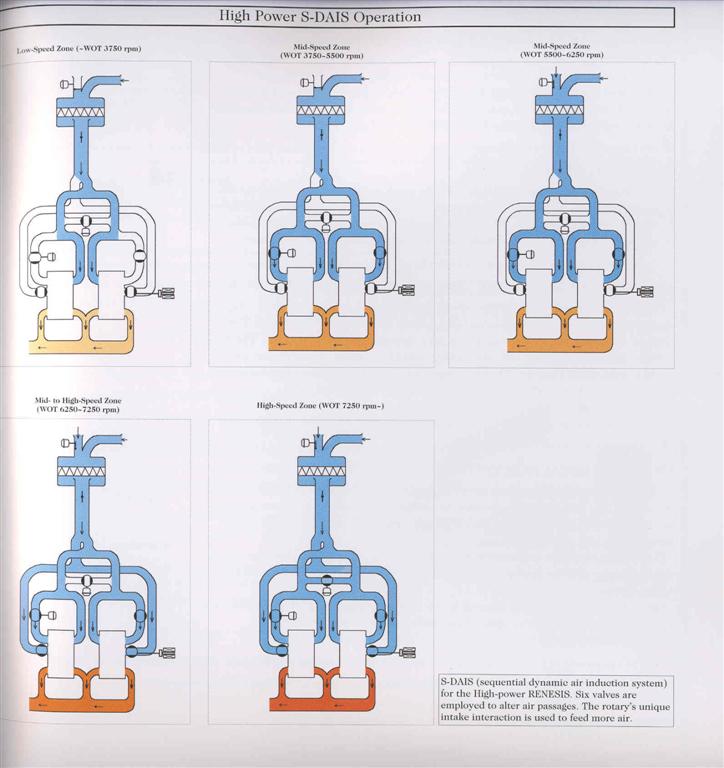
Ok so what is making those noises when you accellerate? the intake used on the RX-8 is called the Sequential Dynamic Air Iduction System or S-DAIS for short. it looks sort of like the diagram in the next post. what you hear at those rpms when the intake tracts open is a barrel shaped valve that is operated electronically turning inside the intake "tube" to open it's specific tract. the intake tracts open at specific rpms regardless of throttle position. althouigh i think, and i may be wrong on this point, that the VFAD- variable fresh air duct my be throttle position sensitive in relation to it's option of opening at 5500.
What happens when :
RPM___SYSTEM_______WHAT
3750__Fuel Injectors__#2 primary and secondary injector start
___________________controlled by ECU fuel maps
___________________(All in use during WOT!?!)
3750__SDAIS________#2 primary intake ports open
5500__SDAIS________VFAD may open (Yamaguchi p 115)
6250__SDAIS________Tertiary intake ports open
7250__SDAIS________Primary intake ports interconnnect
___________________adds a second shorter path
7250__SDAIS________VFAD opens on WOT
What happens when :
RPM___SYSTEM_______WHAT
3750__Fuel Injectors__#2 primary and secondary injector start
___________________controlled by ECU fuel maps
___________________(All in use during WOT!?!)
3750__SDAIS________#2 primary intake ports open
5500__SDAIS________VFAD may open (Yamaguchi p 115)
6250__SDAIS________Tertiary intake ports open
7250__SDAIS________Primary intake ports interconnnect
___________________adds a second shorter path
7250__SDAIS________VFAD opens on WOT
Last edited by zoom44; Apr 1, 2004 at 08:27 PM.
Thread Starter
Administrator
Joined: Jul 2002
Posts: 21,958
Likes: 115
From: portland oregon
as was mentioned in the other thread that this spun off of, others have thought the intake opening sounds were "pinging" or "bearings". for instance in this thread http://www.rx8club.com/showthread.ph...ake#post260674
Last edited by zoom44; Apr 1, 2004 at 08:19 PM.

New Member
Joined: Mar 2003
Posts: 9,944
Likes: 2
From: Melbourne, Australia
My question around that idea and talk about the intake - as you see on the top of the diagram there is a valve> that valve as I saw in some video is just outside the air intake... as the wavy lines below that is the air box (I suppose)...
when we do intake - which got rid of the box.... won't we just let it all open????
If the answer is yes then... do we tune the ECU/piggyback to make it better...
THANK YOU VERY MUCH TO THE ANSWER IN ADVANCE.
Taka
when we do intake - which got rid of the box.... won't we just let it all open????
If the answer is yes then... do we tune the ECU/piggyback to make it better...
THANK YOU VERY MUCH TO THE ANSWER IN ADVANCE.
Taka

Registered
Joined: Apr 2003
Posts: 9,134
Likes: 26
From: Houston
Here's all you ever wanted to know about the RX-8 intake.
Aftermarket intakes only do away with VFAD. No there is no ecu retuning to account for this. There are gains (very small) though but they are based on total airflow vs resonant tuning. Somone needs to make a resonant tuned intake that flows good too. This would yield bigger gains that ANYONE else's intake system out there. I've said it here for almost a year now and still no one has done it.
I am not sure but I should at least hope that each valve and VFAD open at a set rpm regardless of load. Tuning is rpm based not load based. This would make the most sense.
If you look at the diagram very carefully you can see how everything works. The wavy lines are the air filter in the airbox. This set of diagrams is the 6 port engine. There is also one of the 4 port engine but not pictured here. It is very similar but lacks 2 intake ports and the VFAD duct on the intake.
Below 3750 rpm, only the primary (2 center ports) are receiving air. This insures that all of the airflow going into the engine is at a high velocity unlike the older rotaries where all of the ports were open at the same time. Mazda tried to overcome this problem with a 3 plate throttlebody and only opening the primary plate alone unit 20% throttle. It is a little complicated and I don't want to explain it all here. Let's just say this (Renesis) is superior.
At 3750 rpm when airflow is at its greatest and is starting to hurt power (intake airspeed around .6 mach), the secondary ports open up. Obviously this is why the fuel injectors are fired sequentially so there is no fuel in a nonmoving runner. Now we have a total of 4 ports being used until 6250 rpm. This again becomes a flow restriction and the tertiary ports open up.
At 7250 rpm the VDI (Variable Dynamic Intake as known on the 2nd gen RX-7) valve opens up which retunes the intake for higher rpm use. I'll explain it in a minute. Also at 7250 rpm the VFAD duct on the intake box opens up. This does a couple of things. It does allow a shorter more direct route for air to enter but that is really a moot point. More importantly it retunes the intake box. The stock airbox size along with the intake duct's length and width combine to acoustically tune the airbox to resonate at a certain frequency. This frequency is set to help the engine gain power at lower rpms. When the VFAD duct opens, it is retuning the intake box and adding its own area to the available area for air to flow through. It does a pretty good job considering that it is only a few horsepower less than the aftermarket cone filter systems but has the capability for way less ariflow. The total area for air to enter the stock box is less than the area of either the throttlebody or the MAF sensor. If Mazda would have given it a little more intake area with the same tuning, the aftermarket probably would have never outdone it. If you want to figure out the perfect size for the intake tube, figure out the diameter necessary for air entering the box at 8500 rpms to not exceed 122.74 mph. That will be the optimum size. Length will be determined based on tuning rpm and intake box size. There is a fun exercise for someone.
Back to the subject of VDI. The reason this valve opens is to retune the intake manifold so the engine thinks the runners are shorter. I've posted this before but here it is again. The intake runner lengths are determined by what rpm the designers want a gain to be at. The continuously variable intake runner length as on the LeMans 787B car is not feasible in a streetcar but we can partially simulate the effects. When VDI opens, the pulses from one rotor do not have to go back to a central point before heading back down the opposite runner to either help or hurt it. In essence when the VDI valve is open, the engine only "sees" the runner up to the valve and not after (before depending on your frame of reference) it. Here's the effective lengths.
6 port "effective" intake runner lengths.
Primary VDI closed 19.8"
Secondary VDI closed 20.4"
Primary VDI open 13.5"
Secondary VDI open 14.2"
Tertiary always 17.3" VDI does not effect these runners.
4 port "effective" intake runner lengths.
Primary VDI closed 27.1"
Secondary VDI closed 29.1"
Primary VDI open 14.8"
Secondary VDI open 16.5"
As you can see when the valve opens it is like installing a shorter intake manifold which retunes for better high end power. The real black art is designing an entire system that works together almost seemlessly. Mazda did a very good job on this intake manifold. It is much better than anything they have ever done and most likely will be very tough to improve upon without some big sacrifices elsewhere in the powerband.
The dips in power as seen on the dyno are the valves opening. The problem isn't so much that there is a pressure drop causing the dips but rather than the valves don't open quick enough. They are not electrically opened as other here have stated. They are opened pneumatically. The electric confusion comes from the fact that there is a solenoid that electrically opens at a set rpm that allows air to flow to the actuators which causes them to open. If a reliable servo could be found, it would be a better system. The faster the better.
I forgot to mention another length difference between the 4 and 6 port engines. The intake duct going into the airbox is not the same between both engines. The 4 port engine does not just use the long pipe from the 6 port engine. It uses a longer pipe. Obviously it does not have the VFAD duct either. Different engine require different tunings.
I wonder if I forgot anything else?
Aftermarket intakes only do away with VFAD. No there is no ecu retuning to account for this. There are gains (very small) though but they are based on total airflow vs resonant tuning. Somone needs to make a resonant tuned intake that flows good too. This would yield bigger gains that ANYONE else's intake system out there. I've said it here for almost a year now and still no one has done it.
I am not sure but I should at least hope that each valve and VFAD open at a set rpm regardless of load. Tuning is rpm based not load based. This would make the most sense.
If you look at the diagram very carefully you can see how everything works. The wavy lines are the air filter in the airbox. This set of diagrams is the 6 port engine. There is also one of the 4 port engine but not pictured here. It is very similar but lacks 2 intake ports and the VFAD duct on the intake.
Below 3750 rpm, only the primary (2 center ports) are receiving air. This insures that all of the airflow going into the engine is at a high velocity unlike the older rotaries where all of the ports were open at the same time. Mazda tried to overcome this problem with a 3 plate throttlebody and only opening the primary plate alone unit 20% throttle. It is a little complicated and I don't want to explain it all here. Let's just say this (Renesis) is superior.
At 3750 rpm when airflow is at its greatest and is starting to hurt power (intake airspeed around .6 mach), the secondary ports open up. Obviously this is why the fuel injectors are fired sequentially so there is no fuel in a nonmoving runner. Now we have a total of 4 ports being used until 6250 rpm. This again becomes a flow restriction and the tertiary ports open up.
At 7250 rpm the VDI (Variable Dynamic Intake as known on the 2nd gen RX-7) valve opens up which retunes the intake for higher rpm use. I'll explain it in a minute. Also at 7250 rpm the VFAD duct on the intake box opens up. This does a couple of things. It does allow a shorter more direct route for air to enter but that is really a moot point. More importantly it retunes the intake box. The stock airbox size along with the intake duct's length and width combine to acoustically tune the airbox to resonate at a certain frequency. This frequency is set to help the engine gain power at lower rpms. When the VFAD duct opens, it is retuning the intake box and adding its own area to the available area for air to flow through. It does a pretty good job considering that it is only a few horsepower less than the aftermarket cone filter systems but has the capability for way less ariflow. The total area for air to enter the stock box is less than the area of either the throttlebody or the MAF sensor. If Mazda would have given it a little more intake area with the same tuning, the aftermarket probably would have never outdone it. If you want to figure out the perfect size for the intake tube, figure out the diameter necessary for air entering the box at 8500 rpms to not exceed 122.74 mph. That will be the optimum size. Length will be determined based on tuning rpm and intake box size. There is a fun exercise for someone.
Back to the subject of VDI. The reason this valve opens is to retune the intake manifold so the engine thinks the runners are shorter. I've posted this before but here it is again. The intake runner lengths are determined by what rpm the designers want a gain to be at. The continuously variable intake runner length as on the LeMans 787B car is not feasible in a streetcar but we can partially simulate the effects. When VDI opens, the pulses from one rotor do not have to go back to a central point before heading back down the opposite runner to either help or hurt it. In essence when the VDI valve is open, the engine only "sees" the runner up to the valve and not after (before depending on your frame of reference) it. Here's the effective lengths.
6 port "effective" intake runner lengths.
Primary VDI closed 19.8"
Secondary VDI closed 20.4"
Primary VDI open 13.5"
Secondary VDI open 14.2"
Tertiary always 17.3" VDI does not effect these runners.
4 port "effective" intake runner lengths.
Primary VDI closed 27.1"
Secondary VDI closed 29.1"
Primary VDI open 14.8"
Secondary VDI open 16.5"
As you can see when the valve opens it is like installing a shorter intake manifold which retunes for better high end power. The real black art is designing an entire system that works together almost seemlessly. Mazda did a very good job on this intake manifold. It is much better than anything they have ever done and most likely will be very tough to improve upon without some big sacrifices elsewhere in the powerband.
The dips in power as seen on the dyno are the valves opening. The problem isn't so much that there is a pressure drop causing the dips but rather than the valves don't open quick enough. They are not electrically opened as other here have stated. They are opened pneumatically. The electric confusion comes from the fact that there is a solenoid that electrically opens at a set rpm that allows air to flow to the actuators which causes them to open. If a reliable servo could be found, it would be a better system. The faster the better.
I forgot to mention another length difference between the 4 and 6 port engines. The intake duct going into the airbox is not the same between both engines. The 4 port engine does not just use the long pipe from the 6 port engine. It uses a longer pipe. Obviously it does not have the VFAD duct either. Different engine require different tunings.
I wonder if I forgot anything else?
Last edited by rotarygod; Apr 2, 2004 at 01:51 AM.

Thread Starter
Administrator
Joined: Jul 2002
Posts: 21,958
Likes: 115
From: portland oregon
thansk for the input. i thought about just quoting some of your posts from prvious discussions but wanted to give you a chance to way in here. you have put it together very neatly. thanks again rotarygod!

Power!!
Joined: Feb 2004
Posts: 4,412
Likes: 3
From: Sunny See attle
I have a related question and I would like to know if anyone else is experiencing the same thing...between 3200-3700 RPM when I'm accelerating, regardless of how hard, I hear a rasping or rattling sound coming from under the hood.
The Dealer also heard it when I took it in for an oil change. They didn't have time to get into it since I couldn't leave it. I first thought this may have been noise from the other intake runners opening up but according to the above posts it sounds like it's too early in the rpm band. Could it be misfiring? Is this normal? Does anyone else have the same sounds? (You'd know if you did) Would the "L" flash help fix this if it is detonation?
The Dealer also heard it when I took it in for an oil change. They didn't have time to get into it since I couldn't leave it. I first thought this may have been noise from the other intake runners opening up but according to the above posts it sounds like it's too early in the rpm band. Could it be misfiring? Is this normal? Does anyone else have the same sounds? (You'd know if you did) Would the "L" flash help fix this if it is detonation?

 Almost....
Almost, Mr. God,
The air shutter valve, up front, IS a vacuum flap, operated by a solenoid signal, but the Auxiliary port 'barrel valves' are MOTOR operated.
S
sorry for the crappy scan....
The air shutter valve, up front, IS a vacuum flap, operated by a solenoid signal, but the Auxiliary port 'barrel valves' are MOTOR operated.
S
sorry for the crappy scan....
Registered
Joined: Apr 2003
Posts: 9,134
Likes: 26
From: Houston
Re: Almost....
Originally posted by StealthTL
Almost, Mr. God,
The air shutter valve, up front, IS a vacuum flap, operated by a solenoid signal, but the Auxiliary port 'barrel valves' are MOTOR operated.
S
sorry for the crappy scan....
Almost, Mr. God,
The air shutter valve, up front, IS a vacuum flap, operated by a solenoid signal, but the Auxiliary port 'barrel valves' are MOTOR operated.
S
sorry for the crappy scan....
Here is a picture of the lower Renesis manifold. The secondary runners and the VDI valve are vacuum actuators. Judging by the gears it does appear that only the auxillary valves are operated with a motor. I don't want to use a motor to spin like Mazda did but rather an electric actuator that moves back and forth instantly. Mazda didn't do this anywhere.
Last edited by rotarygod; Apr 4, 2004 at 06:52 PM.
Registered
Joined: Apr 2003
Posts: 9,134
Likes: 26
From: Houston
Originally posted by takahashi
Oh God... so are you saying that it is not worth JUST putting a "mushroom" (CAI) in with out anything like a Turbo or S/C or has a ECU retune wtih a piggyback?
Oh God... so are you saying that it is not worth JUST putting a "mushroom" (CAI) in with out anything like a Turbo or S/C or has a ECU retune wtih a piggyback?
Power!!
Joined: Feb 2004
Posts: 4,412
Likes: 3
From: Sunny See attle
Originally posted by rotarygod
Somone needs to make a resonant tuned intake that flows good too. This would yield bigger gains that ANYONE else's intake system out there. I've said it here for almost a year now and still no one has done it.
Somone needs to make a resonant tuned intake that flows good too. This would yield bigger gains that ANYONE else's intake system out there. I've said it here for almost a year now and still no one has done it.
https://www.rx8club.com/showthread.p...ght=aem+intake
And I have a hunch, based on their V2 history, they are doing excatly what you asked for...

Thread Starter
Administrator
Joined: Jul 2002
Posts: 21,958
Likes: 115
From: portland oregon
Originally posted by shaunv74
Could it be misfiring? Is this normal? Does anyone else have the same sounds? (You'd know if you did) Would the "L" flash help fix this if it is detonation?
Could it be misfiring? Is this normal? Does anyone else have the same sounds? (You'd know if you did) Would the "L" flash help fix this if it is detonation?

RX-7 Guru
Joined: Jan 2003
Posts: 347
Likes: 6
From: Pensacola, FL
Fudging through the translation, Greddy's new intake is supposed to be tuned to some extent -
http://www.trust-power.com/mazda/rx8.../airinx_b.html
From what I can tell, it's supposed to be better than a regular cone intake, but I can't tell if it still uses some sort of actuator, or they just have a tuned length/size for the intake.
Dale
http://www.trust-power.com/mazda/rx8.../airinx_b.html
From what I can tell, it's supposed to be better than a regular cone intake, but I can't tell if it still uses some sort of actuator, or they just have a tuned length/size for the intake.
Dale
Registered
Joined: Apr 2003
Posts: 9,134
Likes: 26
From: Houston
Greddy has what I would consider the best alternative currently out there. It's size and length should give the car more usable power lower in the powerband than the others out there. It probably doesn't do much for ultimate top end but we don't all drive there anyways. It does not have an actuator at all. Just really long.
An unnamed but respected person on the forum here has claimed that the MAF would get bad readings because the air has too much velocity in this format. Doesn't the air have high velocity at high rpm's anyways? I find this to be a poor excuse against this intake.
Several people here have commented about how worried they are of sucking up water through the intake. It is nearly impossible without purposely driving through a flood as it would take about 90% of the filter being submerged for a period of time along with high rpms for this to happen. Someone has to be really careless to drive through water that high. My little Honda has a filter this low and I have never had a problem.
An unnamed but respected person on the forum here has claimed that the MAF would get bad readings because the air has too much velocity in this format. Doesn't the air have high velocity at high rpm's anyways? I find this to be a poor excuse against this intake.
Several people here have commented about how worried they are of sucking up water through the intake. It is nearly impossible without purposely driving through a flood as it would take about 90% of the filter being submerged for a period of time along with high rpms for this to happen. Someone has to be really careless to drive through water that high. My little Honda has a filter this low and I have never had a problem.
Last edited by rotarygod; Apr 5, 2004 at 05:02 PM.
Power!!
Joined: Feb 2004
Posts: 4,412
Likes: 3
From: Sunny See attle
Thanks. I'll have to ask them to take a look at it when I bring it in next. It sounds like a rattle that comes on at a specific rpm range for a specific duration under acceleration. If the computer stores a code then they'll find it easily enough.
Thanks '44.
Thanks '44.

Registered User
Joined: Dec 2003
Posts: 49
Likes: 0
From: Orlando
Now that I am off the ceiling from my engine ordeal. Thanks for the info on the intake system Zoom44. The new engine seems to run better now that I have run a couple of tanks of gas in it.I still get that noise/ping but only about 10 to 20 percent of the time. do you think it could have been gas problems? Is there a learning time in the computer because they gave me the L flash with the new engine. It is much better now than last week.

0.19 posts per day
Joined: Feb 2004
Posts: 246
Likes: 0
From: Chicagoland, IL
[QUOTE]"I have a related question and I would like to know if anyone else is experiencing the same thing...between 3200-3700 RPM when I'm accelerating, regardless of how hard, I hear a rasping or rattling sound coming from under the hood.
The Dealer also heard it when I took it in for an oil change. They didn't have time to get into it since I couldn't leave it. I first thought this may have been noise from the other intake runners opening up but according to the above posts it sounds like it's too early in the rpm band. Could it be misfiring? Is this normal? Does anyone else have the same sounds? (You'd know if you did) Would the "L" flash help fix this if it is detonation?"
I experienced somethig that sounds a bit like this. I would hear the noise in the lower RPMs and when I was decelerating. To me it sounded like it was coming from the transmission. Upon further investigation I ruled this out by simply having some one rev the motor while I stood outside the car. We realized it was coming from the exhaust and not the trans. I thought it might be gravel or something. Anyway, I dropped the car of at dealer to have them fix it and was suprised to hear that I had somehow blown out the catylst from the catalytic converter. The only explanation I can think of, short of a faulty catalytic converter, is that when I drove through a rather deep and long puddle the other night the rapid cooling on the outside followed by my rapid acceleration some how cracked the catalyst and then blew it into the exaust pipe. If anyone else has a theory or a similar experience, please share.
The Dealer also heard it when I took it in for an oil change. They didn't have time to get into it since I couldn't leave it. I first thought this may have been noise from the other intake runners opening up but according to the above posts it sounds like it's too early in the rpm band. Could it be misfiring? Is this normal? Does anyone else have the same sounds? (You'd know if you did) Would the "L" flash help fix this if it is detonation?"
I experienced somethig that sounds a bit like this. I would hear the noise in the lower RPMs and when I was decelerating. To me it sounded like it was coming from the transmission. Upon further investigation I ruled this out by simply having some one rev the motor while I stood outside the car. We realized it was coming from the exhaust and not the trans. I thought it might be gravel or something. Anyway, I dropped the car of at dealer to have them fix it and was suprised to hear that I had somehow blown out the catylst from the catalytic converter. The only explanation I can think of, short of a faulty catalytic converter, is that when I drove through a rather deep and long puddle the other night the rapid cooling on the outside followed by my rapid acceleration some how cracked the catalyst and then blew it into the exaust pipe. If anyone else has a theory or a similar experience, please share.
Thread Starter
Administrator
Joined: Jul 2002
Posts: 21,958
Likes: 115
From: portland oregon
Originally posted by Topgun
Now that I am off the ceiling from my engine ordeal. Thanks for the info on the intake system Zoom44. The new engine seems to run better now that I have run a couple of tanks of gas in it.I still get that noise/ping but only about 10 to 20 percent of the time. do you think it could have been gas problems? Is there a learning time in the computer because they gave me the L flash with the new engine. It is much better now than last week.
Now that I am off the ceiling from my engine ordeal. Thanks for the info on the intake system Zoom44. The new engine seems to run better now that I have run a couple of tanks of gas in it.I still get that noise/ping but only about 10 to 20 percent of the time. do you think it could have been gas problems? Is there a learning time in the computer because they gave me the L flash with the new engine. It is much better now than last week.

Registered User
Joined: Sep 2003
Posts: 886
Likes: 0
From: Liberty Hill, TX (Austin)
ShaunV
I have the raspy / rattling sound as well. I think mine is related to the crack-able (cracked?) housing above the tranny. I haven't taken it in for the recall yet, but when I do I'll tell them about it and see if any codes are stored.

Ricer is Nicer.....
Joined: Apr 2002
Posts: 547
Likes: 1
From: Canada.
 Water suckage....
I have to agree with you, rotarygod, the concern for sucking in water thru the CAI type intake is way overblown.
I'm pretty sure it is an urban myth, everyone knows someone who's 'friend' went thru a little puddle and blew the heads off their WRX/civic/Evo (whatever).
This scenario doesn't 'hold water' if you do the math - revs/water depth/amount per cylinder/vacuum required to lift water head etc.
Probably just perpetuated by the vendors of those 'foam-anti-suck' valves....don't get me started!
Also, this thread has got this far without mentioning the word 'Helmholtz'. This is not allowed. Don't ask me, it is one of Wakeech's rules.
.
.
.
doc
I'm pretty sure it is an urban myth, everyone knows someone who's 'friend' went thru a little puddle and blew the heads off their WRX/civic/Evo (whatever).
This scenario doesn't 'hold water' if you do the math - revs/water depth/amount per cylinder/vacuum required to lift water head etc.
Probably just perpetuated by the vendors of those 'foam-anti-suck' valves....don't get me started!
Also, this thread has got this far without mentioning the word 'Helmholtz'. This is not allowed. Don't ask me, it is one of Wakeech's rules.
.
.
.
doc