View Full Version : Ethanol Fuel Discussion Here


FloppinNachos
03-19-2008, 11:36 AM
Post any ethanol related stuff here, but read this first. http://www.drivingethanol.org/motorsports/racing_fuel_characteristics.aspx

Advantages of Ethanol Enriched Racing Fuels
HORSEPOWER: Because Ethanol contains oxygen, it has a very low power stoichiometric when compared to gasoline fuels (6.5 compared to 12.5). Ethanol must be run at much richer mixtures than gasoline, more than offsetting the lower energy per unit volume. The net energy released per cycle is higher and this results in more horsepower.

For example, if gasoline is run at its preferred max power air fuel mixture of 12.5/1, it will release approximately 19,000 BTU's of energy, where ethanol run at its preferred power stoichiometric of 6.5/1 will release approximately 24,400 BTU's. By comparison, methanol releases slightly more, about 27,650 BTU's. The more ethanol there is in gasoline, the more powerful it is as a motor fuel. Typically, you can expect at least 5% more horsepower at the rear wheels of a vehicle running on E-85 than one burning gasoline only.

INCREASED ENGINE LIFE: Ethanol has a very high MON octane rating, allowing engine builders to run higher compression ratios without fears of destructive detonation. It also has a very high Latent Heat of Vaporization, so the engine is cooled far better than one running on gasoline. This lowers bottom end and oiling system temperatures substantially.

rotarygod
03-19-2008, 03:06 PM
Do you really want to be wrong in more than one thread? I mean seriously give it up.

You are quoting an ethanol website. They will make any results favor them. You are also using the excuse that there is oxygen in it which takes up space. That's a part of the fuel. Remove it. How about quoting an unbiased source for once? Don't quote yourself either. That didn't work in the last thread. Here's one. Read it. Study it. Learn it. Even though it was written when gas prices were lower, the info remains valid.

http://zfacts.com/p/436.html

You try to skew the facts in your favor by saying mileage isn't indictive of efficiency. You try to skew the results by saying that btu content isn't a measure of efficiency. You try to skew the results by removing a certain property of the fuel you are arguing for. If these aren't indicitive of efficiency, nothing is!

The only thing you are focusing on is the fact that at each fuels stoich a/f ratio, that more energy is being released. That's fine but you are ignoring the fact that it takes FAR more ethanol than gasoline to reach stoich which means on an even amount basis by volume, it's less efficient! The really sad part is that in the real world even an engine running on pure ethanol at stoich is STILL making less power than a gasoline engine at stoich, all things remaining unchanged in the engine of course. Yes I am accounting for proper tuning for each fuel.

I'm not too sure how long it's going to take to figure this out but when I was 17 I was equally as stubborn about things I didn't fully understand too. We've all been there.

StealthTL
03-19-2008, 03:08 PM
We don't have the "higher compression ratio" to recover the power lost in the changeover, so net effect is a power loss.

Add the fact that a full tank will take me roughly half the distance, you have a lose-lose proposition.

Unless you work for Archer-Daniels Midland, the biggest winner in the food-to-fuel scam, (and also the biggest government lobbyist) corn ethanol is a dead end on the road to alternative fuels.

Around here we have the same agri-business lobby grabbing the same ethanol subsidies from the our government - except up here the ethanol must, by law, be made from Western Canada Prairie Grain. Because our farmers don't grow corn. If you think this is about energy self-sufficiency you are blinkered......


S

rotarygod
03-19-2008, 03:11 PM
A higher compression ratio will help recover SOME of the losses. It still won't make up for all of it though.

FloppinNachos
03-19-2008, 04:33 PM
I just don't know, do you have any dyno numbers? The chemistry says it should make more power...

mac11
03-19-2008, 04:36 PM
with almost twice the fuel.

RWagz
03-19-2008, 04:42 PM
I just don't know, do you have any dyno numbers? The chemistry says it should make more power...

We all know you have little knowledge about chemistry. In the previous thread you thought methanol had higher energy density than ethanol. Next you'll tell us that hybrid cars are going to save the environment.

rotarygod
03-19-2008, 05:26 PM
"Should" and "Do" don't always end up being the same thing. This is why things that are based in theory must also be tested to be either confirmed or disproved.

I do think that Ethanol has it's place. I think we should make it from waste which is also known as cellulosic ethanol. This is where I'd like to see the small amount that we blend originate from. This way we are making something from nothing and not from corn. While we don't have a food shortage in regards to corn as most of it gets fed to cows, it is driving prices up and effecting other markets. Even hops for beer have grown more scarce and expensive because farmers are planting corn instead due to prices increasing. Ethanol will never be more efficient than gasoline but it does have it's place if done correctly.

RWagz
03-19-2008, 05:34 PM
Only cash-cropping corn farmers have waste. Us normal folks use the whole plant sans roots. Silage.

rotarygod
03-19-2008, 05:44 PM
You can make ethanol from any waste that contains sugars or starches. It doesn't have to just be corn. It could be pumpkins, fruit, etc... Waste in general. There is even a special yeast strain that can break down grasses into ethanol but it's a patented product owned by a company whose name I forgot. That company is owned by Chevron though! Can you imagine using grass clippings from mowing your lawn to contribute to ethanol! It wouldn't be much but every little bit adds up. You could get a sizable amount of ethanol from all of our waste products.

MikeW
03-19-2008, 06:20 PM
Engines are air pumps. Unless you are a top fuel dragster, you aren't limited by the amount of fuel you can deliver.

E10 gas stinks in the US.
Big oil reduces the AKI of the fuel base stock so that the gain in AKI from the 10% ethanol results in no change in fuel AKI. It is still 87,89,91.

That is nuts. It should be raised to 87,90,93.
So no change for the people who purchase regular, Mid-grade is raised so that vehicles with engines that require European mid-grade (95RON) can save 10 cents a gallon by purchasing mid-grade instead of premium.
and the US premium can match European mid-grade, 98RON.

alnielsen
03-19-2008, 06:29 PM
Using corn, a food product, to make our ethanol is ruining our economy. I would rather see grasses use in the process.
Is there any reason the the RX8, with a proper tune, can't use E85? Especially in FI applications?

MikeW
03-19-2008, 06:39 PM
Oh and I forgot the 3.25+-0.25% drop in mileage from 10% ethanol
Also the 20% drop from E70, 25% drop from E85.

So you it costs you more to drive.

The only performance gains from from turbocharged engines, where you can get more boost because of the higher AKI.

mac11
03-19-2008, 06:44 PM
Oh and I forgot the 3.25+-0.25% drop in mileage from 10% ethanol
Also the 20% drop from E70, 25% drop from E85.

So you it costs you more to drive.

The only performance gains from from turbocharged engines, where you can get more boost because of the higher AKI.


I've read some technical papers that show the drop in mileage using E85 is not nearly as severe when using a motor and tune setup exclusively for the fuel, not a flex fuel system. Ethanol still did not make the same fuel economy as regular gasoline, however.


We need to start developing battery and storage technology so we can start using solar power. It's not renewable but it sure is abundant.

FloppinNachos
03-19-2008, 06:48 PM
We all know you have little knowledge about chemistry. In the previous thread you thought methanol had higher energy density than ethanol. Next you'll tell us that hybrid cars are going to save the environment.

what are you talking about? I do have a fair amount of knowledge in chemistry...

especially stoich.


but, honestly, i dont give two slides of a sandy fuck about this topic anymore.

RWagz
03-19-2008, 07:22 PM
:pokeowned

CERAMICSEAL
03-19-2008, 07:54 PM
what are you talking about? I do have a fair amount of knowledge in chemistry...

especially stoich.


but, honestly, i dont give two slides of a sandy fuck about this topic anymore.

Wow,

If you're going to play with the big boys you need to think like the big boys (Or out think them). Internet battling isn't always fun. You are more knowledgeable about fuels than I am but you won't convince anyone of your opinion (Right or wrong) by letting them get to you and getting upset. YOU started this and it's good for general education for us to continue this.

Just my public 2 cents to you my dear friend. Hit um civil-like bro :) .

Seal.

RWagz
03-19-2008, 08:23 PM
The only thing he knows about fuels is what he's read on drivingethanol.org.

kartweb
03-19-2008, 09:33 PM
You can love it, you can hate it, that won't matter, ethanol is here to stay.

We did a little dyno testing with various fuels back when we ran shifter karts. Straight up an engine tuned for gas was more powerful on gas, 2 stroke and 4 stroke. Likewise, an engine tuned to ethanol was more powerful on ethanol.

Our test gasoline was Phillips B32 which is the exact same formula as T111 today. We also tried a few others in various mixtures;


B42 - 3% oxygenated
Toluene (pure)
Methanol
Propylene Oxide
Lacquer Thinner
Acetone
Nitromethane


We used CR125 2 strokes and a 250cc Biland 4 stroke.

The B32 gas has higher octane then the ethanol, but it burns faster. Major advance to the timing (we use a Programmable Ignition system).

Ethanol consistently provided more power then gasoline did. Methanol is even better. Add a little acetone and it burns faster - not as fast as gas, but enough to back off the timing. And viola, even more power.

Toluene is good stuff but as good as Del'Orto carbs are it was downright difficult to tune consistently across the throttle/RPM range. Strong sweet yet acrid exhaust smell.

Propylene Oxide was a great oxygenator but it boils away too quickly.

Nitromethane at 15% should have been incredible. Tuning it was a bitch. It fouled my O2 sensors before I could get a decent reading. It leaves a brown residue on everything so we coudn't go by color. Not to mention melting holes through a couple of CR125 pistons.

Lacquer Thinner? Toluene, Methanol, Acetone and Methyl Ethyl Ketone was the cat's ass. I think someone was really trying to formulate the perfect fuel and realized it was a great paint solvent afterwards. Too bad it has such a strong odor that screams ILLEGAL FUEL.

Back to ethanol & E85. I've not tried it in the RX8, but have mixed a bit in the CX7 to roughly 30% ethanol. Sure enough it drinks more fuel. No real difference in 0-80 MPH time, but it definately is more crisp when pushing the throttle enough for a downshift. Probably more to due with the way Mazda tuned the CX7.

I think we'll see gas hit $5 a gallon long before we see it drop to $2 a gallon. Petroleum prices have no reason to drop by much, and every reason to keep climbing. China and India now have a population that wants to burn gasoline too. Like the US they buy from foreign sources, the same sources we buy from. Small world you say?

Ethanol is hardly a perfect solution. But its been proven to work and relatively easy to adapt the production technology to use. If some great new engine that ran on dogshit was invented today, how long would it take to replace the American fleet of cars? For that matter how long would it take to breed dogs quickly enough for fuel?

It all takes time. There will be no instant gratification on a cheap new motor fuel. Thats why ethanol is here to stay.

Oh, yeah, when folks use the word efficiency they should understand what it means. Basically its a ratio of energy in/energy out. It has nothing to do with the volume of liquid in/energy out.

mac11
03-19-2008, 11:28 PM
Oh, yeah, when folks use the word efficiency they should understand what it means. Basically its a ratio of energy in/energy out. It has nothing to do with the volume of liquid in/energy out.

This is absolutely not an advocation for any type of fuel but what also needs to be considered is the energy put into creating the fuel. The entire segway from natural resource to final exhaust burp needs to be taken into account. What good have you done using a cleaner burning fuel if you've created more polution and used more energy during production?

refugeefrompistons
03-19-2008, 11:59 PM
Use of the fodder is also a problem. You are removing a natural fertilizer that will need to be replaced with an artificial one that is a product of natural gas.

The best use of ethanol is as supplement. Is it not one of the best additives to gasoline for our emissions laws?

kartweb
03-20-2008, 01:01 AM
Once upon a time there were oil wells so shallow all it took was an hour with a shovel to dig deep enough to ignite a fire pit that would burn for a few days. Those days are long gone. Man has managed to either tap or drain all the "easy" oil.

The next phase of oil is either below 7000 feet of dirt, or the Tar Sands in Ft. McMurray Canada, or even encased in the sandstone on Colorado. Sure there is more oil in the ANWR but its loaded with sulpher. But it ain't cheap and it takes a lot of energy to extract.

Tar Sands are the least costly of the new virgin reserves to extract. That takes shovels capable of 100 tons per scoop and trucks capable of hauling 400 tons across soft wet sand (running 24/7/365) to haul the Tar Sand to a refinery, then large doese of heat and water to remove the oil, then returning the sand to where it came from. Each gallon of oil takes about half a gallon to extract.

There are all sorts of urban legends about how much energy ethanol takes to produce. Here is the bottom line;

At current production costs per BTU, ethanol is less then 75% of oil in production cost. Thats before taxes and profits. Ethanol production cost still has a lot of promising technology to reduce cost further, while oil will only increase.

No one is giving free oil away to manufacture ethanol so that oil it takes to manufacture is already included in the price we pay.

One could argue that other energy sources like coal to fire electrical generation plants are involved in the production of ethanol, and thats true. Keep in mind those costs also are included in the price.

The US won't be shifting to ethanol overnight, it will be slow and gradual, but it will happen. At the same time other oil sources like those mentioned above will come on line.

It won't be the greepeace people behind ethanol, its entirely a matter of economics. Unless of of course, someone invents a dogshit engine.

Ike
03-20-2008, 02:07 AM
Ethanol in the US is such political bullshit. Corn is one of the least efficient crops to use for ethanol production but lobbyists and subsidies have caused the average american to think that E85 ethanol is great because it comes from corn. However, I don't know how much Sugarcane production we're capable of. But it seems we'd be much better off dumping a bunch of money in some poor country with a tropical climate to produce our ethanol for us. This statement is mind boggling to me... "fill up an SUV's fuel tank with ethanol and you have used enough maize to feed a person for a year".

http://www.economist.com/research/articlesBySubject/displaystory.cfm?subjectid=7216688&story_id=10252015

Flashwing
03-20-2008, 04:01 AM
Everyone is looking for a silver bullet in regards to fixing the oil crisis.

I'm afraid currently there isn't one. There's a reason that gasoline and oil based fuels are used so much and that's because of the abundance of the product combined with the high amount of energy stored within oil itself. Whether or not the products "cost" is less than oil, the overall amount of energy used to produce Ethanol either equals or outweighs what Ethanol yields.

A good example would be working for $100 a day and then deciding to work for $50 doing the same amount of work. It makes no sense.

Using Ethanol or other food related sources of energy is simply a bad idea because it drives up the costs of other food related items. Farmers are now switching to Corn instead of growing other food items driving up cost and increasing inflation.

The issue at had is whether Ethanol works as a fuel. It simply fails. Oil is about 5 times more efficient than Ethanol and that process changes very little when it's refined into gasoline.

Ethanol is being pushed because of farmer lobbists and the want of these people to keep selling a product all while being supported by the federal government. It's nothing more than an attempt to make serious cash by selling people on a bogus lie that Ethanol will solve our problems and make us energy independant.

The ONLY way you will see fuel prices come down is for the US government to allow oil companies to expand drilling and exploration, ease restrictions on building refineries, and lower or better use gas tax revenue.

Bio fuel, Ethanol, or anything else that involved burning FOOD for energy is a seriously bad idea and will only result in economic upsets. Oil is the blood of our economy and that's not going to change.

crispeed
03-20-2008, 06:20 AM
I have never made less power with any of the alcohol or ethanol fuels at the same AFR's/lambda values on both NA or boosted setups for both rotary or piston applications.
I've also never got the same fuel efficency as regular fuel. That will never happen. Now when you're dealing with E-70-85 type ethanol fuels then you're not really say using 100% alcohol/ethanol type fuels so the results are deffinately going to be different. I still don't believe you will ever be able to get the same efficency although some people have gone great lengths to prove that it's possible. It might be if you can run the compression ratio close to what say diesels run since it's very possible and have been done using 100% alcohol/methanol type fuels.
Only one way to find out.:lol:

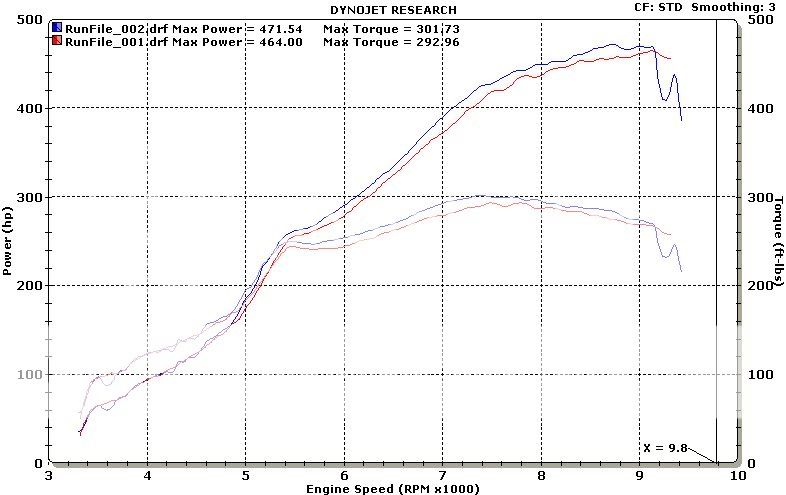
Here's a 13B-REW at 13psi of boost on E-85 fuel.
http://www.rx7club.com/showthread.php?t=714725&highlight=E85

http://i238.photobucket.com/albums/ff279/uspmotorsports/V8killa-1.jpg

Some internet E-85 reading material.
http://www.rx7club.com/showthread.php?t=683456&highlight=E85

FloppinNachos
03-20-2008, 07:12 AM
The only thing he knows about fuels is what he's read on drivingethanol.org.

I actually have done a lot with fuels. I've done experiments with fuels using a pulsejet engine. I had a simple thrust measuring setup and used gasoline vs. diesel. Diesel made more thrust since it had more energy in it. This is obvious. I've done a lot of research and have done a fair amount number crunching and stoichometry. What you don't seem to understand is that alcohol fuels are more complex because of the attached oxygen.

This isn't a quote, it is a FACT OF SCIENCE.
Ethanol is 34.7% OXYGEN by mass

That's a very large percentage of liquid oxygen. It takes up a negligible volume so it's pretty much free oxygen. Air (air contains oxygen btw (~20%)) is the limiting factor of an engine as i have stated before. The "free oxygen" in ethanol more than makes up for its low energy.


V8 Kila has backed it up with numbers too.

alnielsen
03-20-2008, 09:36 AM
Anything that grows 'can convert into oil'
Company finds natural solution that turns plants into gasoline
http://www.worldnetdaily.com/index.php?fa=PAGE.view&pageId=59402

This isn't exactly about Ethanol, but it is about producing alternate fuels from plant materials.

rotarygod
03-20-2008, 10:20 AM
V8Kila has a turbo!!!!

On a turbo engine it's very easy to make more power on ethanol than gasoline due in part to it's higher octane and better latent heat of evaporation properties. You can run more boost and more aggressive timing. However mileage will never go up. Far from it. You always need more fuel. Looking at only power numbers on a forced inducted car isn't telling you the whole story. It's not telling you why it is the way it is.

Also get over the oxygen by mass argument. Kindly remove it if you want to discount it so we can do an equal comparison under your own terms. I'll wait. By your own admission ethanol is less efficient. Here's what you said: The "free oxygen" in ethanol more than makes up for its low energy. Low energy! Exactly! That's because it's less efficient!!! What it can do when you use more of it is not indicitive of it's efficiency. The fact that it takes more by volume to do the same thing means that it is in fact less efficient. This is backed up by btu and by mileage.

zoom44
03-20-2008, 11:02 AM
Anything that grows 'can convert into oil'
Company finds natural solution that turns plants into gasoline
http://www.worldnetdaily.com/index.php?fa=PAGE.view&pageId=59402

This isn't exactly about Ethanol, but it is about producing alternate fuels from plant materials.


A company called Changing World Technologies has been doing somehting simliar with a process it call "Thermal Depolymerization" for a number of years now with actual production facilities

http://www.changingworldtech.com/who/index.asp

rotarygod
03-20-2008, 11:06 AM
Here's another thought. If ethanol is 34.7% oxygen by mass, if it's so much more efficient, wouldn't you think that it would need to run leaner? It's supplying some of it's own air. It doesn't run leaner though. Not even close. It needs to be much much richer. It's because it's inefficient!

EdwardsB
03-20-2008, 11:14 AM
Anything that grows 'can convert into oil'
Company finds natural solution that turns plants into gasoline
http://www.worldnetdaily.com/index.php?fa=PAGE.view&pageId=59402

This isn't exactly about Ethanol, but it is about producing alternate fuels from plant materials.

now i just need get some of this bacteria and a gas pump, I wont ever complain about cutting grass again in fact ill love it!

alnielsen
03-20-2008, 11:17 AM
The bacteria converts the waste into oil. You would still need to refine it to make gasoline. But, add this bacteria to a large landfill and see what happens.

EdwardsB
03-20-2008, 11:25 AM
yeah, hope this works out and solves to problems at the same time on a large scale.

zoom44
03-20-2008, 11:31 AM
so on to ethanol-

Have people still not fully read this?

http://www.epa.gov/otaq/presentations/epa-fev-isaf-no55.pdf

it and others like it have found that yes- under normal conditions found in normal spark ignition motors gasoline/ethanol mixtures produce less mpg because of the LOWER ENERGY DENSITY vs "pure" gasoline.

HOWEVER the study found that using the alcohol/gas mixtures of 10% to 85% and even 100% alcohol in a spark ignited engien with a 19.5/1 native compression ratio you could achieve the same power and mileage OR MORE than "pure" gasoline at normal spark ignited gasoline motors.

its very clear that at the normal compressions pumping in blends is less efficient and as the paper states

Despite the widespread availability of flexible fuel vehicles (FFVs) that are capable of using these fuels, the growth in E85 production has not kept pace with the overall growth of the ethanol market, for various reasons. For one, retailers and terminal operators have been largely unable to obtain a favorable return on investment with E85 due to low production volumes, high transportation costs, special handling requirements, and tax incentives that favor gasohol blends. Consequently, the sale of E85 is restricted to relatively few outlets, mostly in the Midwest region. Also, the availability of sustainable natural resources ultimately constrains the upper limit on ethanol production (a factor that may, in turn, favor alternative fuels like methanol, which can be more easily produced from readily-available sources such as coal or stranded natural gas reserves). More importantly, however, has been that the market price of E85 has remained closely tied to gasoline prices [6], which puts it at roughly a 25% disadvantage in terms of energy content relative to gasoline (assuming 74% average ethanol content in E85). Using conventional FFV technology, very little of this apparent disincentive can be recovered, making E85 less cost-effective for both fleets and rational consumers.

and more importantly - to me at least in terms of extending our fuel availability- it that the use of blends in between E10 and E85 have not be pushed or focused on as much as needed.

Relatively little fuel economy and emissions data has been published for engines operating with fuel blends ranging between 10% and 85% ethanol [8, 9]. Ordinarily, neither dedicated fuel vehicles nor FFVs operate in this range for a significant amount of time, since these “intermediate” fuel blends are not produced commercially in the U.S. Consequently, there has been little work to optimize the engine efficiency over this range, improving it to the level where it would offset the additional fuel cost. For example, while nearly a 25% increase in fuel economy is needed to operate economically with E85, only a modest increase of around 8% would be needed with E30. The present work examines the benefits of higher-compression ratio engines with alcohol-gasoline blends, focusing primarily on the range of 10%-50% alcohol.

using something like E30 would offer a huge advantage in rate of return over E85 but it just isn't being pursued - probably because of some political or "green" agenda

Socket7
03-20-2008, 01:11 PM
I actually have done a lot with fuels. I've done experiments with fuels using a pulsejet engine .

I don't claim to be an expert on fuels at all, but how is a pulse jet engine at all similar to a piston or rotary engine?

FloppinNachos
03-20-2008, 02:57 PM
I don't claim to be an expert on fuels at all, but how is a pulse jet engine at all similar to a piston or rotary engine?

it isn't really, I was just trying to show that I've done more research on fuels other than prickhole suggested by saying I just read some website.


RG, if it has oxygen attached to it you would run it richer because the "fuel" part of the AFR ratio would have oxygen ("air") in it.

FloppinNachos
03-20-2008, 02:58 PM
V8Kila has a turbo!!!!

On a turbo engine it's very easy to make more power on ethanol than gasoline due in part to it's higher octane and better latent heat of evaporation properties. You can run more boost and more aggressive timing. However mileage will never go up. Far from it. You always need more fuel. Looking at only power numbers on a forced inducted car isn't telling you the whole story. It's not telling you why it is the way it is.


He said he didn't see any power loss on N/A cars either.

rotarygod
03-20-2008, 03:02 PM
RG, if it has oxygen attached to it you would run it richer because the "fuel" part of the AFR ratio would have oxygen ("air") in it.

Actually that would be true. I somehow got that messed up in my head. When I was using the term "richer" in my head, I was thinking in terms of richer air not fuel and vice versa with lean.

Please stop with the name calling. It's not needed.

rotarygod
03-20-2008, 03:05 PM
He said he didn't see any power loss on N/A cars either.

If he has to use more volume of fuel then it's a net loss so even then it would still be irrelevant. This is because it's less efficient. At the end of the day the gas pump dispenses fuel in gallons. You buy ethanol by the gallon. That's the frame of reference that matters. If you need more of it, it's not as efficient.

FloppinNachos
03-20-2008, 03:17 PM
If he has to use more volume of fuel then it's a net loss so even then it would still be irrelevant. This is because it's less efficient. At the end of the day the gas pump dispenses fuel in gallons. You buy ethanol by the gallon. That's the frame of reference that matters. If you need more of it, it's not as efficient.

The term efficiency doesn't really fit then. Defined as the ratio of the output to the input of any system. The automakers use fuel and gallons to define engine efficiency.
The engine's efficiency won't change. You just have different mileage values because ethanol is a different fuel.

It has less energy/volume that's undisputed, but it's oxygenation which is worth more power and "cleaner air".

rotarygod
03-20-2008, 03:25 PM
The fact that it's oxygenated from a "clean air" standpoint would seem to cancel out since it has to run richer and you have to physically burn more fuel. More fuel equals more pollution.

The engine's efficiency won't change from the standpoint that it can only convert so much % of input energy into useful power output. However if you use a less efficient fuel, even if the engine's efficiency stays the same, the output power will also be less. Less energy in= less energy out. The engine's efficiency doesn't have to change. This stays true. With ethanol you have much less energy going in. Less energy in a fuel equals less efficiency in a fuel. This is why it takes more of it to do the same thing.

rotarygod
03-20-2008, 03:28 PM
I know, I know, "but it's oxygenated!". So what? This means absolutely jack squat since a non oxygenated fuel needs to run leaner, which is more air which is more oxygen. It doesn't matter where the O2 comes from. It still gets in the engine somehow.

FloppinNachos
03-20-2008, 04:08 PM
right, but since the oxygen is being injected by a fuel pump and in a much denser form (liquid) the engine doesn't have to draw in the air which is only 20% oxygen. This mean that the engine will have a lot more oxygen in it, from the oxygen it draws in from the air and the oxygen in ethanol. If it didn't make a difference then there would be reason to port an engine, as I've said before the limiting factor of an engine is how much oxygen you can get into the combustion chamber; fuel is always easily added.

rotarygod
03-20-2008, 04:28 PM
Then why can't you go as far on it and why can't you make the power with it? Keep in mind that flex fuel vehicles do in fact retune for it and their mileage really really suffers. So does their performance. I've never seen anyone with one of those running on E85 say they had better throttle response. They don't.

At the end of the day, it's a less efficient fuel than gasoline. Period. Arguing about it won't change that. If someone has made more power on a naturally aspirated engine with ethanol than they did with gasoline there can only be one of 2 reasons and I guarantee that mileage would still suffer. Problem one is that the engine had too much compression for gasoline and timing had to be severely pulled out. This is an effect of octane only. The other thing that could cause ethanol to be more powerful assuming the 2 engines are the same and that compression is good for gasoline is that the engine tuner quite frankly sucked. Yes I said it and I know it'll piss someone off.

If you specially build an engine for Ethanol, it's performance can be decent with minimal loss compared to gasoline. It'll always suffer from a mileage standpoint though due to it's lower efficiency. That's lower btu's for you. Less energy in equals less energy potential out hence everyone's lower results.

zoom44
03-20-2008, 04:37 PM
no it wont fred- read the paper :)

it's performance can be decent with minimal loss compared to gasoline. It'll always suffer from a mileage standpoint though due to it's lower efficiency.

alnielsen
03-20-2008, 04:41 PM
Don't you just love it when Admins dissagree? :lol:

MP3Guy
03-20-2008, 05:25 PM
Everyone is looking for a silver bullet in regards to fixing the oil crisis.

I'm afraid currently there isn't one. There's a reason that gasoline and oil based fuels are used so much and that's because of the abundance of the product combined with the high amount of energy stored within oil itself. Whether or not the products "cost" is less than oil, the overall amount of energy used to produce Ethanol either equals or outweighs what Ethanol yields.

A good example would be working for $100 a day and then deciding to work for $50 doing the same amount of work. It makes no sense.

Using Ethanol or other food related sources of energy is simply a bad idea because it drives up the costs of other food related items. Farmers are now switching to Corn instead of growing other food items driving up cost and increasing inflation.

The issue at had is whether Ethanol works as a fuel. It simply fails. Oil is about 5 times more efficient than Ethanol and that process changes very little when it's refined into gasoline.


Bio fuel, Ethanol, or anything else that involved burning FOOD for energy is a seriously bad idea and will only result in economic upsets. Oil is the blood of our economy and that's not going to change.

I agree with much of what you say here. But keep in mind ethanol is being worked on with different sources to make it less dependent on corn, and more efficient as a fuel. I think we're still at the beginning of the development cycle, Eventually, some equilibrium will take hold.

I think in the end, the consumer will have several different choices- oil, ethanol based, plug in, hybrid, and eventually, hydrogen.

FloppinNachos
03-20-2008, 05:25 PM
I could care less about mileage from ethanol, it isn't a limited resource. The main waste products of burning any kind of hydrocarbon are CO2 and H2O which are the two main "foods" for plants. Photosynthesis uses the sun to arrange these into a sugar which is converted to alcohol. Ethanol is essentially liquid solar power. The "ineffecieny" of ethanol is related to it's low C:H ratio. You get more exothermic energy from oxidizing carbon than you do from oxidizing hydrogen. This is why you lose power from using things like natural gas (methane CH4) and propane (C3H8) compared to gasoline (basically octane C8H18). The oxygen in an ethanol molecule provides the extra energy in an oxygen starved chamber (our engines) because it requires less oxygen to burn.

The OFR (oxygen : fuel ratio) for ethanol is ~2.1:1 and 3.5:1 for octane (basic stoich calculation by mass). This is conclusive of the 9:1 associated with ethanol and 14.7:1 associated with gasoline. This means 1.63 times more ethanol can be burned than gasoline with the same amount of air. Ethanol has 12,800BTU/lb and gasoline has 18,500BTU/lb. So 12,800*1.63=20864 which is greater than 18,500. The "power" AFRs for ethanol are ~6.5 and gasoline ~12.5 which raises the "BTU multiplier" to about 1.9.

Ethanol cars making less power can be attributed to them probably running leaner AFRs to make the loss of fuel mileage (the only important factor in buying a car it seems...) less.

MP3Guy
03-20-2008, 05:29 PM
And this is pretty neat alt fuel website I drop in on from time to time- lots of smart people focusing in this.

http://www.matternetwork.com/

kartweb
03-20-2008, 06:57 PM
If someone would have told me a few years ago that people are emotionally disturbed that ethanol would one day be used as a fuel, I wouldn't have believed them. Time has proven otherwise.

I love the one-liners:

"Lets just drill for more oil."

OK, where? I recall a great little oil prospecting company named Spectrum 7 that would be happy to have you invest in them for that purpose. Do a Google on Spectrum 7.

"Ethanol takes more energy then it produces."

Sure, SOLAR energy. But if you believe it takes more oil energy to produce an equal amount of ethanol energy, let me suggest a few perpetual motion machines to invest in.

I don't think anyone disagrees that gasoilne has the best phyical properties for automotive fuel. Its not a question physical properties. Its a question of economics, and rapidly becoming one of national security.

We all know how much we pay at the pump.

But how much are we contributing to supplement the cost of oil? What would happen to our oil supply if the Perisan Gulf were blockaded? Oil around the world including Canada and Venezuala would rise in price, not a little, a lot. You might be surpised at how much the US spends to avoid an interrupt to the flow of oil from the middle east.

If you think oil is high now, wait a few more years. Over the last few years I've been to China and India a few times every year. Every year I am amazed at the number of new cars and trucks, even more amazed at the number of people who are looking forward to buying a car. Even India now has an F1 team funded by a billionaire who owns Kingfisher Airlines. Every Kingfisher flight in india is full and every time I visit Kingfisher has many more airplanes. Thats just India. China's sparkplug population is growing at a rate of 3x per year. And both of those countries are just beginning to step into the motorized era.

Where do you think they're buying their oil?

Earlier I mentioned the Tar Sands. China is financing a 350 mile long pipeline from one of the richest deposits in Canada for exclusive port rights.

Personally I'll use whatever fuel makes the most sense to use. When gasoline reaches $4 a gallon, I'll be looking a little closer at the economics to convert the RX8 over to E85. Not because I prefer the superior performance of ethanol, but strictly the economic reasons.

kartweb
03-20-2008, 07:52 PM
If someone has made more power on a naturally aspirated engine with ethanol than they did with gasoline there can only be one of 2 reasons and I guarantee that mileage would still suffer. Problem one is that the engine had too much compression for gasoline and timing had to be severely pulled out. This is an effect of octane only. The other thing that could cause ethanol to be more powerful assuming the 2 engines are the same and that compression is good for gasoline is that the engine tuner quite frankly sucked.

First you are quite correct, the rate of fuel consumption volume increased significantly, about 45%. Not only are there less C's & H's to bond with the O's per volume, but ethanol carries along an O to share with it's components.

And for those entropic minded keeping score, it takes about 10% the energy to liberate the O in ethanol as it gain back in bonding to a more powerful bond directly with a C or H. (If you don't understand why, do some research on cycloalkanes and bond angles).

In my case the racing fuel we used has 110 octane, about the same as ethanol. Our CR125's do indeed run high compression. 6.2 CCV against a swept 125cc volume. We also ran a nearly perfect mixture and an HRC Det Counter.

The advantage of ethanol came from two things;
First the extra oxygen in the ethanol.
Second is the higher heat of transformation that cools the charge, and is especially valuable in a 2 stroke.

The Biland also showed a healthy increase, despite being low compression. The Biland runs just fine on 89 octane as it was designed to run. Each of the (2) 125cc cylinders has a CCV of 11.5cc's. All we did was rejet it and reset the static ignition.

I wold have tried it with the Rotary Seatta we borrowed for a while except that there are some concerns with the existing lubrication system.

As far as tuning, I run a website that hasn't been updated in two years that caters to Karting and requires a $25 subscription to get access to the tuning and Data Acqusition operations info. We still get a healthy income from renewals, and have had subscribers that include Brad Coleman, Scott Speed, AJ Allmendinger, Brian Herta, Kyle Rahal, Marco Andretti, and Jimmy Vassar. If you run into Brad at one of the local Freebirds, tell him I said hi.

FloppinNachos
03-20-2008, 07:59 PM
psscht, CR125s are for bitches. I tune/ride RS125s :batman:

haha, j/k


I wonder if we could use something like the HRC Det counter on our RX-8s? So we could actually figure out if it was detonating, unlike the crappy detonation listener thing we have on the engines now.

kartweb
03-20-2008, 08:39 PM
If only they would let us run RS125's it would have made life so much easier.

Other then rod length when we get done we practically have an RS125 when we get done.

The HRC Det counter won't work on a Rennie.

I'm guessing you've been to this track

http://www.kartweb.com/Archives/Atlanta/snippet.wmv

I rented a 250 to play there. The last time I ran there a bridge was over turn 1 and there was no chicane before turn 11 so it's been a few years. That was in a C Sports Racer.

FloppinNachos
03-20-2008, 09:34 PM
not the exact HRC det counter, but something that fit on the spark plugs. there might be something out there like this

FloppinNachos
03-20-2008, 11:15 PM
so, you guys wanna see my pulsejet? it's real nice, I got it on sale at target, haha

http://www.youtube.com/watch?v=26FymT9dDzM&NR=1

YES I KNOW THERE IS A PROPANE TANK next to it, this is for start-up/warming for the diesel/gasoline.

Feras
03-20-2008, 11:28 PM
I actually have done a lot with fuels. I've done experiments with fuels using a pulsejet engine. I had a simple thrust measuring setup and used gasoline vs. diesel. Diesel made more thrust since it had more energy in it. This is obvious. I've done a lot of research and have done a fair amount number crunching and stoichometry. What you don't seem to understand is that alcohol fuels are more complex because of the attached oxygen.

This isn't a quote, it is a FACT OF SCIENCE.
Ethanol is 34.7% OXYGEN by mass

That's a very large percentage of liquid oxygen. It takes up a negligible volume so it's pretty much free oxygen. Air (air contains oxygen btw (~20%)) is the limiting factor of an engine as i have stated before. The "free oxygen" in ethanol more than makes up for its low energy.


V8 Kila has backed it up with numbers too.

Like most alcohols ethanol is in fact not very complex at all, it is a simple hydrocarbon ethylene with an attached hydroxyl group. While yes adding an OH to ethylene does in fact increase the mass of oxygen that oxygen is by no means free and isn't just liquid oxygen floating around. I think ya need to rethink your basic chemistry. oh and btw the combustion of ethanol delivers 23.5 megajoules per liter, while gasoline delivers 34.8.

Feras
03-20-2008, 11:32 PM
btw this is not in anyway a knock on ethanol in general, i tihnk we should use it, its a reusable energy source that can end up costing very little (make it from the stalks of corn) and also end our reliance on imported fuels.

FloppinNachos
03-20-2008, 11:48 PM
that's why I put the quotes on it. I know it's not just entirely free, but it gets oxygen into the combustion chamber. I know there are some bond energy things that I'm kind of rusty on, but if you have the final enthalpies then it doesn't really matter.

I said 12,800BTU/lb for ethanol and 18,500 for gasoline. You said 23.5MJ/L and 34.8MJ/L. They're both pretty close to each other. Either way you'll make more power with ethanol because the AFR is so much lower 23.5*(14.7/9)=38.4 .

Flashwing
03-20-2008, 11:52 PM
The bottom line is Ethanol cannot survive in a free market which is why the federal government has to prop it up with major subsidies.

Here's the lastest stories to back up my facts:

Ethanol: How the promise dwindled (http://www.sacbee.com/103/story/799508.html)

The cash crunch at Sacramento's Pacific Ethanol Inc. spotlights the swift decline of an industry battered by too much supply, too-expensive corn and too many increases in plant construction costs.

Ethanol – hailed by some as a "green" fuel that would reduce America's dependence on foreign oil – is in a major slump here and nationwide.

Across California, profit margins are vanishing, new plants are being canceled and some existing facilities are struggling. The state's first major plant, opened in Tulare County in 2005, has suspended operations.


Here's the latest example that production of Ethanol takes more energy than what Ethanol would yield which means sacrificing other resources to produce it.

Big Corn and Ethanol Hoax (http://www.townhall.com/columnists/WalterEWilliams/2008/03/12/big_corn_and_ethanol_hoax)

Ethanol is 20 to 30 percent less efficient than gasoline, making it more expensive per highway mile. It takes 450 pounds of corn to produce the ethanol to fill one SUV tank.

That's enough corn to feed one person for a year. Plus, it takes more than one gallon of fossil fuel -- oil and natural gas -- to produce one gallon of ethanol. After all, corn must be grown, fertilized, harvested and trucked to ethanol producers -- all of which are fuel-using activities.

And, it takes 1,700 gallons of water to produce one gallon of ethanol. On top of all this, if our total annual corn output were put to ethanol production, it would reduce gasoline consumption by 10 or 12 percent

This article also spells out the subsidies that the government puts on Ethanol...

Congress has enacted major ethanol subsidies, about $1.05 to $1.38 a gallon, which is no less than a tax on consumers.

In fact, there's a double tax -- one in the form of ethanol subsidies and another in the form of handouts to corn farmers to the tune of $9.5 billion in 2005 alone.


Over at the NPR they report that Ethanol is worse for the environment again debunking the excuse that it's worth to waste production to save the earth.

Study: Ethanol Worse for Climate Than Gasoline (http://www.npr.org/templates/story/story.php?storyId=18784732)

Searchinger and his colleagues looked globally to figure out where the new cropland is coming from, as American farmers produce fuel crops where they used to grow food. The answer is that biofuel production here is driving agriculture to expand in other parts of the world.

"That's done in a significant part by burning down forests, plowing up grasslands. That releases a great deal of carbon dioxide," Searchinger says.


I suppose I should also point out that vast parts of the Rain Forest are being burned, and cleared to plant trees that produce sap for Biofuel. I love how everyone wants to save the rain forest when we cut down trees for homes, paper, and other needs but to produce bio fuel nobody cares.

So what have we learned?

Ethanol costs more money, takes more resources, and produces less energy than it does with oil or gasoline. It's incapable of surviving in a free market which is why BILLIONS of subsidies are paid out every year to famers and Ethanol producers. Finally, we're seeing that the investments into Ethanol are already failing and energy companies are losing tons of cash.

FloppinNachos
03-20-2008, 11:59 PM
I don't know about that. The figures I've always read were 1.4 units of energy out for every 1 unit of energy in.

kartweb
03-21-2008, 01:47 AM
The bottom line is Ethanol cannot survive in a free market which is why the federal government has to prop it up with major subsidies.

Finally, we're seeing that the investments into Ethanol are already failing and energy companies are losing tons of cash.

Ethanol definately would fail without some subsidies. To begin with any new fuel competing with oil has to compete against an existing infrastructure.

But the real challenge is competing with oil subsidies. Before The Iraq War, over 1/5th of the Navy budget went to the cost of patrolling the middle east. Duty free imported oil amounts to over a million dollars a day. Tax free income from domestic oil production profits is another couple million dollars a day.

I'm not suggesting we take away the oil subsidies, just pointing out that in order for any fuel to compete it will almost certainly take some subsidies to launch it.

As far as bad business decisions, they're everywhere, especially in the oil prospecting industry. Look at the history of Spectrum 7, or Standard Oil, or Sinclair, or Marathon, or even my favorite, Phillips Petroleum. They've all made mega-million dollar flops. But for every failure there are four success stories.

Feras
03-21-2008, 11:34 AM
that's why I put the quotes on it. I know it's not just entirely free, but it gets oxygen into the combustion chamber. I know there are some bond energy things that I'm kind of rusty on, but if you have the final enthalpies then it doesn't really matter.

I said 12,800BTU/lb for ethanol and 18,500 for gasoline. You said 23.5MJ/L and 34.8MJ/L. They're both pretty close to each other. Either way you'll make more power with ethanol because the AFR is so much lower 23.5*(14.7/9)=38.4 .

yeah bond dissociation energy is the key element of what you're going for here, but combustion isn't the same thing as bond dissociation. Do the stoichometry of the energy released from combustion and complete bond disassociation, very different numbers.

FloppinNachos
03-21-2008, 11:40 AM
you have to take the bond energies of the products and the reactants though. and do something with them, add substract i forget and that's the combustion energy. right?

kartweb
03-21-2008, 12:13 PM
yeah bond dissociation energy is the key element of what you're going for here, but combustion isn't the same thing as bond dissociation. Do the stoichometry of the energy released from combustion and complete bond disassociation, very different numbers.

Great answer. It's great to see we have a chemist on board. Its been close to 30 years ago since I worked in the Champion Spark Plug Combustion Analysis Lab, but I spent enough time there to wear out 2 Waukesha Engines. Even in those days we did quite a few tests for the petroleum and automotive engineers for various formulations of fuel.

It looks like the biggest speedbump for the success of ethanol is really the mis-information among the general public.

From a performance perspective ethanol is superior to unleaded gasoline.

From a cost perspective per BTU ethanol (at the current demand) is still less then gasoline. Sure people can argue subsidies and that is valid - except when they neglect the subsidies applied to gasoline.

From an environmental perspective no one can really say which is better or worse. Combustion wise there could be a slight favortism towards ethanol due to a very slightly higher by-product of H2O as opposed to CO2. But on the flip side how do you really quantify all the production, distribution, and storage emissions for ethanol and gasoline? How about the nasty little oil spills? How about the risks of deep drilling in the Gulf of Mexico?

On the flip side when it comes to energy density gasoline whallops ethanol. The majority of the US auto fleet runs fine on gasoline. But that same majority also runs fine on E10, and probably even E15.

If used everywhere in America, E10 would reduce daily import of oil by 800,000 barrels a day.

If E20 were practical for the US fleet we could eliminate our dependence on Middle Eastern oil.

Feras
03-21-2008, 01:47 PM
you have to take the bond energies of the products and the reactants though. and do something with them, add substract i forget and that's the combustion energy. right?

you can only do that for gaseous reactants at standard conditions, hess' law and all that stuff. and for ethanol and gasoline both are liquids at standard conditions, so the total bond dissociation is not a practical or realistic measure of the energy released. But lets think about what has to happen with those bond energies. another way to go about the thinking of the O in ethanol is to look at the lewis structure, in order to get the oxygen free as a reactant you'd have to break an OH and a single CO bond. I dont remember what the specific energies are for that, but thats energy that is lost and not doing work (hence ethanol's total energy released during combustion is lower than that of gasoline and at the same time also partially explains why alcohol has a high octane rating.) :) At least i think so from what im remembering, i have to focus on more biological organic chemistry but i enjoy fire too lol.

Feras
03-21-2008, 01:53 PM
speaking of chemists in here, anybody know of a good way to oversaturate an NaCl solution to 6M one of my protocols requires 6M NaCl for DNA extraction and for the life of me i thought NaCl saturates at like 5.5M.

zoom44
03-21-2008, 02:50 PM
im no chemist and im sure im saying the wrong thing buuutttt...

way back in 7th grade when we were needing to oversaturate solutions for crystal growth experiments we heated them.

FloppinNachos
03-21-2008, 02:53 PM
The only thing I can think of is to heat the solution so that 6M of NaCl will dissolve, the NaCl solution graph (solubility Y/ heat Y) is kind of a small linear slope though so it might take a lot of heat to do this.

alnielsen
03-21-2008, 03:36 PM
As far as bad business decisions, they're everywhere, especially in the oil prospecting industry. Look at the history of Spectrum 7, or Standard Oil, or Sinclair, or Marathon, or even my favorite, Phillips Petroleum. They've all made mega-million dollar flops. But for every failure there are four success stories.Every business makes bad decisions and they recover from them. If you are trying to say these companies are gone, you are wrong. For the most part they have merged with other companies. As for Standard Oil (of Indiana, there were several Standard Oils after the monopoly was broken up), it changed it's name to Amoco and later merged with BP. I'm setting in the ex-Amoco Research Center, in the Chicago area, at this moment.

Feras
03-21-2008, 03:44 PM
oh yeah gotta be without heat, since i gotta do the extraction at a certain temp. i'll reread the protocol next week

zoom44
03-21-2008, 07:44 PM
well then you need some kinda chemical catalyst. mix with some other salt maybe? or what about pressurizing it?

kartweb
03-21-2008, 07:59 PM
Every business makes bad decisions and they recover from them. If you are trying to say these companies are gone, you are wrong. For the most part they have merged with other companies. As for Standard Oil (of Indiana, there were several Standard Oils after the monopoly was broken up), it changed it's name to Amoco and later merged with BP. I'm setting in the ex-Amoco Research Center, in the Chicago area, at this moment.


The only one on that list tahst gone is Spectrum 7.

Georgia8er
03-21-2008, 09:21 PM
I don't know about that. The figures I've always read were 1.4 units of energy out for every 1 unit of energy in.

Studies vary wildly on net energy production from ethanol. The factors people don't think about such as distillation of the ethanol, fuel for farm equipment, production of fertilizer, etc, have 100 different answers on energy consumption for each of these steps. You can come up with high or low net energy production if you pick and choose, even totally leave out steps.

kartweb
03-22-2008, 02:40 PM
Studies vary wildly on net energy production from ethanol. The factors people don't think about such as distillation of the ethanol, fuel for farm equipment, production of fertilizer, etc, have 100 different answers on energy consumption for each of these steps. You can come up with high or low net energy production if you pick and choose, even totally leave out steps.

Exactly.

Moreover, various different "studies" that have come up with totally different findings used totally different inputs.

While some subsidies exist, they are mostly in the form of tax relief and again depending on who reports the numbers as they too vary. Just like the numbers for our subsidies of oil.

So the bottom line is how much does ethanol or gasoline cost to produce on a BTU basis?

The clear winner today is ethanol. And going forward its safe to bet gasoline will only go up while ethanol will either remain the same or go down.

Winfree
03-22-2008, 03:35 PM
Here, in grape country, ethanol is an everyday part of the brewer's art. Often a wine is fermented to it's fullest ethanol potential because the government makes the vintner pay higher taxes per bottle.

In France, poorly made lots are collected and recycled for fuel. I think, if we stopped worrying about flavor, and included vine wood which is cut off and burned, but is high in carbohydrates, we could increase our national production of fuel ethanol....

However, I have some concerns with ethanol as fuel: When we get reagent grade ethanol it is 100% alcohol, but as soon as it is exposed to the air, it begins to collect water, and it may pull in enough water that it is barely above 70% alcohol.

All the fuel work is done, I assume, with 100% alcohol - but what about ethanol in fuel mixtures - does it pick up water? Does this have an effect on storage or usage? Would a ethanol -gas fuel become less able to burn, and run engines over time?

Also, gasoline can burn down to CO2 and H2O - but ethanol and toluene, ect. seem to produce aromatic compounds or carbon chains with enough components that you can detect them by smell - are we getting air that is less clean as a product of burning and more clogging for our cats?

TG05
03-22-2008, 03:57 PM
ethanol from corn is definitely temporary, a bridge fuel to more advanced biofuels that don't use corn. At least the government has a cap on the amount of corn ethanol that can be made. By 2022 there is a requirement for 36 billion gallons of biofuel to be made, 21 billion of which must be advanced biofuel, most likely cellulosic ethanol because it the closest to being commercial viable. If biobutanol can be made commercially viable it will be much closer characteristically to gasoline. There are already steps in this direction, with similar processes to making cellulosic ethanol. Here are some links, one an article, the other biobutanol wiki:
http://www.upi.com/International_Security/Energy/Analysis/2008/03/20/analysis_can_biotechnology_save_ethanol/7919/
http://en.wikipedia.org/wiki/Biobutanol

Georgia8er
03-22-2008, 05:50 PM
Exactly.

Moreover, various different "studies" that have come up with totally different findings used totally different inputs.

While some subsidies exist, they are mostly in the form of tax relief and again depending on who reports the numbers as they too vary. Just like the numbers for our subsidies of oil.

So the bottom line is how much does ethanol or gasoline cost to produce on a BTU basis?

The clear winner today is ethanol. And going forward its safe to bet gasoline will only go up while ethanol will either remain the same or go down.

If ethanol uses more energy in production than you get out of it, then it will not matter what the costs, you will run out of energy to produce it. Eventually you get caught by thermodynamics.

FloppinNachos
03-22-2008, 07:01 PM
If ethanol uses more energy in production than you get out of it, then it will not matter what the costs, you will run out of energy to produce it. Eventually you get caught by thermodynamics.

No, the added energy from ethanol comes from the sun. If you want to look at from a thermodynamics point of view. Honestly, I don't believe you know what you are really talking about and are just making obvious statements. If it was that simple then why would anyone make ethanol...

Georgia8er
03-23-2008, 11:00 PM
No, the added energy from ethanol comes from the sun. If you want to look at from a thermodynamics point of view. Honestly, I don't believe you know what you are really talking about and are just making obvious statements. If it was that simple then why would anyone make ethanol...

You should be careful with telling people they don't know what they are talking about, you haven't impressed me so far. If to produce one gallon of ethanol the farming, transportation, distillation, and storage takes more than one gallon of ethanol, you have a net loss of energy. It does not matter where the production of the starch/sugar for fermentation comes from, the sun is not (yet) providing energy to do all the other steps in the process, unless you get more energy out of production than you put in. National Geographic recently had an article on ethanol production, and aside from some exotic as yet untested ideas, it comes out close to a 1:1 ratio of energy input:output.

Why do people make ethanol? In the US it is mandated, since we can no longer use MTBE as an oxygenator. A company can also get tax breaks, direct subsidies, and make a lot of money at it. Just because a company will produce it and people will buy it doesn't make something efficient.

FloppinNachos
03-23-2008, 11:36 PM
You should be careful with telling people they don't know what they are talking about, you haven't impressed me so far. If to produce one gallon of ethanol the farming, transportation, distillation, and storage takes more than one gallon of ethanol, you have a net loss of energy. It does not matter where the production of the starch/sugar for fermentation comes from, the sun is not (yet) providing energy to do all the other steps in the process, unless you get more energy out of production than you put in. National Geographic recently had an article on ethanol production, and aside from some exotic as yet untested ideas, it comes out close to a 1:1 ratio of energy input:output.

Why do people make ethanol? In the US it is mandated, since we can no longer use MTBE as an oxygenator. A company can also get tax breaks, direct subsidies, and make a lot of money at it. Just because a company will produce it and people will buy it doesn't make something efficient.

If my knowledge hasn't impressed you, wait til you see my driving :evil_laug

haha, just kidding, kinda....

I do realize there is energy put into harvesting the corn, grinding it up, and then the mix has to be heated and later distilled. This isn't thermodynamics though and you saying that made me think you were just some guy that wanted to say "thermodynamics" in an ethanol thread.

You have to define "close". I think a lot of people would say 1.26-1.4 are pretty close to 1. Do you have any literature on the production efficiency?

Georgia8er
03-24-2008, 05:22 PM
If my knowledge hasn't impressed you, wait til you see my driving :evil_laug

haha, just kidding, kinda....

I do realize there is energy put into harvesting the corn, grinding it up, and then the mix has to be heated and later distilled. This isn't thermodynamics though and you saying that made me think you were just some guy that wanted to say "thermodynamics" in an ethanol thread.

You have to define "close". I think a lot of people would say 1.26-1.4 are pretty close to 1. Do you have any literature on the production efficiency?

I have looked at several things, but I haven't seen anything I would consider serious research on a closed ethanol system. That would be using ethanol in the farm equipment, transportation, distillation, etc. At some point opponents and proponents do magic handwaving and say "it's great!" or "it's a crock!" There may be some great research I haven't heard about, and if there is I would like to see it. And anything involving energy production/use is related to thermodynamics. Each of the steps cited uses energy, energy that you will be using on one side of the equation to figure net energy gain. Sure, it's not an exact citing, but doing that you are using the first law about conservation of energy.

As far as close, you are correct, 1.26-1.4 is very close. Imagine it this way: at 1.26 for every 26 gallons of ethanol you make you consume 100 gallons in production. For gasoline/oil for every 20 gallons you consume you make around 80 gallons. The EPA or Energy Department has stated it is around 1.3:1 for ethanol, but there is some debate about methodology. Other sources have put it close to 1.1:1 or even parity, 1:1. The truth is no one can claim to be certain, and advances in agriculture and production will probably raise this.

FloppinNachos
03-24-2008, 05:33 PM
The thing with gasoline though is you aren't really making it, you're taking it. You worded that kind of oddly. At 1.26, you don't use 100 gallons to make 26 gallons, you use 100 gallons to make 126 gallons, if you use 100 gallons you will have a net gain of 26.

There are ways to improve this though, i.e. using solar energy to power to the production plants or atleast assist in powering them.

rotarygod
03-25-2008, 10:05 AM
Why is this thread still going on? Ethanol hasn't stopped sucking any less in the last few days.

Georgia8er
03-25-2008, 12:17 PM
The thing with gasoline though is you aren't really making it, you're taking it. You worded that kind of oddly. At 1.26, you don't use 100 gallons to make 26 gallons, you use 100 gallons to make 126 gallons, if you use 100 gallons you will have a net gain of 26.

There are ways to improve this though, i.e. using solar energy to power to the production plants or atleast assist in powering them.

There is the problem, you've changed it. No longer can it be a closed system, you have to use some outside power source to keep your production running. Most likely it wouldn't be solar power, but coal.

And I thought about it and yes I did word that somewhat incorrectly. You do get a net gain of 26 gallons, but think of how small a gain that is. A bad crop yield one year, maybe aging equipment gets less efficient, you name it and you're moving backwards instead of forwards. Sure, gasoline has its supply problems as well, but it is a proven system.

Ethanol is a great fuel, for drinking. :) Not bad for certain types of racing either.

FloppinNachos
03-25-2008, 02:47 PM
I have changed it to use an outside power to improve production. How is that a problem? It could very well be solar power too. It isn't that small of a gain either. They can get up to 1.4 in effecieny so let's start using that term and not making ethanol look bad with the 1.26 stuff. Aging equipment? not much of an effect really. A bad crop? Most of the energy consumed in making ethanol is the actual processing of the corn into ethanol, not growing the corn.


You haven't become any less wrong in the last few days...

RotaryGod, where do you get your hatred for ethanol? The only bad thing about ethanol is that you use more of it because it's oxygenated. Otherwise, it makes more power, burns cleaner, and is renewable.

leadguitarist05
03-25-2008, 04:52 PM
I certainly don't know as much as you guys seem to know about fuels and chemistry... but E85 certainly seems to have it's place... the standard Koenigsegg CCX produces 888hp on standard gasoline and gets 18mpg on the freeway... the CCXR (E85 version) is exactly the same car but is tuned for E85... it produces 1018hp but only gets 13mpg on the freeway...

Personally, I don't give a bears shit in the woods about the fuel efficiency of E85, what I care about is the cost of using it... I don't care if I have to fill up every 130miles (instead of the every 180 miles that my RX8 currently mandates), I don't care about miles per gallon, I CARE about dollars per mile! if E85 were cheap enough that it's use cost the SAME as gasoline, I'd happily enjoy the extra 33hp that I should theoretically get from E85 (properly tuned of course)

Having said that I think that E85 will NEVER become a widely used or available fuel in the US... I think that instead we will see cars capable of hundreds of miles per gallon... such as the Aptera... I also think we'll see a lot of development in hydrogen... and I think Diesel cars are going to become a lot more commonplace in the US...

FloppinNachos
03-25-2008, 07:12 PM
I certainly don't know as much as you guys seem to know about fuels and chemistry... but E85 certainly seems to have it's place... the standard Koenigsegg CCX produces 888hp on standard gasoline and gets 18mpg on the freeway... the CCXR (E85 version) is exactly the same car but is tuned for E85... it produces 1018hp but only gets 13mpg on the freeway...

Personally, I don't give a bears shit in the woods about the fuel efficiency of E85, what I care about is the cost of using it... I don't care if I have to fill up every 130miles (instead of the every 180 miles that my RX8 currently mandates), I don't care about miles per gallon, I CARE about dollars per mile! if E85 were cheap enough that it's use cost the SAME as gasoline, I'd happily enjoy the extra 33hp that I should theoretically get from E85 (properly tuned of course)

Having said that I think that E85 will NEVER become a widely used or available fuel in the US... I think that instead we will see cars capable of hundreds of miles per gallon... such as the Aptera... I also think we'll see a lot of development in hydrogen... and I think Diesel cars are going to become a lot more commonplace in the US...


really? NEVER?!

Most gas stations are using E10 have been for a while, E85 is becoming more available and the car manufacturers are making ethanol capable vehicles.

The reason ethanol is good is because we can easily make ethanol and it's renewable resource. Hydrogen makes a lot less power, and how are we going to effectively produce hydrogen? The fueling issues with hydrogen are of concern too. It is a gas at atmospheric pressure and liquid hydrogen is extremely dangerous. I've seen the metal hydride tanks which seem to be effective, but are expensive. Here is an interesting product http://www.switch2hydrogen.com/
You make your own hydrogen using solar electrolysis and store it in the metal hydride tanks.

Feras
03-25-2008, 11:51 PM
actually the production costs of hydrogen are probably cheaper than ethanol, electrolysis is relatively easy making alcohol takes a few steps. Don't forget that hydrogen is the most abundant element in the universe. Water is quite abundant here, run a current through it and hydrogen and oxygen are released, Burn the hydrogen later and you make it water again...hooray.

FloppinNachos
03-26-2008, 06:06 AM
I know all about electrolysis, but the amount of energy used to separate the hydrogen and oxygen is much greater than the amount of energy yielded by that hydrogen.

Feras
03-26-2008, 09:40 AM
I know all about electrolysis, but the amount of energy used to separate the hydrogen and oxygen is much greater than the amount of energy yielded by that hydrogen.

obviously otherwise there'd be no water on the surface of the earth. But i think thats gonna be true about most fuels, gasoline and ethanol included. If it took less energy to create than it made when it was spent then we'd have no energy crisis. Thermodynamics and entropy always win...reactions occur because on some level increase entropy of the universe. There is no free energy.

rotarygod
03-26-2008, 11:52 AM
You haven't become any less wrong in the last few days...

RotaryGod, where do you get your hatred for ethanol? The only bad thing about ethanol is that you use more of it because it's oxygenated. Otherwise, it makes more power, burns cleaner, and is renewable.


I actually don't have a hatred for Ethanol. I'm just smart enough to know it isn't as powerful or efficient as gasoline on a natrually aspirated engine. It's not and you can't prove otherwise. I'm not wrong. Saying it's oxygenated (repeatedly as you have nothing else to go on!) is just a cheap bs way of justifying it's lack of efficiency.

Yes it burns cleaner per equal volume. Somewhat. It depends what we are measuring. Too bad you need to burn ALOT more of it than gasoline which means these results are skewed a bit. I know, I know, but it's oxygenated! It's still cleaner than gasoline I'll give it that. It is renewable which is also a good thing. Oil is renewable too. It just takes a bit longer!!! ;)

It does have it's place. It's not the be all end all fuel. It's a poor fuel as a straight substitute and always will be. If we make it from waste, all kind of waste, then it's a good thing. It's not something that we should be making from any amount of corn though. We haven't addressed it's production correctly. We also can't make enough of it to replace gasoline anyways. We can supplement though and that's what we should be doing with it. Supplemental fuel made from ONLY waste byproducts. As you have pointed out if we can obtain the power to produce it from solar or wind, that would be gravy. If it makes sense, chances are it won't happen.

BTW: I will never let a 17 year old kid call me wrong on anything car or rotary related. It's not going to happen. At least not without them making some phone calls to certain people first to confirm things! ;)

Feras
03-26-2008, 11:58 AM
now from what i understand about ethanol from corn production the chaff (the stalks) are used to make the ethanol, so it is what is normally a waste product. Correct me if im wrong, i just heard this somewhere.

rotarygod
03-26-2008, 12:56 PM
Before anyone gets on my case for my last statement, please recognize the smiley face as it was intended to be taken with a sense of humor.

rotarygod
03-26-2008, 12:59 PM
now from what i understand about ethanol from corn production the chaff (the stalks) are used to make the ethanol, so it is what is normally a waste product. Correct me if im wrong, i just heard this somewhere.

This is known as Cellulosic ethanol. The term really applies to any method to produce it that utilizes waste products. When I say waste, I mean things like rotting fruit, pumpkins, etc... It is in fact possible to ferment grass clippings but that's a special type of yeast that has a patent and is owned by a company that is owned by Chevron so good luck with ever getting that one. That would make way too much sense. Imagine going outside to mow your lawn for fuel albeit a very small amount. Anything that contains sugars or starches (which can be converted to sugars) that gets thrown away could be used. You'd be surprised at how much of this there is.

CERAMICSEAL
03-26-2008, 02:18 PM
I get the impression that someday Fred and Nachos will be good friends :fingersx:

Seal.

rotarygod
03-26-2008, 05:42 PM
Here's the way to do it. I've always been a diesel fan and especially biodiesel. Here's a new way to make it with virtually no waste! This is kick ass! I saw this talked about in a Biodiesel Magazine online article. It an convert almost any kind of feedstock. It's a continuous process rather than a batch. It works in seconds not hours. It doesn't have glycerine as a byproduct. It gets converted too! This would be the perfect method to use with all kinds of waste products.

http://www.evercatfuels.com/Default.asp

StealthTL
03-26-2008, 05:47 PM
You realise that 'biodiesel' as we know it, from the pumps, is actually only 10% bio, and 90% ordinary dinosaur juice.......

S

FloppinNachos
03-26-2008, 09:51 PM
obviously otherwise there'd be no water on the surface of the earth. But i think thats gonna be true about most fuels, gasoline and ethanol included. If it took less energy to create than it made when it was spent then we'd have no energy crisis. Thermodynamics and entropy always win...reactions occur because on some level increase entropy of the universe. There is no free energy.

obviously there is no free energy, the extra energy from ethanol comes from the sun! The highly endothermic reaction of 6CO2 + 2H20 -> C6H12O6 + 6O2 is performed by photosynthesis. I don't know how hydrogen is a solution unless it is generated using solar power or wind turbines. Running electricity through water and using the hydrogen for an internal combustion engine is like drinking a bottle of water so you can sell your piss. Profitable but pretty ineffecient, if you have the electricity to do electrolysis it is exponentially better to use it in an electric motor than to use it to make a very poor combustible out of water...


and RotaryGod, just wait until i make/have access to a dyno. Then a 17 year old kid won't tell you your wrong, the numbers will!!! :cool:

and your correct, the phone call was only to confirm what I had figured out. :)

Feras
03-26-2008, 10:47 PM
making ethanol (especially pure) from the sugars in corn is an added step, can't run a car on glucose, and you left that part out. We all understand that photosynthesis makes the sugars and starches in corn, making ethanol from said sugars and starches isnt exactly an automatic reaction.

Umm btw hydrogen gas is probably one of the best combustibles there is period. no question or argument. Pound for pound it releases 4.5 times the energy of ethanol. Theres a reason liquid hydrogen and liquid oxygen is used as rocket fuel

FloppinNachos
03-26-2008, 11:42 PM
making ethanol (especially pure) from the sugars in corn is an added step, can't run a car on glucose, and you left that part out. We all understand that photosynthesis makes the sugars and starches in corn, making ethanol from said sugars and starches isnt exactly an automatic reaction.

Umm btw hydrogen gas is probably one of the best combustibles there is period. no question or argument. Pound for pound it releases 4.5 times the energy of ethanol. Theres a reason liquid hydrogen and liquid oxygen is used as rocket fuel

The processing, heating, and distilling are just converting the "free" sugar. The most efficient ratio (as I have stated previously in this thread) is 1:1.4 for in:out. So you are getting energy! Very much unlike electrolysis....

Liquid Hydrogen and Liquid Oxygen, hell yeah! but in an ICE it sucks. The Hydrogen Renesis makes about 50% of the power of the gasoline powered Renesis, and would make about ~45% of the power of an ethanol powered Renesis :) .

rotarygod
03-27-2008, 09:37 AM
making ethanol (especially pure) from the sugars in corn is an added step, can't run a car on glucose, and you left that part out. We all understand that photosynthesis makes the sugars and starches in corn, making ethanol from said sugars and starches isnt exactly an automatic reaction.

Umm btw hydrogen gas is probably one of the best combustibles there is period. no question or argument. Pound for pound it releases 4.5 times the energy of ethanol. Theres a reason liquid hydrogen and liquid oxygen is used as rocket fuel

Since rocket engines aren't internal combustion but rather external combustion engines, they are really a poor justification for using hydrogen in a car engine. It doesn't work that way. A different type of engine altogether that has different fueling needs. Too bad when it's used in an internal combustion engine it can't make crap for power.

rotarygod
03-27-2008, 09:39 AM
and RotaryGod, just wait until i make/have access to a dyno. Then a 17 year old kid won't tell you your wrong, the numbers will!!! :cool:
Keep telling yourself that! If you can't do it with the same amount (volume) of fuel, I'm still going to laugh at you because it was less efficient.

Feras
03-27-2008, 09:41 AM
Since rocket engines aren't internal combustion but rather external combustion engines, they are really a poor justification for using hydrogen in a car engine. It doesn't work that way. A different type of engine altogether that has different fueling needs. Too bad when it's used in an internal combustion engine it can't make crap for power.

i was taking personal offense to the idea that H2 is a poor combustible mostly lol. The little chemist inside me screamed shenanigans. I'm not a mechanical engineer i haven't got a clue when it comes to automotive applications, but i do know my chemistry and what a compound should be able to do.

rotarygod
03-27-2008, 09:44 AM
There comes a certain point where you can have something too combustable. It just burns too fast and is hard to control the flame front. A rocket engine is ALL flame front!

Feras
03-27-2008, 09:58 AM
The processing, heating, and distilling are just converting the "free" sugar. The most efficient ratio (as I have stated previously in this thread) is 1:1.4 for in:out. So you are getting energy! Very much unlike electrolysis....

Liquid Hydrogen and Liquid Oxygen, hell yeah! but in an ICE it sucks. The Hydrogen Renesis makes about 50% of the power of the gasoline powered Renesis, and would make about ~45% of the power of an ethanol powered Renesis :) .

i think its time for some numbers, processing, heating and the distilling process aren't a charity. Threshing the corn takes a certain amount of energy (not provided by the sun), separating the usable portion from the chaff also takes a certain amount of energy (not provided by the sun), processing the corn into a solution to be fermented takes a certain amount of energy (not provided by the sun), fermentation takes a certain amount of energy but in this case who cares the bacteria do the work, but keeping the vat warm takes a certain amount of energy (not provided by the sun), and of course in the end distillation also takes a certain amount of energy (not provided by the sun). Its important to think of the entire process. I agree absolutely if you disregard the conversion process ethanol is an amazingly efficient deal, but once you add the fuel for all the farm equipment, all the fuel for the heating, and all the electricity used along the way, i doubt its going to be a 1:1.4 ratio. Since you are clamoring for the amazing ratio here please provide to me the processing energy required per kilogram of ethanol, because it actually is quite important.

And the hydrogen thing was more of me being appalled at it being called a terrible combustible, i had to yell shenanigans on that one ;). I'm aware of the issues of using hydrogen in cars, on paper its a sweet fuel but its hard to apply in an internal combustion engine. My guess would be because unlike most other fuels hydrogen is a gas at the temperatures and pressures currently used in engines, and gasses just can't carry the same amount of mass as a liquid especially if its a gas of pretty much the smallest molecular substance.

Feras
03-27-2008, 10:01 AM
There comes a certain point where you can have something too combustable. It just burns too fast and is hard to control the flame front. A rocket engine is ALL flame front!

this is probably also the same reason people add nitrous oxide instead of straight up oxygen when it comes to bottle boosting. Straight up oxygen probably makes things way too volatile.

rotarygod
03-27-2008, 10:15 AM
i think its time for some numbers, processing, heating and the distilling process aren't a charity. Threshing the corn takes a certain amount of energy (not provided by the sun), separating the usable portion from the chaff also takes a certain amount of energy (not provided by the sun), processing the corn into a solution to be fermented takes a certain amount of energy (not provided by the sun), fermentation takes a certain amount of energy but in this case who cares the bacteria do the work, but keeping the vat warm takes a certain amount of energy (not provided by the sun), and of course in the end distillation also takes a certain amount of energy (not provided by the sun). Its important to think of the entire process. I agree absolutely if you disregard the conversion process ethanol is an amazingly efficient deal, but once you add the fuel for all the farm equipment, all the fuel for the heating, and all the electricity used along the way, i doubt its going to be a 1:1.4 ratio. Since you are clamoring for the amazing ratio here please provide to me the processing energy required per kilogram of ethanol, because it actually is quite important.

This is something that most people leave out when they talk about making fuels. They look at it from the standpoint that it yields X amount of fuel but the amount of fuel it takes to make it is less. That's all fine and dandy but at the end of the day it ALWAYS takes more total energy (in other ways you pointed out) to make it than it yields. This is always true no matter what fuel it is. The real discussion should really be based on what requires the least total energy to produce compared to it's yield.

rotarygod
03-27-2008, 10:42 AM
There are some basic rules that apply to fuels. We know that burning too slow is not a good thing. We also know that burning too fast is not a good thing. At least not with current internal combustion engines. Ignoring aspects such as timing, some basic rules are the slower the fuel burns, the lower the rpm limit. Diesel being a good example. The faster it burns, the higher the rpm limit "can" be. The faster a fuel burns, the higher it's octane needs to be to control detonation. The slower it burns, the lower it's octane level can be. Again, diesel is a good example. Slow flame front speed, very low octane. If we design an engine that is specifically accounting for each type of fuel in compression ratio, etc, in other words the perfect diesel engine, the perfect gasoline engine intended for X octane, the perfect hydrogen engine, and the perfect ethanol fueled engine, tune them optimally around each fuel in both timing and a/f ratio, the engine that is using the fuel with the most btu content should make the most power on average. Note I am not saying torque as torque never has been and never will be a measure of work. Also keep in mind that each engine will have varying rpm limits as per their engine/fuel design limits. I am also not taking into account the fact that a diesel is not throttled. That is an efficiency gain right there but really only applies anywhere that is not at full throttle. For comparison sake, let's just assume full throttle. Keep in mind this is a theoretical comparison and only applies in a perfect world. There are lots of things that can affect the results but if done perfectly the above would work accordingly.

The above is mostly true since when you get to the flame front extremes both high and low, you start running into other isses that just don't match well with internal combustion engine. When you get to faster burning, more volitile fuels, regardless of their btu content, they would be hard to use in internal combustion engines. A very fast burning fuel is best used in external combustion such as the above mentioned rocket engines. A slower burning fuel is better suited to different types of internal combustion other than the otto or diesel cycles such as jet engines and the brayton cycle. Each type of engine has it's own fuel sweet spots in terms of volitility. Go outside of that range and it's just not a good fuel to use for that application hence my hatred for hydrogen in internal combustion engines. It's a crap fuel for that purpose.

The chart in this link shows very well what fuels have what btu potential. When we look at the power levels of each type of engine that runs on these we can pretty easily draw the correlation that their total efficiency is very well linked with the type of fuel they are running on. It works! If you look, it takes a gallon and a half of pure Ethanol to equal the same energy content as 1 gallon of gasoline. It's btu content is much lower. Now you can justify this with excuses and change the chemical content in your favor all you want but the numbers don't lie. What this should mean is that a perfect engine running on ethanol and a perfect engine designed for gasoline both tuned to stoich should make the exact same power as each other when the ethanol engine is ingesting nearly 50% more fuel per volume. Even if you could optimally tune each engine around it's fuel at the max power a/f ratio, and even if the ethanol engine made more power than gasoline, it's still less efficient! Why? btu content. Yes it matters!!! I have in the past said it's not all about btu in diesel engines but that was a little white lie as they are not throttled and have other efficiency advantages at this time. A blanket statement is easier.

At the end of the day it comes down to btu content. No matter what you do or what your dyno shows, ethanol is ALWAYS ALWAYS ALWAYS less efficient than gasoline. When you can show that it has more btu potential than gasoline per equal volume, then and only then will I be proved wrong. Until then you may as well try to invent perpetual motion because odds are you'll figure it out before you figure out how to make ethanol more efficient than gasoline.

The truth shall set you free!

http://alternativefuels.about.com/od/resources/a/gge.htm

FloppinNachos
03-27-2008, 12:35 PM
the numbers 1: (1.26-1.4) are the figures that research organizations have come up with for all of the energy put into taking corn and turning it into ethanol comapred to the energy in the ethanol.

rotarygod
03-27-2008, 12:47 PM
Cornell University would disagree with those figures:

http://healthandenergy.com/ethanol.htm

There are of course other estimates. Here's a breakdown that completely says otherwise. It even goes into how to make it more efficient through different processes:

http://www.carbohydrateeconomy.org/library/admin/uploadedfiles/How_Much_Energy_Does_it_Take_to_Make_a_Gallon_.htm l

It does make one impossible conclusion though and that is even after accounting for energy required to grow the corn that there is still a greater energy output yield from ethanol than there is to grow the corn, process it, and yield ethanol. This is impossible. You can not use less energy to create something than it yields in the end. You just can't account for the energy absorbed by the sun or the water and fertilzers. Then again this study was conducted 13 years ago so I don't put a whole lot of faith in it's results anyways. We've learned alot since then. This is also the same info that ethanol.org has on their site. They are biased towards Ethanol use though!

At the end of the day this is all moot anyways as the real topic is overall production efficiency in relation to other fuels. That's the only thing that really matters. The overall individial numbers on their own don't mean anything. The key that everyone focuses on of course is how much energy WE need to put into making it vs what we get out of it. From that standpoint it is possible to show a positive but the TOTAL energy requiements are always greater to produce something. There's a difference.

One thing I do find interesting is that there are very large differences in opinion in these studies as to what the total energy consumption and yield is which really only says to me that no one really knows for sure and that it's irrelevant to try to compare based on these results.

Feras
03-27-2008, 01:39 PM
the numbers 1: (1.26-1.4) are the figures that research organizations have come up with for all of the energy put into taking corn and turning it into ethanol comapred to the energy in the ethanol.

i think you are putting too much faith in an article you may not fully understand.

Georgia8er
03-27-2008, 02:36 PM
I think we keep saying the same thing over and over to FN.

Also, FloppinNachos, you have to remember, photosynthesis is terribly inefficient, 0.5-6% energy from the sun is used to make sugars and starches. Part of that is due to chlorophyll only using certain wavelengths, so a little bioengineering could possibly ramp that up. But unless you get into really high efficiencies, it is still not viable. The ethanol yield per acre would be higher, but so would fertilizer requirements (if that could even be met).


Cornell University would disagree with those figures:

http://healthandenergy.com/ethanol.htm

There are of course other estimates. Here's a breakdown that completely says otherwise. It even goes into how to make it more efficient through different processes:

http://www.carbohydrateeconomy.org/library/admin/uploadedfiles/How_Much_Energy_Does_it_Take_to_Make_a_Gallon_.htm l

It does make one impossible conclusion though and that is even after accounting for energy required to grow the corn that there is still a greater energy output yield from ethanol than there is to grow the corn, process it, and yield ethanol. This is impossible. You can not use less energy to create something than it yields in the end. You just can't account for the energy absorbed by the sun or the water and fertilzers. Then again this study was conducted 13 years ago so I don't put a whole lot of faith in it's results anyways. We've learned alot since then. This is also the same info that ethanol.org has on their site. They are biased towards Ethanol use though!

At the end of the day this is all moot anyways as the real topic is overall production efficiency in relation to other fuels. That's the only thing that really matters. The overall individial numbers on their own don't mean anything. The key that everyone focuses on of course is how much energy WE need to put into making it vs what we get out of it. From that standpoint it is possible to show a positive but the TOTAL energy requiements are always greater to produce something. There's a difference.

One thing I do find interesting is that there are very large differences in opinion in these studies as to what the total energy consumption and yield is which really only says to me that no one really knows for sure and that it's irrelevant to try to compare based on these results.

Floyd
03-28-2008, 06:36 PM
Check this out! This may bridge the gap between sugar based ethanol and standard pump gas. Not to mention this stuff can be made from non-food source sugars. Very cool 8)

http://www.nextenergynews.com/news1/next-energy-news3.28d.html

kartweb
03-28-2008, 10:30 PM
Simple math.

Back in 2005 when gas first peaked at $3 a gallon, a bushel of corn sold for under $3. Considering the cost of land, labor, farm equipment and all the rest, I wonder how much of that goes to oil - I just know its not much. For those keeping score, a bushel of corn produces 2.75 gallons of ethanol.

Regarding the amount of oil it takes to ferment, well again, not much.

Distilling the mash into alcohol probably takes the most energy. How much heat? Figure the ambient tempearture is maybe 50° F. Ethanol boils at 148° so we only need to raise the temp by about 100°F. It weighs about 7.4 lbs per gallon. and the mash is about 15% ethanol.

(100° F * 7.4 Lbs)/.15 = 4934 BTU

Ethanol has 75,700 BTU per gallon.

I just filled up my RX8 the usual blend of 87 & 93 for $3.24 a gallon. 114,000 BTU per gallon. That's 35185 BTU per dollar.

E85 in the North Dallas area is selling for $2.79, at 75,700 BTU per gallon. That's 27132 BTU per dollar.

Today in Dallas, gasoline is a better bargain. To be equal, gasoline would have to cost $4.21 against ethanol at $2.79.

As much as I like the higher output ethanol produces I'll keep burning the cheaper gas. Of course that may only be for another year or two.

Rote8
04-07-2008, 10:44 PM
NHRA (http://www.nhra.com/streetlegal/funfacts.html) facts...

Quote:
Top Fuel Dragsters: The fastest-accelerating vehicles in the world, these are the most recognizable of all drag race cars. The 25-foot-long landlocked missiles can cover the quarter-mile in 4.4 seconds at speeds faster than 335 mph. The engine of choice is an aluminum version of the famous Chrysler Hemi. The supercharged, fuel-injected nitromethane-burning engines produce an estimated 7,000 horsepower.
/Quote

Now we're talking; try running nitromethane in your next dyno run :lol:
Too bad it's $16 a gallon, and those nitromethane cars get about 16 to 20 Gallons to the mile! :banghead:

EdwardsB
04-07-2008, 10:57 PM
Read this a while back, didn't do the math so I'm not sure if its 100% accurate but still crazy...

You are driving the average $140,000 Lingenfelter "twin-turbo" powered Corvette Z06. Over a mile up the road, a Top Fuel dragster is staged and ready to launch down a quarter mile strip as you pass. You have the advantage of a flying start. You run the 'Vette hard up through the gears and blast across the starting line and past the dragster at an honest 200 mph. The 'tree' goes green for both of you at that moment. The dragster launches and starts after you. You keep your foot down hard, but you hear an incredibly brutal whine that sears your eardrums and within 3 seconds the dragster catches and passes you. He beats you to the finish line, a quarter mile away from where you just passed him.

Think about it, from a standing start, the dragster had spotted you 200 mph and not only caught, but nearly blasted you off the road when he passed you within a mere 1320 foot long race course.

alnielsen
06-03-2008, 12:22 PM
Gates set to dump half his stake in Pacific Ethanol
By Dale Kasler - dkasler@sacbee.com
Published 12:00 am PDT Tuesday, June 3, 2008

Bill Gates is on track to dump half his original stake in Sacramento's Pacific Ethanol Inc., reflecting growing investor dismay with the industry.

Gates' Cascade Investment LLC, an early major investor in Pacific Ethanol, sold 1 million shares last week at prices ranging from $3.45 to $3.83 a share, according to filings with the Securities and Exchange Commission. That's in addition to the roughly 1.3 million shares he sold over a three-week period starting in late April.

The SEC filings suggest Gates is taking a loss on Pacific Ethanol. He has been converting his preferred stock into common shares at $8 a share, and then selling the common stock at less than $4 a share.

Neil Koehler, Pacific Ethanol's president and chief executive, said he wasn't sure what percentage of Pacific Ethanol's stock is held by Gates. But Koehler said it looks like Gates has converted about half of his preferred stock into common shares for the sole purpose of selling those common shares.

His original stake was 20 percent, and "he's well on his way to 10 percent," Koehler said.

Gates' $84 million investment in 2005 was a big early boost to Pacific Ethanol, but Koehler said he isn't particularly bothered by Gates' recent sales.

"That's the great thing about markets; people are free to buy and sell," he said.

He noted that he and three other insiders, including his brothers and company Chairman Bill Jones, recently purchased about $5.8 million in Pacific Ethanol stock through a private sale. The company, pressed for cash, has raised about $75 million through private stock sales since late March.

A representative for Cascade couldn't be reached for comment Monday.

Pacific Ethanol's stock closed Monday at $3.44, down 10 cents, on the Nasdaq market.

zoom44
06-03-2008, 01:04 PM
here- besidess the fact that last year 1/4 of our corn production went to ethanol that replaced only 5% of the fuel- look at the real economy reduction of cars when usign e85

http://www.fueleconomy.gov/feg/byfueltype.htm

look around on there. there are more.


Nissan Titan
Gas 13 city 18hwy

E85 9 city 13hwy


Nissan Armada
Gas 12 city 18hwy

E85 9 city 13hwy

EdwardsB
06-03-2008, 01:14 PM
give the corn to our cows so beef stays cheap!