


Power Adders (FI) For Dummies (Turbo, Supercharger, Nitrous)



Power Adders (FI) For Dummies (Turbo, Supercharger, Nitrous)
Forced Induction for Dummies (Turbocharger, Supercharger, Nitrous)
________________________________________
Updated from the First One
First note: This is the tip of a VERY VERY VERY VERY VERY big iceberg. If you are thinking of going FI, DO YOUR HOMEWORK! Laziness now can cost you an engine.
I just now really noticed that there is no easy to find thread that clearly and easily describes this mod in plain English for people who have no idea other than "make more power, me want". In the hope that this NEW thread becomes a sticky, I thought I would make one.
Terms you Should Know
General Gas Law – In any gas (liquid is a gas or gas is a liquid and they are both fluids; you pick), the combination of volume, pressure and temperature are related. A change in any one will affect a corresponding change in the others. Pressure and Volume are inversely related (volume up, pressure down), Volume and Temperature are inversely related (Volume Up, Temperature Down) and Pressure and Temperature are proportional (Pressure Up, Temperature Up).
Volumetric Efficiency – The amount of air the engine is ingesting divided by the amount of air the engine is capable of ingesting at Atmospheric Pressure (14.7 PSIA). More simply air volume ingested/engine displacement.
Engine Cycle – One power stroke / engine revolution. RPM is (Revolutions per Minute). This is when the piston / rotor moves from Top Dead Center to Bottom Dead Center and back to Top Dead Center. For each Engine Rotation (RPM), the rotor/ piston leaves Top Dead Center (TDC) and moves to Bottom Dead Center(BDC), this movement creates vacuum as the volume of the space increases, this vacuum causes the Atmospheric Pressure to push air from the intake track into the engine in order to equalize the pressure differential. The perfect volume of air ingested by the engine is equal to the volume of the engine (displacement). Once the air is ingested, it is compressed by the reduction of volume as the rotor / piston travels from BDC to TDC. Along with fuel, this compressed mixture is ignited by the spark plug(s) creating a pressure expansion which drives the rotor / piston from TDC back to BDC rotating the eccentric shaft / crankshaft. Then exhaust is forced out the engine by movement from BDC back to TDC and the whole thing starts over again. This cycle is not perfect as restrictions on the intake, overlapping valves, mixtures of the outgoing / incoming gases and time to equalize the pressure differential all affect how much air the engine actually gets. The driving force of engine air movement is pressure gradients, the difference in pressure.
Tuning – Engine Tuning is the process of specifying the proper amount of fuel and the proper time to induce ignition based on the specific spot your engine is currently in. The engines Brain (or aftermarket Brain; or both) read from the sensors what your engine is doing. Based on the air, temperature, RPM, pressure, air density, throttle position, RPM change…yada yada yada; put in this amount of fuel and ignite the spark at this time. There are so many specific tuning “things” to deal with and know about, for now just know that each engine is different and tuning for FI will almost always have to be done.
Flame Speed / Brisance – Fuel is an explosive (kinda) and an engine produces a controlled explosion (kinda). The term Brisance is used to reference the shattering effect of an explosion. This can also be thought of as the speed in which the potential energy is converted to kinetic energy. In demolitions, we convert Brisance into Relative Effectiveness (RE) of an explosive, with TNT = 1. So C4, RDX and other High Explosives have an RE greater than 1, and Ammonium Nitrate and other Low Explosives have an RE less than 1. Low Explosives PUSH and High Explosives SHATTER. While TNT has a detonation velocity of 6,940 Meters Per Second a Stoichiometric Air Fuel Mixture has a flame speed of .34 Meters Per Second or an RE less than .0001. So Fuel is a LOW LOW EXPLOSIVE which PUSHES. The point to this is the higher the oxygen content the faster the flame speed (more push), this is also why timing is retarded during FI applications.
Partial Pressure of Oxygen (PPO2) - The master of all things "power" in your engine. In the end, what really matters is the number of oxygen molecules in the combustion chamber (provided you have enough fuel to use it.) With an increase in pressure, the number of molecules goes up due to squeezing more air in a smaller space. The term Partial Pressure is in reference to the pressure of the Oxygen as a percentage of total volume. So, in air at sea level the Partial Pressure is .21 or 21% of total volume at 1 Atmosphere. If you boost to 14.7 PSI, or 2 Atmospheres, the partial pressure is going to double to .42, since you have twice as many oxygen molecules per volume. This "extra" oxygen is what provides the extra power and why Forced Induction can make a small engine perform like a much larger one. You see, you do not need extra PRESSURE to make more power, you need more PPO2. You can get it from pressurizing the intake, or from increasing the Oxygen content in the engine (vis a vis Nitrous). Remember the General Gas Law, since you will heat the mixture while you pressurize it, 14.7 PSI of boost is not exactly .42 PPO2 since it would heat up and become less dense. The fine details are more complicated, but the theory is - plan for, fuel for, tune for, EVERYTHING for PPO2, that is absolute unlike other strategies.
Pressure Gradient - Picture that old Jr. High Science Class Exp. No, not the girl who first let you touch her boob, focus! The one where you have two cups of liquid and a hose between them, lift one cup and the liquid will flow into the other (lower) cup. This is a good demonstration of a pressure gradient. Simply put, air is going to flow from the higher pressure, into the lower pressure. The higher the "high" pressure / the lower the "low" pressure are, affects the velocity of that air movement. So in your engine cycle, the intake pressure is higher which moves the air into the cylinder. After combustion the expanded exhaust gas pressure is higher than the pressure in the exhaust so the air moves into the exhaust. In boosted applications, this air is moving faster due to an increased pressure gradient.
Mixed Gas - Technically "Air" is the mixture of 21% oxygen, and 79% nitrogen (I know, but for simplicity). When you alter that ratio, it is no longer air; it is classified as a MIXED GAS. This applies to storage and handling requirements as well as HAZMAT classification (more oxygen the more flammable the gas). Plus this is an important distinction for divers. So While Turbo and Superchargers deal with air, Nitrous deals with a mixed gas.
Volumetric Efficiency - the amount of power the engine can produce based on the amount of air it can get for each engine cycle. Technically, volumetric efficiency only relates to air flow, however for the sake of simplicity assume; more air + more fuel = more power, therefore volumetric efficiency can be directly related to power. Called VE for short, the goal of most engine mods is to increase VE, with the rest being designed to reduce loss of power by drag, heat or other variables. At ambient air pressure VE can approach 100%, it can even be slightly over 100% in some highly designed racing engines; but for all intensive purposes the goal is a VE of (1 or 100%); and naturally aspirated motors can't get there. An engine with manifold pressures greater than atmospheric will put a larger amount of air into the chamber than what atmospheric pressure would do and, therefore, have volumetric efficiencies greater than 100%.
Forced Induction - this is the term that applies to adding pressurized *air to make it contain more oxygen molecules per space in the engine. This means you can burn more fuel. By adding more air and more fuel you raise the combustion pressure on the eccentric shaft/ crankshaft which makes it turn harder (torque) and makes more horsepower (torque * engine RPM). Since all engine modifications (mods for short) attempt to increase the volumetric efficiency of the engine; forced induction is attractive as it can achieve a VE in excess of 1 quite readily. The saying "there is no replacement for displacement" should be "there is no replacement for VE".
* Special note about nitrous, NO2, NOS, ZEX, whatever. It raises the partial pressure of O2 (higher oxygen content, not the pressure) so it is not technically air anymore. But they all do the same thing; allow more fuel to be burned.
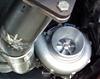
Turbocharger / Turbo / Snail – this raises the pressure of the air (boost) by using the exhaust gases exiting the engine to power a compressor that pressurizes the incoming air.
Supercharger / Blower – this raises the pressure of the air (boost) by using the eccentric shaft / crankshaft to power a compressor that pressurizes the incoming air.
Nitrous / Spray / Bottle – this raises the oxygen CONTENT or partial pressure by injecting nitrous oxide into the incoming air. A partial pressure of oxygen (pp O2) of .42 or 42% would be equal to the partial pressure of oxygen in air at 2 ATA, or roughly 14.7 PSI of boost. Oxygen at sea level is pp O2 = .21 or 21% of the total volume of air.
Turbo Advantages: can be installed anywhere in the exhaust stream. Usually smaller than a supercharger. Uses energy that is already being wasted anyway; low parasitic loss. Modern turbos can be highly reliable and provide boost at a wide range of engine speed (RPM). Modular, you can build or buy some or all the parts to make your own system or get a kit. Boost can be increased to the system without mechanical changes.
Turbo Disadvantages: Can be difficult to install. Compressor is not linear meaning it does not provide a specific pressure at a certain RPM, may cause tuning difficulty. It is an obstruction in the exhaust stream lowering the flow of the exhaust gases and therefore lowering overall VE. Requires tuning of more than just EMS for maximum performance and reliability (boost controller, BOV, wastegate etc.)
Supercharger Advantages: Can provide pressurized air as soon as the engine is running. May also provide a linear increase in pressure due to it being tied to the engine RPM. Tuning may be easier than a turbo.
Supercharger Disadvantages: Limited location area since it is physically powered by the eccentric / crankshaft of the engine. Uses some engine power to power compressor causing parasitic loss. Typically not modular. Boost cannot be increased without mechanical changes. Often tied to higher intake temperatures over similarly powered turbo cars.
Nitrous Oxide Advantages: Inexpensive to purchase and easy to install. Does not cause any additional heat of the intake air (intake charge). Can be installed in numerous locations depending on the size of the bottle. Easier to maintain.
Nitrous Oxide Disadvantages: Must refill bottle. Typically only on during wide open throttle and or a button is pushed. To reach any significant power levels, some expense must be added for engine management.
Special note about temperature and air – when air is compressed regardless of how, it creates heat due to the friction of the air molecules being squished together. Intercoolers and other modifications have been invented to cool this charge air, but the reality is that 1 cubic foot of air compressed into ½ cubic foot area will become hotter, thus is the nature of gas. So both a supercharger and a turbo will create more heat than a naturally aspirated engine of the same size and design. This does not account for heating of the exhaust gas due higher fuel volume in the chamber, all FI will cause a hotter "burn", this is a good thing when properly managed. See General Gas Law ^^^
Special note about exhaust temperature- all FI systems will raise exhaust temperatures due to the increase of air and fuel being burned in the combustion chamber. In most cases this is not a great concern. If you get an EGT or exhaust gas temperature monitor you can monitor changes from normal (assuming you know what your normal EGT is). You can also use EGT as a tuning aid.
Special note about fuel systems- Once you go FI, your max ability to boost will likely be limited by your ability to deliver fuel. You must work your FI system and fuel system together. If your FI application requires 30 lb/hr of fuel but you can only deliver 25 lb/hr, you will run lean and cause engine damage. Our injectors are typically rated in cc/min or lb/hr. The time it takes to deliver the rated fuel (the injector is open) is called duration. If a .44 lb/min injector needs to deliver .44 lb/min of fuel, it will be at 100% Duty Cycle AKA Maxed Out. Based on RPM, the duration available will be shorter in high RPMs and longer in low RPMs, all of this affects the total volume of fuel you can flow.
Special note about tuning - your non-factory FI-ed engine is designed to provide fuel in a variety of engine situations, none of which cover forced induction. With all of the extra air the engines "brain" will not add enough fuel causing you to run lean and destroy your engine. Therefore aftermarket forced induction kits have or will need an aftermarket computer to address this shortcoming. Setting this aftermarket computer up and refining the air fuel mixtures and timing is called tuning. All forced induction systems need to be tuned to your engine.
Why go FI at all? Is a Rotary a good FI engine?
Rotary engines do have some FI advantages. For turboing, a rotary flows twice as much air as its reciprocating counterpart. This means your 1.3L engine will use turbo sizing like a 2.6L piston engine. That takes you from Geo Metro to Subaru territory. When a piston engine suffers pre-ignition; the explosion usually occurs before top dead center, causing the piston to want to reverse course. Piston rods are already highly loaded due simply to moving the piston up and down. This applies a huge compressive force to the piston and supporting rod. Often, one will give and you will have catastrophic engine failure. In a rotary, the counterforce won't be as high. Usually, it will be a seal that gives rather than the rotor. This will still cause engine failure, though it may not manifest for a long time. See Reliability Below.
Recommended Reading:
Street Turbocharging - Mark Warner
How to Tune and Modify Engine Management Systems - Jeff Hartmen
Turbocharging - Corky Bell.
Engine Management: Advanced Tuning - Greg Banish
I'll add to the list if anyone has others they have personally read, don't tell me you heard from so and so that this book was good.
Any omissions or errors will be corrected in the original thread. Keep It Simple, the point is to give people a good down and dirty on FI.
Last note: This is the tip of a VERY big iceberg. If you are thinking FI, DO YOUR HOMEWORK! Laziness now can cost you an engine.
Where to next:
https://www.rx8club.com/series-i-major-horsepower-upgrades-93/turbochargers-superchargers-compilation-63023/ - Specific Information on performance and prices.
https://www.rx8club.com/series-i-major-horsepower-upgrades-93/rules-nitrous-use-109820/ - Nitrous Information
https://www.rx8club.com/series-i-engine-tuning-forum-63/ - Tuning Information
________________________________________
Updated from the First One
First note: This is the tip of a VERY VERY VERY VERY VERY big iceberg. If you are thinking of going FI, DO YOUR HOMEWORK! Laziness now can cost you an engine.
I just now really noticed that there is no easy to find thread that clearly and easily describes this mod in plain English for people who have no idea other than "make more power, me want". In the hope that this NEW thread becomes a sticky, I thought I would make one.
Terms you Should Know
General Gas Law – In any gas (liquid is a gas or gas is a liquid and they are both fluids; you pick), the combination of volume, pressure and temperature are related. A change in any one will affect a corresponding change in the others. Pressure and Volume are inversely related (volume up, pressure down), Volume and Temperature are inversely related (Volume Up, Temperature Down) and Pressure and Temperature are proportional (Pressure Up, Temperature Up).
Volumetric Efficiency – The amount of air the engine is ingesting divided by the amount of air the engine is capable of ingesting at Atmospheric Pressure (14.7 PSIA). More simply air volume ingested/engine displacement.
Engine Cycle – One power stroke / engine revolution. RPM is (Revolutions per Minute). This is when the piston / rotor moves from Top Dead Center to Bottom Dead Center and back to Top Dead Center. For each Engine Rotation (RPM), the rotor/ piston leaves Top Dead Center (TDC) and moves to Bottom Dead Center(BDC), this movement creates vacuum as the volume of the space increases, this vacuum causes the Atmospheric Pressure to push air from the intake track into the engine in order to equalize the pressure differential. The perfect volume of air ingested by the engine is equal to the volume of the engine (displacement). Once the air is ingested, it is compressed by the reduction of volume as the rotor / piston travels from BDC to TDC. Along with fuel, this compressed mixture is ignited by the spark plug(s) creating a pressure expansion which drives the rotor / piston from TDC back to BDC rotating the eccentric shaft / crankshaft. Then exhaust is forced out the engine by movement from BDC back to TDC and the whole thing starts over again. This cycle is not perfect as restrictions on the intake, overlapping valves, mixtures of the outgoing / incoming gases and time to equalize the pressure differential all affect how much air the engine actually gets. The driving force of engine air movement is pressure gradients, the difference in pressure.
Tuning – Engine Tuning is the process of specifying the proper amount of fuel and the proper time to induce ignition based on the specific spot your engine is currently in. The engines Brain (or aftermarket Brain; or both) read from the sensors what your engine is doing. Based on the air, temperature, RPM, pressure, air density, throttle position, RPM change…yada yada yada; put in this amount of fuel and ignite the spark at this time. There are so many specific tuning “things” to deal with and know about, for now just know that each engine is different and tuning for FI will almost always have to be done.
Flame Speed / Brisance – Fuel is an explosive (kinda) and an engine produces a controlled explosion (kinda). The term Brisance is used to reference the shattering effect of an explosion. This can also be thought of as the speed in which the potential energy is converted to kinetic energy. In demolitions, we convert Brisance into Relative Effectiveness (RE) of an explosive, with TNT = 1. So C4, RDX and other High Explosives have an RE greater than 1, and Ammonium Nitrate and other Low Explosives have an RE less than 1. Low Explosives PUSH and High Explosives SHATTER. While TNT has a detonation velocity of 6,940 Meters Per Second a Stoichiometric Air Fuel Mixture has a flame speed of .34 Meters Per Second or an RE less than .0001. So Fuel is a LOW LOW EXPLOSIVE which PUSHES. The point to this is the higher the oxygen content the faster the flame speed (more push), this is also why timing is retarded during FI applications.
Partial Pressure of Oxygen (PPO2) - The master of all things "power" in your engine. In the end, what really matters is the number of oxygen molecules in the combustion chamber (provided you have enough fuel to use it.) With an increase in pressure, the number of molecules goes up due to squeezing more air in a smaller space. The term Partial Pressure is in reference to the pressure of the Oxygen as a percentage of total volume. So, in air at sea level the Partial Pressure is .21 or 21% of total volume at 1 Atmosphere. If you boost to 14.7 PSI, or 2 Atmospheres, the partial pressure is going to double to .42, since you have twice as many oxygen molecules per volume. This "extra" oxygen is what provides the extra power and why Forced Induction can make a small engine perform like a much larger one. You see, you do not need extra PRESSURE to make more power, you need more PPO2. You can get it from pressurizing the intake, or from increasing the Oxygen content in the engine (vis a vis Nitrous). Remember the General Gas Law, since you will heat the mixture while you pressurize it, 14.7 PSI of boost is not exactly .42 PPO2 since it would heat up and become less dense. The fine details are more complicated, but the theory is - plan for, fuel for, tune for, EVERYTHING for PPO2, that is absolute unlike other strategies.
Pressure Gradient - Picture that old Jr. High Science Class Exp. No, not the girl who first let you touch her boob, focus! The one where you have two cups of liquid and a hose between them, lift one cup and the liquid will flow into the other (lower) cup. This is a good demonstration of a pressure gradient. Simply put, air is going to flow from the higher pressure, into the lower pressure. The higher the "high" pressure / the lower the "low" pressure are, affects the velocity of that air movement. So in your engine cycle, the intake pressure is higher which moves the air into the cylinder. After combustion the expanded exhaust gas pressure is higher than the pressure in the exhaust so the air moves into the exhaust. In boosted applications, this air is moving faster due to an increased pressure gradient.
Mixed Gas - Technically "Air" is the mixture of 21% oxygen, and 79% nitrogen (I know, but for simplicity). When you alter that ratio, it is no longer air; it is classified as a MIXED GAS. This applies to storage and handling requirements as well as HAZMAT classification (more oxygen the more flammable the gas). Plus this is an important distinction for divers. So While Turbo and Superchargers deal with air, Nitrous deals with a mixed gas.
Volumetric Efficiency - the amount of power the engine can produce based on the amount of air it can get for each engine cycle. Technically, volumetric efficiency only relates to air flow, however for the sake of simplicity assume; more air + more fuel = more power, therefore volumetric efficiency can be directly related to power. Called VE for short, the goal of most engine mods is to increase VE, with the rest being designed to reduce loss of power by drag, heat or other variables. At ambient air pressure VE can approach 100%, it can even be slightly over 100% in some highly designed racing engines; but for all intensive purposes the goal is a VE of (1 or 100%); and naturally aspirated motors can't get there. An engine with manifold pressures greater than atmospheric will put a larger amount of air into the chamber than what atmospheric pressure would do and, therefore, have volumetric efficiencies greater than 100%.
Forced Induction - this is the term that applies to adding pressurized *air to make it contain more oxygen molecules per space in the engine. This means you can burn more fuel. By adding more air and more fuel you raise the combustion pressure on the eccentric shaft/ crankshaft which makes it turn harder (torque) and makes more horsepower (torque * engine RPM). Since all engine modifications (mods for short) attempt to increase the volumetric efficiency of the engine; forced induction is attractive as it can achieve a VE in excess of 1 quite readily. The saying "there is no replacement for displacement" should be "there is no replacement for VE".
* Special note about nitrous, NO2, NOS, ZEX, whatever. It raises the partial pressure of O2 (higher oxygen content, not the pressure) so it is not technically air anymore. But they all do the same thing; allow more fuel to be burned.
Turbocharger / Turbo / Snail – this raises the pressure of the air (boost) by using the exhaust gases exiting the engine to power a compressor that pressurizes the incoming air.
Supercharger / Blower – this raises the pressure of the air (boost) by using the eccentric shaft / crankshaft to power a compressor that pressurizes the incoming air.
Nitrous / Spray / Bottle – this raises the oxygen CONTENT or partial pressure by injecting nitrous oxide into the incoming air. A partial pressure of oxygen (pp O2) of .42 or 42% would be equal to the partial pressure of oxygen in air at 2 ATA, or roughly 14.7 PSI of boost. Oxygen at sea level is pp O2 = .21 or 21% of the total volume of air.
Turbo Advantages: can be installed anywhere in the exhaust stream. Usually smaller than a supercharger. Uses energy that is already being wasted anyway; low parasitic loss. Modern turbos can be highly reliable and provide boost at a wide range of engine speed (RPM). Modular, you can build or buy some or all the parts to make your own system or get a kit. Boost can be increased to the system without mechanical changes.
Turbo Disadvantages: Can be difficult to install. Compressor is not linear meaning it does not provide a specific pressure at a certain RPM, may cause tuning difficulty. It is an obstruction in the exhaust stream lowering the flow of the exhaust gases and therefore lowering overall VE. Requires tuning of more than just EMS for maximum performance and reliability (boost controller, BOV, wastegate etc.)
Supercharger Advantages: Can provide pressurized air as soon as the engine is running. May also provide a linear increase in pressure due to it being tied to the engine RPM. Tuning may be easier than a turbo.
Supercharger Disadvantages: Limited location area since it is physically powered by the eccentric / crankshaft of the engine. Uses some engine power to power compressor causing parasitic loss. Typically not modular. Boost cannot be increased without mechanical changes. Often tied to higher intake temperatures over similarly powered turbo cars.
Nitrous Oxide Advantages: Inexpensive to purchase and easy to install. Does not cause any additional heat of the intake air (intake charge). Can be installed in numerous locations depending on the size of the bottle. Easier to maintain.
Nitrous Oxide Disadvantages: Must refill bottle. Typically only on during wide open throttle and or a button is pushed. To reach any significant power levels, some expense must be added for engine management.
Special note about temperature and air – when air is compressed regardless of how, it creates heat due to the friction of the air molecules being squished together. Intercoolers and other modifications have been invented to cool this charge air, but the reality is that 1 cubic foot of air compressed into ½ cubic foot area will become hotter, thus is the nature of gas. So both a supercharger and a turbo will create more heat than a naturally aspirated engine of the same size and design. This does not account for heating of the exhaust gas due higher fuel volume in the chamber, all FI will cause a hotter "burn", this is a good thing when properly managed. See General Gas Law ^^^
Special note about exhaust temperature- all FI systems will raise exhaust temperatures due to the increase of air and fuel being burned in the combustion chamber. In most cases this is not a great concern. If you get an EGT or exhaust gas temperature monitor you can monitor changes from normal (assuming you know what your normal EGT is). You can also use EGT as a tuning aid.
Special note about fuel systems- Once you go FI, your max ability to boost will likely be limited by your ability to deliver fuel. You must work your FI system and fuel system together. If your FI application requires 30 lb/hr of fuel but you can only deliver 25 lb/hr, you will run lean and cause engine damage. Our injectors are typically rated in cc/min or lb/hr. The time it takes to deliver the rated fuel (the injector is open) is called duration. If a .44 lb/min injector needs to deliver .44 lb/min of fuel, it will be at 100% Duty Cycle AKA Maxed Out. Based on RPM, the duration available will be shorter in high RPMs and longer in low RPMs, all of this affects the total volume of fuel you can flow.
Special note about tuning - your non-factory FI-ed engine is designed to provide fuel in a variety of engine situations, none of which cover forced induction. With all of the extra air the engines "brain" will not add enough fuel causing you to run lean and destroy your engine. Therefore aftermarket forced induction kits have or will need an aftermarket computer to address this shortcoming. Setting this aftermarket computer up and refining the air fuel mixtures and timing is called tuning. All forced induction systems need to be tuned to your engine.
Why go FI at all? Is a Rotary a good FI engine?
Rotary engines do have some FI advantages. For turboing, a rotary flows twice as much air as its reciprocating counterpart. This means your 1.3L engine will use turbo sizing like a 2.6L piston engine. That takes you from Geo Metro to Subaru territory. When a piston engine suffers pre-ignition; the explosion usually occurs before top dead center, causing the piston to want to reverse course. Piston rods are already highly loaded due simply to moving the piston up and down. This applies a huge compressive force to the piston and supporting rod. Often, one will give and you will have catastrophic engine failure. In a rotary, the counterforce won't be as high. Usually, it will be a seal that gives rather than the rotor. This will still cause engine failure, though it may not manifest for a long time. See Reliability Below.
Recommended Reading:
Street Turbocharging - Mark Warner
How to Tune and Modify Engine Management Systems - Jeff Hartmen
Turbocharging - Corky Bell.
Engine Management: Advanced Tuning - Greg Banish
I'll add to the list if anyone has others they have personally read, don't tell me you heard from so and so that this book was good.
Any omissions or errors will be corrected in the original thread. Keep It Simple, the point is to give people a good down and dirty on FI.
Last note: This is the tip of a VERY big iceberg. If you are thinking FI, DO YOUR HOMEWORK! Laziness now can cost you an engine.
Where to next:
https://www.rx8club.com/series-i-major-horsepower-upgrades-93/turbochargers-superchargers-compilation-63023/ - Specific Information on performance and prices.
https://www.rx8club.com/series-i-major-horsepower-upgrades-93/rules-nitrous-use-109820/ - Nitrous Information
https://www.rx8club.com/series-i-engine-tuning-forum-63/ - Tuning Information
Last edited by Kane; May 25, 2008 at 06:12 PM.




Some More Advanced Information
Brake Specific Fuel Consumption (BSFC) - This is a measure of how much horsepower-hours an engine generates per pound of fuel consumption. This indicates the general efficiency of the engine it self. An internal combustion engine only makes use of a fraction of the chemical energy that is released during combustion. Much of the energy escapes as hot exhaust gas, heat into the cooling system, vibrations, and noise. Much of these factors do not get altered much with modification. Most of the time, modifications work on burning more fuel to generate more power rather than trying to generate more power out of the fuel the engine burns. BSFC is an excellent factor in designing an engine from scratch. It is not as useful on an engine that already exists. It's a worthwhile concept to keep in mind.
Reliability of Forced Induction Intro - Any FI will place more heat and more pressure on an engine than its naturally aspirated twin. However, Rotary engines are as FI-able as piston engines, with some special considerations. All FI-ed engines need more maintenance than a NA engine, but with proper maintenance can provide many trouble free miles. Ultimately, FI will shorten the life of your engine to some degree.
Rotary Fragility with Detonation
Understanding the "fragility" of a rotary motor as compared to a piston motor is not a simple exercise. Though the inertial loading on the rods of a piston motor are extreme, the dynamics are known and very simple. Piston design is at a state where there are very few variables left to consider.
A rotary motor is under considerably more stress and that stress is highly dynamic, principally because of the engine's simplicity. Think about what an apex seal is being asked to do: it must support two phases of combustion simultaneously on opposite sides while constantly accelerating (and decelerating) along two axes of motion!
Though there are no rods to stress, detonation affects the dynamics of the rotary motor with forces that are exponentially more damaging than they are in a piston motor. (BTW - detonation is not pre-ignition and understanding the difference is pretty important.) The Renesis is FAR more fragile than any other motor in existence. It cannot take ANY overheating. It cannot survive any pre-ignition. It will not survive any oiling malfunctions. Though it might keep running, any failings in the fuel/water/oil will yield a damaged motor. A piston motor's typical failure mode will lower its operational efficiency by some fraction of its total output. A rotary motor - even with a minor failure - typically becomes completely unusable. Similarly, a Renesis is not really rebuildable after a failure. Under optimal conditions however, the Renesis may be the most robust motor in existence because of its simplicity.
Oil
First, rotaries live and die by their oil. They require oil for both cooling and lubrication. Oil is passively added to the intake to lubricate the apex seals. Rx-8s come with front mounted oil coolers (often 2). Changing the oil will give you basically 50% new oil unless you empty the coolers as well.
Heat
Secondly, when adding FI of any sort to any car, more attention is always paid to getting more power than removing more heat. If you make twice as much horsepower, why would you expect the engine NOT to emit twice as much heat. There are 3 main causes of premature failure in aftermarket FI-ed cars: detonation, pre-ignition and heat. The rotary is no exception.
Heat death: Short of overhauling your oil and radiator systems, few modifications will make their way into your cooling system. To compensate, you will need to monitor your coolant, exhaust and oil temperatures to ensure that under boost, you do not put too much heat into either. Your stock cooling systems will not handle boosting for extended periods of time. Keep these things maintained and keep an eye on them.
Detonation
Detonation death: Three things contribute strongly to detonation: intake charge temperature, timing and air fuel ratio. Intake charge temperatures rise if you are pushing your turbo passed reasonable limits, you have inadequate charge cooling (intercooler), or if your initial intake temps and engine bay temps are simply too high. Air fuel ratio comes almost directly from the health of your components and the strength of your tune. Injectors not flowing correctly or a fuel pump not delivering the correct pressure can lean you out. Predominantly, however, it is either a tuning issue or a malfunction that leads to detonation. The best way to avoid both is to have the kit installed correctly and properly tuned from the get go. There are additional considerations for Octane rating and Timing that are beyond the scope of this document for the time being.
Reliability of Forced Induction Intro - Any FI will place more heat and more pressure on an engine than its naturally aspirated twin. However, Rotary engines are as FI-able as piston engines, with some special considerations. All FI-ed engines need more maintenance than a NA engine, but with proper maintenance can provide many trouble free miles. Ultimately, FI will shorten the life of your engine to some degree.
Rotary Fragility with Detonation
Understanding the "fragility" of a rotary motor as compared to a piston motor is not a simple exercise. Though the inertial loading on the rods of a piston motor are extreme, the dynamics are known and very simple. Piston design is at a state where there are very few variables left to consider.
A rotary motor is under considerably more stress and that stress is highly dynamic, principally because of the engine's simplicity. Think about what an apex seal is being asked to do: it must support two phases of combustion simultaneously on opposite sides while constantly accelerating (and decelerating) along two axes of motion!
Though there are no rods to stress, detonation affects the dynamics of the rotary motor with forces that are exponentially more damaging than they are in a piston motor. (BTW - detonation is not pre-ignition and understanding the difference is pretty important.) The Renesis is FAR more fragile than any other motor in existence. It cannot take ANY overheating. It cannot survive any pre-ignition. It will not survive any oiling malfunctions. Though it might keep running, any failings in the fuel/water/oil will yield a damaged motor. A piston motor's typical failure mode will lower its operational efficiency by some fraction of its total output. A rotary motor - even with a minor failure - typically becomes completely unusable. Similarly, a Renesis is not really rebuildable after a failure. Under optimal conditions however, the Renesis may be the most robust motor in existence because of its simplicity.
Oil
First, rotaries live and die by their oil. They require oil for both cooling and lubrication. Oil is passively added to the intake to lubricate the apex seals. Rx-8s come with front mounted oil coolers (often 2). Changing the oil will give you basically 50% new oil unless you empty the coolers as well.
Heat
Secondly, when adding FI of any sort to any car, more attention is always paid to getting more power than removing more heat. If you make twice as much horsepower, why would you expect the engine NOT to emit twice as much heat. There are 3 main causes of premature failure in aftermarket FI-ed cars: detonation, pre-ignition and heat. The rotary is no exception.
Heat death: Short of overhauling your oil and radiator systems, few modifications will make their way into your cooling system. To compensate, you will need to monitor your coolant, exhaust and oil temperatures to ensure that under boost, you do not put too much heat into either. Your stock cooling systems will not handle boosting for extended periods of time. Keep these things maintained and keep an eye on them.
Detonation
Detonation death: Three things contribute strongly to detonation: intake charge temperature, timing and air fuel ratio. Intake charge temperatures rise if you are pushing your turbo passed reasonable limits, you have inadequate charge cooling (intercooler), or if your initial intake temps and engine bay temps are simply too high. Air fuel ratio comes almost directly from the health of your components and the strength of your tune. Injectors not flowing correctly or a fuel pump not delivering the correct pressure can lean you out. Predominantly, however, it is either a tuning issue or a malfunction that leads to detonation. The best way to avoid both is to have the kit installed correctly and properly tuned from the get go. There are additional considerations for Octane rating and Timing that are beyond the scope of this document for the time being.
Last edited by Kane; Jul 24, 2007 at 10:58 AM.
An interesting article from Ben Strader - EFI University
Air/Fuel Ratio Management For Racers, A Three Part Series
When it comes to racing, there is never any shortage of hard work and chores to be done before the next event. Often, race teams are required to travel long distances during the week, prep the car, show up on the weekend ready to run, and then do it all over again the next week. This doesn’t leave much time for experimentation and trying out new concepts. That means most of the time, when racers find something that works okay they tend not to change it, even though there might be a better way. They simply can’t afford to risk missing an event or losing a race. Often times a discussion arises about the best Air to Fuel ratio to use for various tracks and atmospheric conditions. I want to try and address a few of these questions in this series. Here is a list of some common questions asked by racers and tuners:
1) What Air to Fuel Ratio gives the best power?
2) Does the Air to Fuel Ratio that produces the best power change as the altitude my car operates at changes?
3) Does the Air to Fuel Ratio that produces the best power change as the intake air temperature my car operates at changes?
To find answers to these questions I have spent years on the dynamometer testing various engine combinations, talking with other knowledgeable tuners, reading various publications on the subject, and even wrote a book about tuning Electronic Fuel Injected engines, but I found the most convincing answers to these questions in a document written in 1922 by Stanwood Sparrow of the “Bureau of Standards” for the “National Advisory Committee for Aeronautics” (NACA), called NACA Report #189 “Relation of Fuel-Air Ratios to Engine Performance”. In this report, a government agency set out to answer these and many other questions about the effect of Air Fuel Ratios on engine performance over a wide range of parameters, and the evidence proves out many of the answers I am about to present to you for the above questions in this three part series.
PART I
What Air to Fuel Ratio gives the best power? Many folks have tried to shed light on this subject based on single-case observations made in sloppily controlled test environments which show results of all sorts, and yet other, seemingly more knowledgeable sources, (such as the companies trying to sell Air-Fuel ratio meters) are constantly trying to convince us that while they cannot (for reasons of liability) tell us what the magic number is, we cannot possibly hope to achieve maximum engine performance without the help of one of their whiz-bang doo-hickeys!
Well, according to NACA report 189, a wide variety of engines were tested across a large range of Air/Fuel ratios and what they found was basically the following:
“In adjusting the carburetor to obtain maximum power, The following method was employed. First, the mixture was altered until approximately maximum power (for the chosen set of conditions) was obtained. As will be shown later, values of power within 1 percent of maximum are obtained over a wide range of fuel-air ratios. Hence, little difficulty was experienced in finding an Air/Fuel ratio to give approximately maximum power.”
The report goes on to state later that, “From the results to date it is concluded that ordinarily maximum power (at least in so far as aviation engines are concerned) is obtained with gasoline-air ratios of between 0.07 and 0.08 pounds of fuel per pound of air (12.5 to 14.5 pounds of air per pound of fuel).”
What all this means is that basically, if simply making lots of power is your only goal, nearly any Air/Fuel ratio can get you pretty close to the mark.
This corresponds quite closely to what my years’ of engine testing have show as well, and in fact, this is what we have been teaching at EFI University for almost four years, but what I find surprising is the number of supposedly “expert” tuners out there who are still arguing against this point, and pretending that what they do is a special brand of “Magic”.
My experience has been that typically the best engine tuners in the business are the first ones to say: “Ask me anything you like, I have nothing to hide.”
Recently, I spoke with Shane Tecklenburg of FAST Motorsports in Huntington Beach, California, who is widely regarded to be one of the finest engine tuners in the USA, and he had this to say: “Nothing I do is black magic. Everything is based on simple laws of physics that anyone can learn with a little effort, so there is no reason for me not to answer a racer’s question about engine tuning, even if he is a competitor.” I have also spoken to a number of other well known tuners who have had quite the opposite attitude and tried to make it seem as if they knew some special trick or held the golden nugget of knowledge that, if shared with others would seriously jeopardize their standing. Most of the time, when I find a tuner with this attitude, it means they don’t actually know the answers and fear they might reveal this ugly fact if they say too much.
The simple fact is, ten years ago, before the age of $300 wide bands for everyone, nobody even knew what their Air Fuel Ratios were. The rule of thumb was to change the jets one size for every one-thousand feet of elevation, and that was just the way it was. We looked down the tailpipes and at our spark plugs for various color patterns, and even that wasn’t an exact science.
Most racers would have been horrified if they actually saw what the A/F ratios were doing in their engines during a run, but because the engine still performed well, no one cared. What has changed the industry so dramatically in recent years is the advent of the low-cost wide-band Air/Fuel ratio meters. Suddenly, everyone could afford access to this tool to gain priceless insight into their engine’s performance, and then “numbers game” began.
It is not uncommon to go to the racetrack these days and find any number of racers with their laptops plugged into their cars trying to get that last tenth of an A/F point in line. I’ve heard guys say “yesterday she was running a 12.8 A/F ratio, and today it seems to be running about 12.7 and that’s just too rich!” I wonder if either their dyno, or their E.T.’s would support that. If what the NACA report says is true, then I suppose it begs the question, “What is to be gained by agonizing over minute changes in A/F ratios”? Isn’t there some other chassis or tire component that would be better served by spending this time tweaking them instead? What good is ultimate power if it can’t reach the ground?
I’m not suggesting that we abandon this great new technology and throw away our wide-bands just yet. I simply want to help folks get back to the reality of what it is we are trying to accomplish: Getting the maximum performance from the engine… not getting bogged down in the data. Let’s all take a step back, close our eyes, take a deep breath and remember, the only numbers that really matter are not the ones on the wide-band, but the ones that say the letters “E.T.” next to them! Good luck out there folks!
Coming up in Part II: Does the Air to Fuel Ratio that produces the best power change as the altitude that my car operates at changes? Tune in next time to find out!
Written By: Ben Strader
When it comes to racing, there is never any shortage of hard work and chores to be done before the next event. Often, race teams are required to travel long distances during the week, prep the car, show up on the weekend ready to run, and then do it all over again the next week. This doesn’t leave much time for experimentation and trying out new concepts. That means most of the time, when racers find something that works okay they tend not to change it, even though there might be a better way. They simply can’t afford to risk missing an event or losing a race. Often times a discussion arises about the best Air to Fuel ratio to use for various tracks and atmospheric conditions. I want to try and address a few of these questions in this series. Here is a list of some common questions asked by racers and tuners:
1) What Air to Fuel Ratio gives the best power?
2) Does the Air to Fuel Ratio that produces the best power change as the altitude my car operates at changes?
3) Does the Air to Fuel Ratio that produces the best power change as the intake air temperature my car operates at changes?
To find answers to these questions I have spent years on the dynamometer testing various engine combinations, talking with other knowledgeable tuners, reading various publications on the subject, and even wrote a book about tuning Electronic Fuel Injected engines, but I found the most convincing answers to these questions in a document written in 1922 by Stanwood Sparrow of the “Bureau of Standards” for the “National Advisory Committee for Aeronautics” (NACA), called NACA Report #189 “Relation of Fuel-Air Ratios to Engine Performance”. In this report, a government agency set out to answer these and many other questions about the effect of Air Fuel Ratios on engine performance over a wide range of parameters, and the evidence proves out many of the answers I am about to present to you for the above questions in this three part series.
PART I
What Air to Fuel Ratio gives the best power? Many folks have tried to shed light on this subject based on single-case observations made in sloppily controlled test environments which show results of all sorts, and yet other, seemingly more knowledgeable sources, (such as the companies trying to sell Air-Fuel ratio meters) are constantly trying to convince us that while they cannot (for reasons of liability) tell us what the magic number is, we cannot possibly hope to achieve maximum engine performance without the help of one of their whiz-bang doo-hickeys!
Well, according to NACA report 189, a wide variety of engines were tested across a large range of Air/Fuel ratios and what they found was basically the following:
“In adjusting the carburetor to obtain maximum power, The following method was employed. First, the mixture was altered until approximately maximum power (for the chosen set of conditions) was obtained. As will be shown later, values of power within 1 percent of maximum are obtained over a wide range of fuel-air ratios. Hence, little difficulty was experienced in finding an Air/Fuel ratio to give approximately maximum power.”
The report goes on to state later that, “From the results to date it is concluded that ordinarily maximum power (at least in so far as aviation engines are concerned) is obtained with gasoline-air ratios of between 0.07 and 0.08 pounds of fuel per pound of air (12.5 to 14.5 pounds of air per pound of fuel).”
What all this means is that basically, if simply making lots of power is your only goal, nearly any Air/Fuel ratio can get you pretty close to the mark.
This corresponds quite closely to what my years’ of engine testing have show as well, and in fact, this is what we have been teaching at EFI University for almost four years, but what I find surprising is the number of supposedly “expert” tuners out there who are still arguing against this point, and pretending that what they do is a special brand of “Magic”.
My experience has been that typically the best engine tuners in the business are the first ones to say: “Ask me anything you like, I have nothing to hide.”
Recently, I spoke with Shane Tecklenburg of FAST Motorsports in Huntington Beach, California, who is widely regarded to be one of the finest engine tuners in the USA, and he had this to say: “Nothing I do is black magic. Everything is based on simple laws of physics that anyone can learn with a little effort, so there is no reason for me not to answer a racer’s question about engine tuning, even if he is a competitor.” I have also spoken to a number of other well known tuners who have had quite the opposite attitude and tried to make it seem as if they knew some special trick or held the golden nugget of knowledge that, if shared with others would seriously jeopardize their standing. Most of the time, when I find a tuner with this attitude, it means they don’t actually know the answers and fear they might reveal this ugly fact if they say too much.
The simple fact is, ten years ago, before the age of $300 wide bands for everyone, nobody even knew what their Air Fuel Ratios were. The rule of thumb was to change the jets one size for every one-thousand feet of elevation, and that was just the way it was. We looked down the tailpipes and at our spark plugs for various color patterns, and even that wasn’t an exact science.
Most racers would have been horrified if they actually saw what the A/F ratios were doing in their engines during a run, but because the engine still performed well, no one cared. What has changed the industry so dramatically in recent years is the advent of the low-cost wide-band Air/Fuel ratio meters. Suddenly, everyone could afford access to this tool to gain priceless insight into their engine’s performance, and then “numbers game” began.
It is not uncommon to go to the racetrack these days and find any number of racers with their laptops plugged into their cars trying to get that last tenth of an A/F point in line. I’ve heard guys say “yesterday she was running a 12.8 A/F ratio, and today it seems to be running about 12.7 and that’s just too rich!” I wonder if either their dyno, or their E.T.’s would support that. If what the NACA report says is true, then I suppose it begs the question, “What is to be gained by agonizing over minute changes in A/F ratios”? Isn’t there some other chassis or tire component that would be better served by spending this time tweaking them instead? What good is ultimate power if it can’t reach the ground?
I’m not suggesting that we abandon this great new technology and throw away our wide-bands just yet. I simply want to help folks get back to the reality of what it is we are trying to accomplish: Getting the maximum performance from the engine… not getting bogged down in the data. Let’s all take a step back, close our eyes, take a deep breath and remember, the only numbers that really matter are not the ones on the wide-band, but the ones that say the letters “E.T.” next to them! Good luck out there folks!
Coming up in Part II: Does the Air to Fuel Ratio that produces the best power change as the altitude that my car operates at changes? Tune in next time to find out!
Written By: Ben Strader
Last edited by Kane; Dec 5, 2007 at 09:08 AM.

now this may be out of left field, but remember a while back some nascar drivers got fined for having a foreign substance in their airboxes...any idea what that substance was and if it is some sort of evaporating oxidizer where can i get some lol.

⎝⏠⏝⏠⎠
Joined: Apr 2004
Posts: 8,625
Likes: 5
From: USA
I don't know what this means in your post:
How is SC air cooler than turbo air? Compressing the air generates heat in both applications.
The hot side of a turbo (exhaust) should remain hot, as it travels faster that way. Not really a disadvantage. The part was designed to work in the exhaust stream.
Also:
That is actually one of the biggest advantages of the turbo system over superchargers. It's NOT tied to rpm. So as long as your exhaust can spool up the turbo fast enough, you can get your peak boost almost anytime you want. Low rpm, high rpm, doesn't matter. With a SC you're tied to the rpm, so you have to design it for high rpm (See DNA SC dynos), or low rpm, this results with huge trade offs.
Supercharger advantages: Typically easier to install than a turbo. Provides pressurized air as soon as the engine is running. Linear increase in pressure due to it being tied to the engine RPM. May be cooler air than a turbo.
The hot side of a turbo (exhaust) should remain hot, as it travels faster that way. Not really a disadvantage. The part was designed to work in the exhaust stream.
Also:
Turbo disadvantages: Can be difficult to install. Compressor is not linear meaning it does not provide a specific pressure at a certain RPM.
I agree, I will update that. The tuning side of the spool up is more in line with my intentions.
MM already called me out on the heat argument. I need to fix that also, I just wanted to get it moved before I lost the formatting.
MM already called me out on the heat argument. I need to fix that also, I just wanted to get it moved before I lost the formatting.
Woah. I can think of what it MIGHT be...but anything that is an oxidizer is also a very low level explosive. So I am not saying anything.
The higher the Partial Pressure of O2, the more flammable the mixture. So 100% O2, especially under pressure is very flammable, a bur or microscopic metal shaving in the path of flow can cause a massive conflagration (big big fire).

Londons Yellow Peril
Joined: Apr 2005
Posts: 1,340
Likes: 2
From: North London
a disadvatange of an SC is its lack of scalability easily. A turbo u can control with a boost controller, whereas a supercharger is fixed boost unless u get new pulleys and belts etc....
RotoRocks Powered
Joined: May 2006
Posts: 1,236
Likes: 6
From: Delray Beach, FL
Nitrous Oxide Disadvantages:
As the nitrous tank pressures vary based upon a multitude of variables, It is very difficult to control/predict the desired input/output of your system. This makes it difficult to maintain the proper AF, and consequently the ignition curve. To be more specific: The bottle pressure varies greatly from time to time depending on the ambient temperature, the amount of nitrous in the bottle and the duration of your pass/passes.
The higher the ambient temps, the higher the bottle pressure. Longer passes lower the bottle pressure dramatically.
Such volatility of pressure, inadvertently changes the volume on the Nitrous delivered into your engine, thus making it difficult to tune. In order to streamline the variations of the pressure, additional parts must be purchased (pressure regulators), and to my experience they are not hat common and not easy to find. While there are a couple on the market, their price is quite high. This contributes to the price of the implementation of a "complete" system.
Also, It is illegal to use nitrous oxide outside of the race track. I think the bottle must be empty while driving on the streets.
As the nitrous tank pressures vary based upon a multitude of variables, It is very difficult to control/predict the desired input/output of your system. This makes it difficult to maintain the proper AF, and consequently the ignition curve. To be more specific: The bottle pressure varies greatly from time to time depending on the ambient temperature, the amount of nitrous in the bottle and the duration of your pass/passes.
The higher the ambient temps, the higher the bottle pressure. Longer passes lower the bottle pressure dramatically.
Such volatility of pressure, inadvertently changes the volume on the Nitrous delivered into your engine, thus making it difficult to tune. In order to streamline the variations of the pressure, additional parts must be purchased (pressure regulators), and to my experience they are not hat common and not easy to find. While there are a couple on the market, their price is quite high. This contributes to the price of the implementation of a "complete" system.
Also, It is illegal to use nitrous oxide outside of the race track. I think the bottle must be empty while driving on the streets.
Last edited by rotorocks; Jul 24, 2007 at 02:34 PM.

a/s/l/n00dz?
Joined: Aug 2007
Posts: 71
Likes: 0
From: Cleveland
Add an intercooler on either a turbo/supercharged app, and the intake temps will come down drastically - even on a 2 or 3 core Air to Air (A/A).
⎝⏠⏝⏠⎠
Joined: Apr 2004
Posts: 8,625
Likes: 5
From: USA


Registered User
Joined: Dec 2006
Posts: 1,015
Likes: 0
From: Omaha
LoX is no joke..
Well unless your freezing frogs that happen to be on the flightline.

But like Kane said, 100% O2 is damn flammable. LoX itself also cant mix with greases, etc, cause it will cause a big boom. Too many hazards.

Living is best Modified.
Joined: Jul 2007
Posts: 479
Likes: 1
From: South Carolina
I have a question, I've been reading from different sources for fuel efficiency.
I have seen reports that adding a charger, turbo or super would increase fuel effiency. But i've also heard that adding such devices to increase engine power decreases fuel effiency. I'm guessing there's two type of Fuel Effiency being talked about, but I haven't read 1 source that has both types (if both exist) listed.
I'm interested in getting the highest MPG out of an RX8 as possible and if there's any aftermarket items that would increase the MPG to a more tollerable number - like a low 30s. I don't care about engine power, Im not racing and I don't have any interest in showing off. I'd rather leave a couple minutes eariler and ride without a care, then stress and zoom for that hot flash that'll come over me when I see a parked police car. Thankfully the car must've not noticed me >.>
I have seen reports that adding a charger, turbo or super would increase fuel effiency. But i've also heard that adding such devices to increase engine power decreases fuel effiency. I'm guessing there's two type of Fuel Effiency being talked about, but I haven't read 1 source that has both types (if both exist) listed.
I'm interested in getting the highest MPG out of an RX8 as possible and if there's any aftermarket items that would increase the MPG to a more tollerable number - like a low 30s. I don't care about engine power, Im not racing and I don't have any interest in showing off. I'd rather leave a couple minutes eariler and ride without a care, then stress and zoom for that hot flash that'll come over me when I see a parked police car. Thankfully the car must've not noticed me >.>
Last edited by RogueTadhg; Aug 15, 2007 at 01:43 AM. Reason: Grammar!
+1 with CRH.
You will never hit 30's consistantly with a rotary. The only mod you could try is to retune with an eye to efficiency instead of power. That and driving for economy, lightening your car are about it. But then you would end up with carbon galore in the engine since it would not be burning as hot... so all of your gas savings would go into a new engine at some point potentially.
You will never hit 30's consistantly with a rotary. The only mod you could try is to retune with an eye to efficiency instead of power. That and driving for economy, lightening your car are about it. But then you would end up with carbon galore in the engine since it would not be burning as hot... so all of your gas savings would go into a new engine at some point potentially.